




*** Aboriginal and Torres Strait Islander readers are advised this article names a person who has passed ***
Members of Croakey Health Media participated in the final days of the National Walk for Truth in Canberra this week, hearing from health leaders and other participants about the importance of truth-telling for healing and nation-building.
Melissa Sweet writes:
The epic, 39-day journey of the National Walk for Truth may have ended in Canberra this week, but its powerful messages about the importance of truth telling for healing and building a more united, stronger Australia will resonate for long afterwards.
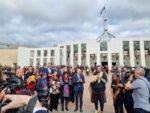
After walking more than 905 kilometres from Naarm/Melbourne, Kerrupmara Gunditjmara man Travis Lovett, accompanied by his wife Renata and their children, were met by the Prime Minister, Ministers and MPs outside Parliament House, before a crowd of several hundred people.
The Prime Minister, presented with message sticks from many First Nations, did not directly address their calls for a national truth-telling process, but thanked Lovett for his leadership and acknowledged that “reconciliation is unfinished business”.
In a stirring speech to the crowd, Lovett, a former Commissioner of Victoria’s landmark Yoorrook Justice Commission, said that what had been learnt in Victoria about truth telling could help inform national processes.
He told the crowd that the walk “was an act of love, an act of kindness…in a less kind world. It is a refusal to surrender to the noise of cruelty…to the powerful forces that fan division, turn neighbour against neighbour and ask us to see one another as threats, instead of us as kin.
“In a time when fear is organised, when lies travel faster than care and when too many people in power mistake hardness for strength, this walk offers something different. It offers tenderness, it offers courage, it offers the open hand, even after hurt.
“It says that truth is not a weapon but a way home. It says that even after everything our people have carried, we are still prepared to walk towards this country, not away from it, and ask it to become more honest, more generous and more human.”
Lovett’s speech ended with a call for support from “every person who loves this country…who wants it to be braver than its fear, kinder than its politics and larger than its old silences to join us in truth telling…
“Come and listen, come and learn, come and stand in the hard places with us, come and help build a country where our children do not inherit denial, where our Elders are heard while they are still here to speak, where our ancestors are brought home, where our sacred objects are returned…”
On Tuesday, after walking on Ngunnawal and Ngambri Country in pouring rain, he told a large crowd at the Australian National University that First Peoples had been forgotten and off the agenda since the Voice referendum.
“We’re not asking for new commitments but for the PM to deliver on the commitment the PM made all Australians when he said he would implement the Uluru Statement from the Heart for all people,” he said.

Healing the nation
Addressing the start of the walk’s final day, Professor Barry Judd, Deputy Vice-Chancellor (Indigenous) at the University of Melbourne, made an eloquent call for truth telling.
Describing the walk as “an act of endurance, reflection and purpose”, he said it was about something deeper than distance, as it was also about walking towards recognition and towards a more honest national story.
“There is something powerful about walking, step by step and day by day, it asks patience, it asks commitment, and it asks us to stay with something even when it is difficult. That is what truth asks of us as well.”
Judd said the walk was taking place at “a moment in our national life that is both challenging and consequential”, when populism, myth and misinformation shape our public conversations.
“In such times it is easy to retreat, to emphasise differences, to harden positions and to deepen divisions,” he said. “But this walk stands for something else. It reminds us that, regardless of whether we are Indigenous or non-Indigenous Australians, we share a common responsibility to seek truth, to listen carefully and to find the ground that binds us together.”
Judd said contemporary Australia is shaped by three undeniable foundations: the deep inheritance of more than 65,000 years of cultural practice and connection to Country; British traditions and institutions introduced since 1788; and, since the end of the second world war, multiculturalism. The first strand was the ground on which everything else rested, he said.
He urged the Prime Minister to show leadership and support truth-telling, “to not allow division to define us but to help us find common ground”.
“If we are to heal as a nation, we must tell the truth about our past, fully and honestly and in doing so we can begin to build shared stories of origin, stories that all Australians can recognise, can stand in and embrace.”
Judd called for “the beginning of a more honest Australia because this moment asks something of us all, not just to walk the truth but to stand for it, speak for it and to act for it”.
Minister for Indigenous Australians, Senator Malarndirri McCarthy, one of several politicians who joined legs of the walk, said that seeing Lovett and the large crowd on the Parliament House forecourt was “an extraordinary moment and an uplifting one for our country”.
“We certainly took the messages from Travis yesterday and that is what we will look at now.”

History and context
Lovett and others acknowledged the long history of First Nations people walking, as acts of self-determination, resistance and justice. Lovett himself was joined by more than 22,000 First Nations community members and allies when he walked more than 500 kilometres across Victoria last year to draw attention to the findings of the state’s historic truth telling commission.
Organisers say more than 7,000 people joined the National Walk for Truth. Its final two days were signposted by historic milestones, with 26 May being National Sorry Day, marking the 29th anniversary of the Bringing them home report, and also the ninth anniversary of the Uluru Statement from the Heart calling for Voice, Treaty and Truth. Professor Megan Davis AC and others have argued for the importance of structural reforms to create lasting change, and stressing the importance of the sequence of Voice, Treaty, Truth.
The walk finished on the first day of National Reconciliation Week, marking the anniversary of the successful 1967 referendum. It took place at a time when many communities are experiencing grief in the wake of, as Reconciliation Australia’s CEO Karen Mundine told the walk, too much Sorry Business.
Lovett also highlighted ongoing injustices, such as the lack of accountability for hundreds of deaths in custody, including that of 24-year-old Warlpiri man Kumanjayi White.
He joined Aboriginal and Torres Strait Islander Social Justice Commissioner Katie Kiss in criticising the timing of the announcement this week that the two police officers who forcibly restrained Kumanjayi White would not be charged over his death.
“The timing of this announcement on the eve of the anniversary [of his death] and on National Sorry Day has caused additional harm to our people on a significantly sensitive day for First Peoples,” Kiss said in a statement.
Kiss said the case yet again highlights the urgent need to ensure that deaths in custody should be independently investigated, and that police should not be investigating other police.
Minister McCarthy also issued a statement expressing concern, saying she was sharing in the grief.
Walk on
Today, Lovett posted a clip on Instagram of himself shaving off the beard that had grown during the walk. While the beard might be gone, he said, the imperative for truth telling continues.
“The National Walk For Truth marks a historic moment but it is not the finish line. It is a call for all of us to continue walking together until a national truth telling process is established,” he said.
Recommended viewing
• A compilation of talks by Travis Lovett over the final two days
• Minda Murray, a researcher at the Australian National University, prepares to walk out in the rain
• Professor Barry Judd, University of Melbourne, addresses the crowd on the final day
• Karen Mundine, CEO of Reconciliation Australia, calls for action
• Larissa Roberts, CEO of Common Threads, highlights the importance of truth-telling for justice
• Dr David Semmens, from the University of Melbourne and a member of the support team, shares his highlights from the walk
• Paul Stewart, CEO of the Lowitja Institute, on the importance of truth telling for health and wellbeing
• Michelle Isles, CEO of the Climate and Health Alliance, with a message for the PM
See Croakey’s archive of articles on the 2025 Walk for Truth






Add Comment