




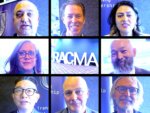


Introduction by Croakey: Medical administrators and others working in healthcare and allied professions came together this week from across Australia, Aotearoa New Zealand and beyond for the annual conference of the Royal Australasian College of Medical Administrators (#RACMA2026).
Speakers included a hero of a catastrophic terrorist attack, sports legends, and others working on the frontline of medical administration, from as far afield as Hong Kong’s 44 public hospitals, to regional Australian settings.
Incoming RACMA president Dr Debbie Holdsworth told participants that the conference theme, ‘Performance Health Leadership on the Global Stage’, had “asked us to hold two things at once – the human judgement that sits at the heart of good leadership, and the system performance our patients and communities depend on”.
Croakey journalist Marie McInerney attended the first day of the conference for the Croakey Conference News Service, talking with a range of international, national and local speakers in the video interviews presented below.
You can also watch this playlist and read more in-depth stories from the conference via this link over the coming week.
Lessons from the All Blacks
Darren Shand, a legendary manager for more than two decades of Aotearoa New Zealand’s national All Blacks rugby union side, sees many similarities between his work and the health and medical sectors.
“We’ve got people working under pressure. We’ve got a lot of factors that are out of our control. We’ve got a skilled workforce that has to work together,” he told Croakey at the conference.
Shand is recognised as the driving force behind the culture and high-performance environment that shaped the All Blacks into the world’s most successful international sports team, with a 76.8 percent win rate across more than 600 test matches that is unrivalled in world sport.
Regarding high performance as “primarily about a mindset”, he said it can come down to creating an environment where people turn up every day “wanting to be better”.
In this interview, he also talks about inclusion and belonging for Maori and Pacific players, about racism, family and faith, and how, if someone can be at their best when they’re under pressure, then they are “in a really good place to lead”.
He also offers insights from his time at the peak of international sport, and advises medical administrators to understand that their real work is in creating the environment for their workforce and the people who rely on it for care.
“You can’t keep asking people to overcome the environment you have created for them,” he said.
Extraordinary leadership
Karambir Singh Kang is a hospitality leader and crisis-management strategist, most known for his extraordinary leadership at the Taj Mahal Palace in the Indian city of Mumbai in 2008, when his hotel was among multiple locations across the city attacked by terrorists.
He lost his wife and two young sons in the attack, but continued to lead staff and protect guests for 36 hours before Indian commandoes could end the fatal siege at the five-star resort.
He told RACMA about moments when he felt paralysed by fear and grief, about how the unique culture of the hotel group meant that not a single staff member tried to get away until guests were safe, and about the parallels between hospitals and hospitality: both needing to be trusted by complete strangers.
“Long after people forget everything else, what they remember is how they were treated when they were their most afraid,” he said.
See our must-read article about Kang’s address here.
Command, control, coordinate, communicate
Dr Eddie Yuen is the Chief Manager of the Hospital Authority of the Hong Kong Special Administrative Region (HKSAR), whose portfolio includes Infection Control, Emergency Preparedness, Contingency Planning, and Major Disaster Management, as well as territory-wide coordination of Accident and Emergency, Trauma, Intensive Care, and Toxicology services.
The Authority manages 44 hospitals in Hong Kong and has more than 90,000 staff.
He spoke to RACMA2026 about the “4Cs” of disaster control, drawing on lessons from last year’s catastrophic fire in a Hong Kong high-rise housing estate that killed 168 people, aged from six months to 98 years, and displaced nearly 5,000 residents.
Working, living and fighting amid polycrisis
Air Commodore Andrew Johnson is a retiring principal consultant to the Surgeon General of the Australian Defence Force, Rear Admiral Sonia Bennett.
In this interview, he describes his main work in that role – providing a national review of clinical governance for the defence health system.
The review was commissioned to comply with recommendation 67 of the Royal Commission into Defence and Veteran Suicide – that the ADF should work with the Australian Commission on Safety and Quality in Health Care, the Royal Australian College of General Practitioners, the Department of Veterans’ Affairs and other bodies, to ensure defence health’s clinical framework aligns with the National Model for Clinical Governance Framework.
Johnson also speaks about imperatives for defence health in a time of polycrisis, with a turbulent geopolitical environment, and where climate change is impacting now.
This includes the potential for re-emergence of diseases thought long gone, particularly for Australia’s near neighbourhood, “our area of interest, where our troops might need to be”.
He says the ADF is “deeply interested” in the impact of those crises, “and what it takes to be able to live, to work, and to fight in that environment”.
Johnson’s presentation at RACMA was about conflict within and between organisations and teams, understanding that the capacity for teams to connect and “actually have each other’s backs” is a critical enabler of safe care.
At the same time, he said, it is worth thinking about how to use tension and difference as a power for creativity, rather than just something destructive to avoid.
Finding purpose
Dr Sue Abhary was born into a revolution and war in Iran, before moving with her family to Australia. Her father’s life threatening injury led her into medicine, and her career has taken her from ophthalmology to summiting mountains in snowstorms and from executive roles, board advisory positions, and research into building wellbeing and resilience with hospitals, health services and other organisations.
Abhary’s presentation at #RACMA2026 was titled, “Against the Odds: A story of courage, identity and purpose”, with the message that leadership “isn’t about fitting in, it’s about creating the conditions to thrive — and empowering others to do the same.”
She tells Croakey in this interview that it is important to share stories like hers, because medical and healthcare workers can still suffer from the misguided notion of having to always be strong, to be the healer. not the person needing care.
Abhary says she has found “absolute purpose and passion” in sharing techniques that can really shift and change an individual’s life and the systems they work in, “and beautifully bring the two worlds together”.
Let’s speed towards AI safety and success
Tom Lawry believes politicians and concerned citizens are asking the wrong question about AI. Rather than focusing on whether its development should be slowed down, as has been urged by some Big Tech leaders, he says in this interview that governments and other sectors, including healthcare, should “speed up the process” of managing it safely.
“Why do we keep saying, let’s slow it down? Why don’t we speed up the process of involving people, of getting input, and having our leaders, private and public, do a better, faster job of putting guardrails in place…[to] make sure that we’re doing more good than harm.”
The United States author and international speaker has worked in hospital management and spent 15 years doing advanced analytics and AI for Microsoft, specific to health and medicine.
He told Croakey at RACMA that there is a lot of misinformation around AI in health and medicine.
“Done right, AI is something that gives us the ability to make health and medicine better. AI is not about technology. It’s about empowerment,” he said.
If we don’t do it, others will
As will be reported in a separate article at Croakey, RACMA has announced it will establish the RACMA Faculty of Digital Health and AI.
RACMA President Professor Erwin Loh and Dr Monica Trujillo, chair of the Faculty Exploration Working Group, speak to Croakey about the current gaps in healthcare standards and expertise in how AI is governed, and call for the health sector to be at the table for Prime Minister Anthony Albanese’s national AI strategy.
“If medical leaders don’t set the standard for how AI is governed in health, others will,” Loh warned.
Bookmark this link to follow Croakey Conference News Service’s coverage of #RACMA2026.








Add Comment