




Introduction by Croakey: Spending time with Country and community as part of research processes is at the heart of developing climate adaptation strategies, according to Dr Lauren Tynan, a Pairrebenne Trawlwoolway woman from Tebrakunna Country in northeast Trouwerner (Tasmania).
Tynan, a Scientia Senior Lecturer in the UNSW School of Built Environment, was recently recognised at the Healthy Environments and Lives (HEAL) Network’s 6th international conference with an award for the best presentation.
Below she shares the presentation with Croakey readers, illustrating the deep connections between the health of Tebrakunna Country and the health of people.
“This project is about planning adaptation strategies to move with climate change and centre our own community conception of wellbeing in the process,” she says.
Lauren Tynan writes:
My name is Lauren Tynan, I’m a Pairrebenne Trawlwoolway woman from Tebrakunna Country in northeast Trouwerner, also known as Lutruwita or Tasmania.
Tebrakunna Country is located in the remote northeast of Trouwerner (Tasmania), which is a global hotspot for ocean warming.
Climate change is impacting both land and Sea Country around Tebrakunna. It is also having detrimental impacts on the wellbeing of Aboriginal communities throughout Australia and the Torres Strait, and here in Tasmania as well.
In our HEAL innovation fund project, we have partnered with Melaythenner Teeackana Warrana Aboriginal Corporation (MTWAC) to talk to northeast Tasmanian Aboriginal community members about how changes to climate are impacting wellbeing.
Lead by myself, Dr Emily Flies, Dr Rob Anders, Dr Kate Sollis, Dr Jenny Styger and Associate Professor Veronica Matthews, we engaged Trawlwoolway and Pairrebeenne researcher Jessica Riley to lead community workshops and the writing up of a journal article.
Our forthcoming paper offers a unique perspective on climate change and adaptation planning.
We realised that while many other parts of the world, including Indigenous peoples of North America, and lots of the Indigenous climate literature from a global perspective, have never experienced the scale and rapidity of environmental change that we are experiencing today, we acknowledge that as Tasmanian Aboriginal people, our Ancestors have survived rapid sea level change in the past across at least two different glacial periods.
Our community hold stories of our Ancestors crossing the land bridge that connects Tasmania to mainland Australia.
For us, climate-induced environmental change is not a new phenomenon for our communities.
Tebrakunna Country. Credit: MTWAC and Lauren Tynan. Map data from OpenStreetMap
Behind the scenes
Our journal article is in the final stages of preparation, moving through our community approval protocols for Indigenous Cultural and Intellectual Property. To respect this process, I’m not actually going to share our findings as intended.
What I am going to yarn about is what happens around the edges of research…because in fact the main point of this presentation is that what we even frame to be around the edges of research is in fact the research, and these edges become pivotal points that our research gathers around.
So rather than showing you the paper, I want to show you behind the scenes.
When we gather for research, we dive for abalone. When we gather for research, we walk along the beach at sunset and yarn about the day, how we feel, and what we’re going to sleep on tonight to bring back to the mob for the next day.
Diving for abalone. Credit: Lauren Tynan
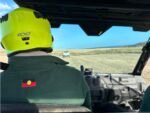
When we gather for research, we have an agenda and we have plans to meet at the shed at 9am to start the workshop. We also overhear the rangers saying they’re heading out to the other side of the Cape to check out some sites and would we like to jump in the All-Terrain Vehicle (ATV) and go with them?
And we do want to go with them. And because our Country is known for its big winds, and for that reason also has a wind farm on it, we get covered in dirt and bugs, and we can’t hear a thing as the wind whips us into shape.
When we gather for research, we end up at Luemerrernanner on the other side of the Cape, and because we’re gathered for research, one of our project research assistants is here. She’s from our Country too, and guess what? She’s also an archaeologist.
So when we gather for research to start the workshop with our butcher’s paper at the shed at 9 am, we’re at Luemerrernanner on the other side of the Cape mapping unregistered heritage sites together.
When we gather for research, we watch the wombats, talk about the rangers’ programs of tackling mange, and we bring in the sick wallabies who sleep next to us overnight in a cardboard box to make sure that they’re okay. And then of course we make it to the shed.
We have the butcher’s paper, the consent forms, the note taking, the summaries, the recordings, and the posters on the wall.
Community workshop on environmental change and wellbeing. Credit: MTWAC
Planning adaptation strategies
We talk to our community about the big old stories of how our old people survived through different glacial periods, walking across land bridges and into different parts of our Country.
We talk in our workshops about what our Elders have learnt from their childhood, how things were and how things have changed. We talk about what people are seeing today and how the seasons are shifting and the snow’s not sticking and the rivers are feeling different.
And then we talk about the future. We talk about the worry that our old people have for the next generation. We talk about our young people, what we’re leaving them, and what we can do as a community to be able to change that.
So, what was this research project all about? About the inextricable link between the health of Country and the health of people, sharing how environmental changes on Country impact our wellbeing.
This project is about planning adaptation strategies to move with climate change and centre our own community conception of wellbeing in the process.
Now, I’m going to do something a little corny here, to show the story of how research is all those things around the edges, and to show you how our wellbeing is tied to the wellbeing of Country and our capacity to be with Country.
Here’s a photo of me. Now this is corny and personal, but someone took this photo at the workshop, and when I saw it, I was really shocked because I was quite unwell in the lead up to this workshop.
Yet here I am, surrounded by our Elders, headache medicine bush behind my ear after a day of being out on Country.
Dr Lauren Tynan. Credit: MTWAC
I am showing you this not to make some anecdotal point that individually I am well when I am on Country, and when Country is cared for. I show you this to make the point that I am a researcher, and this project was led by researchers from Tebrakunna Country.
This makes a difference, because we are leading research with our community, and because of that, we don’t skip over the spontaneous morning trips out to the other side of the Cape to check on the unmapped heritage sites, even though the workshop’s meant to start in the opposite direction in one hour.
We don’t skip over the evening walks along the beach to check on the wombats. Because we also know that this is the research.
And for this project, these moments of gathering are actually our most important climate adaptation strategies.
So, of course, we have our beautiful paper centred on a beautiful theory of how our community is adapting to climate change according to our community protocols of how we conduct business together.
You will be able to read this and all the academic scholarship we’ve brought to bear on that theory. That academic journal article will come.
But for now, today, I want us all to sit with the idea of research and bring all these images and those of your own Country – the behind the scenes that I know many people have experienced – and bring that close to our heart when we think of the word research.
Wollighererperana, thank you very much.
Watch a video about the project here.
See last year’s HEAL article that features Dr Lauren Tynan’s work, here.
Bookmark this link to follow ongoing Croakey Conference News Service coverage of #HEAL2026






Add Comment