

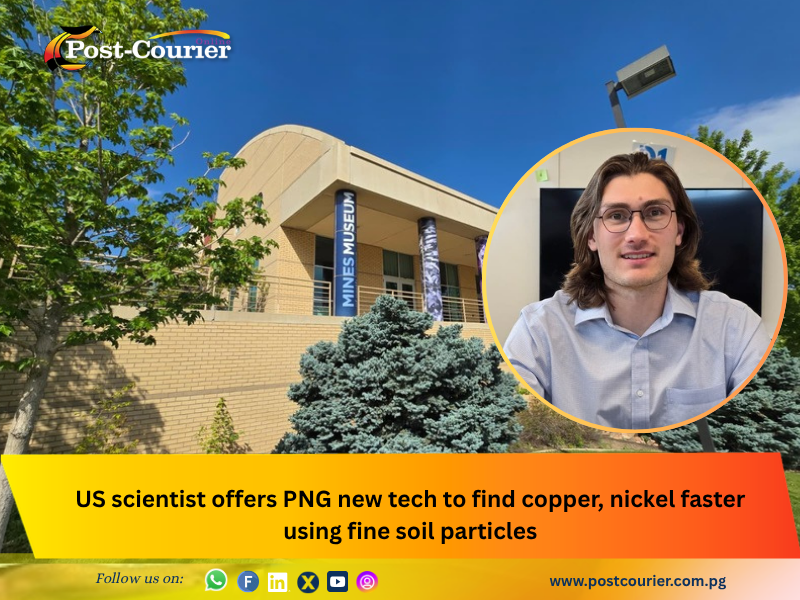


Gorethy Kenneth and Philemon Kassman in Denver, USA
PAPUA New Guinea could speed up discovery of copper and nickel deposits by adopting a new exploration method that analyzes microscopic soil grains, a Colorado School of Mines geochemist has told Post-Courier.
Aaron Goodman, assistant professor at Mines and a geochemist, said PNG’s reliance on “historic data” mirrors practices long used in the US. To modernize, America launched the Earth Mapping Resources Initiative, or Earth MRI, combining geology, geochemistry, and geophysics to map the entire country with state-of-the-art tools. That data is then shared across government and industry to find new deposits.
One technique Goodman’s lab is advancing focuses on the “very small particle sizes” in soil and stream sediment samples. “When you start looking at the smaller and smaller grain sizes, you get a better response,” he said. Large particles are usually common minerals like sand. The fine fraction holds the signals for copper, nickel, and other critical minerals.
Mines is building a prototype with its geology, geochemistry, and robotics programs to isolate those fine grains from soils and sediments. “It doesn’t seem like rocket science. Just look at the smaller particles, but we’re really finding success for a lot of commodity types with that method,” Goodman said.
The approach could help PNG, which has “globally important” copper and nickel geology but still depends on old survey data. Goodman said the fine-fraction method can make exploration “faster and cheaper” because it cuts through background noise in samples.
PNG has 12 operating mines and 30 major deposits, many producing copper and gold with critical mineral byproducts. Better geochemical targeting could unlock new finds without costly drilling campaigns.
Goodman also flagged mine waste as a potential resource. Tailings at PNG sites like Lihir could hold recoverable metals, but the first step is characterization. “Not only how much is there, but what are the forms that it’s in,” he said. Copper and nickel are often in “more readily recoverable phases” than rare earths. “It is very possible that waste rock in that region could be a source of critical minerals. I would say, send us some samples, and we’ll tell you.”
He said PNG labs could adopt these techniques. “These are analyses that are high tech and state of the art, but they’re not impossible to translate… If we develop some brand new method, it doesn’t help anybody if we’re the only ones that know how to do it.”
The post US scientist offers PNG new tech to find copper, nickel faster using fine soil particles appeared first on Post Courier.





Add Comment