

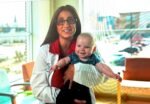


Introduction by Croakey: Despite being a well-documented health hazard, poverty is generally not treated or prevented with the same urgency as we treat infections, diabetes or hypertension, according to United States paediatrician Professor Mona Hanna.
Hanna founded the first universal and unconditional prenatal and infant cash program in the United States, and has been involved in growing the Rx Kids program since its launch in Michigan State in 2024.
Rx Kids provides mothers with US$1,500 during pregnancy and families with babies with US$500 a month until the baby’s first birthday. It is a place-based treatment – everyone who lives in a participating community is eligible. There are no income requirements and no conditions on how the cash is spent; the program is designed on dignity and trust.
While local news reports suggest the program has come under tough scrutiny from some Republicans, Hanna says the benefits are documented across many indicators.
The program shows some of the most powerful health interventions may come not from new drugs or technologies, but from addressing the conditions in which families live, Hanna says. Her article below first appeared in The Conversation.
Mona Hanna writes:
As a paediatrician at Michigan State University College of Human Medicine in Flint, Michigan, I perform well-child checks, treat asthma and discuss nutrition with families. I prescribe medicine and arrange follow-up visits.
Earlier in my career, when I would see families that struggled to pay rent, keep the lights on, feed their families, afford their medications or buy diapers, I saw how those hardships directly harmed their health, yet I felt powerless.
I remember thinking, “What can I do about poverty?”
In medicine, poverty is often screened for, documented and then ignored as a “social” issue outside the scope of medicine. It becomes a side note in a medical chart. We do not treat it or prevent it with the same urgency as we treat infections, diabetes or hypertension.
For over a century, academic medical centres in the United States have produced scientific discoveries that improve health. Achievements such as vaccines, genome mapping and the management of deadly diseases save lives daily.
But even with all our medical advances, the biggest factors that shape health are still social, and a family’s income remains one of the strongest and most lasting.
Focus on poor places
In 2024, Michigan State launched Rx Kids, the country’s first universal and unconditional prenatal and infant cash program.
Rx Kids provides mothers with US$1,500 during pregnancy and families with babies with $500 a month until the baby’s first birthday. Rx Kids is a place-based treatment – everyone who lives in a participating community is eligible. There are no income requirements and no conditions on how the cash is spent; the program is designed on dignity and trust.
This is not an entirely new idea. Similar efforts across the globe reduce child poverty with child allowances.
In the US, the child tax credit was expanded under the American Rescue Plan Act in 2021, which reduced child poverty to the lowest level recorded by providing benefits to low-income families. At the end of 2021, however, the expansion was not renewed and millions of kids went back into poverty.
Rx Kids is designed to treat poor places, not poor people. By means-testing communities instead of individuals, the program has a population-wide reach. This minimises stigma and administrative burden for families while also maximising efficiency for administration.
So far, more than 15,000 families in dozens of Michigan communities have received over $55 million in direct cash.
The relationship between low income and poorer health is one of the most reliable findings in social science. When poverty strikes during pregnancy or early childhood, it has the potential to leave lifelong scars. It’s linked to maternal and infant health disparities, including preterm births, low birth weight, maternal depression, infant death and chronic illness.
For many families, income plunges and poverty spikes right before a child is born, and these effects continue throughout the first year.
In some ways, it’s no surprise that an academic medical center is leading one of the largest anti-poverty programs in the country.
Land-grant universities like MSU were created to use knowledge and rigorous science to solve real-life problems. Just as important, MSU’s College of Human Medicine has its own public health department, which allows it to bring together the often siloed fields of healthcare and public health. Its medical school has always been centered on public service.
Rx Kids builds on these traditions by leveraging the resources of academia to address a major health threat to mothers and children. It’s sustained through a robust public-private partnership that brings together community members, nonprofits, philanthropies and government.
Encouraging results
To date, the program has expanded from our first site in Flint to over 60 Michigan communities, including the entire rural Upper Peninsula.
Our largest launch came in February 2026, when Rx Kids expanded its reach to over 7,500 babies born each year in Detroit.
In total, Rx Kids is expected to reach almost 25,000 Michigan babies each year, and it just celebrated its launch in Ohio.
The results are encouraging. The program leads to more stable housing and better nutrition. Communities have seen moms start prenatal care earlier and stick with it.
Birth outcomes have improved, too. There’s been an 18 percent drop in preterm births and a 27 percent drop in low birth weight in the city of Flint, the first Rx Kids community. Early research also reveals a 50 percent drop in neonatal mortality. Studies also show less postpartum depression, anxiety and stress and better overall well-being for mothers.
The program is linked to a 32 percent drop in infant maltreatment reports, which represents a massive prevention of child welfare involvement.
Beyond health, direct cash support boosts local economies by creating jobs and stimulating spending. It also saves public money by preventing expensive problems, such as stays in neonatal intensive care.
“Cash support helps us keep housing, pay bills, maintain our health, and support our partners, too,” Nyah Phillips, an Rx Kids mom from Inkster, Michigan, told us.
“It allows parents to focus on health instead of survival. And every parent deserves that.”
Helping clinicians
Rx Kids is also helping physicians like me feel less powerless, too.
In a new qualitative study, released while undergoing peer review, pediatricians reported that having Rx Kids in their community improved their sense of professional fulfillment, allowed them to use appointment time more efficiently and made them feel more supported.
When patients can meet their basic needs, paediatricians can practise the kind of care that they were trained to provide, reducing the moral distress and burnout that so often comes when we can’t treat patients’ hunger and homelessness.
At a time when healthcare spending continues to rise while health outcomes in the United States lag behind those of peer nations, especially when it comes to maternal and infant outcomes, programs like Rx Kids suggest that some of our most powerful health interventions may not just come from new drugs or technologies, but from addressing the conditions in which families live.
Years ago, I wondered what a paediatrician could do about the pathogen of poverty. Today, I know we can study it, measure it, treat it, and, better yet, even prevent it before it makes our patients sick.
Author details
Mona Hanna is Professor of Pediatrics and Human Development at the Michigan State University College of Human Medicine, Michigan State University. She receives funding from numerous state and national funders to support her work on Rx Kids. She is the founder and director of Rx Kids. She is also an author (What The Eyes Don’t See, Penguin Random House) and speaker (Penguin Random House Speakers Bureau) and has provided testimony during congressional hearings as a child health expert.
See Croakey’s archive of articles on child health and Dr Tim Senior’s series on Deep End general practice





Add Comment