







The power and reach of Big Tech and the digital determinants of health are undermining the health and wellbeing of people around the world, according to researchers who have put forward strong recommendations for policy, research and advocacy.
Angela Hehir reports for the Croakey Conference News Service.
Angela Hehir writes:
Governments around the world have been urged to act swiftly and determinedly to better regulate the web of interests that shape the digital environment, to address its wide-ranging and often harmful impacts upon health and wellbeing, especially for children and young people.
And the public health sector has been urged to engage much more systematically and proactively in research, advocacy and policy, especially around such regulation, to address health and safety concerns arising from the digital environment.
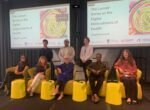
These are some key points from a three-part Lancet series on the digital determinants of health (DDoH) whose regional launch was held in Adelaide last week with a keynote presentation by global public health leader Professor Ilona Kickbusch.
“One of our major frustrations while writing the series was how silenced much of public health around the world is still on this issue,” Kickbusch told the launch. “We think it is a public health crisis, and public health should be responding to it.”
The regional launch of the series was a collaboration between the Centre for Health in All Policies Research Translation, the Adelaide University School of Public Health and the Australian Health Promotion Association, and took place at the South Australian Health and Medical Research Institute (SAHMRI) on 29 October.
Associate Professor Lynne Giles told those attending that The Lancet and Financial Times Commission recognised five years ago that DDoH were an emerging global health priority.
Since that time, however, the focus had been on addressing harms already caused, rather than on preventing such harms, she said.
In a recorded video message, World Health Organization Director-General Dr Tedros Adhanom Ghebreyesus emphasised the need for “stronger evidence, better governance, greater transparency and accountability, and safety by design”.
Importantly, he called for young people to be involved in the public health response – a recurring theme throughout the discussions.
Dr Tedros, stressing the importance of governance. Photo by Angela Hehir.
Unsafe by design
In her presentation, titled ‘Unsafe by Design? The digital determinants of health, and where Australia could lead next’, Kickbusch put forward several recommendations for how Australia could act, including by giving health ministries and the Australian Centre for Disease Control a mandate to address the digital determinants.
Australia could also work with other countries towards development of a related WHO Framework Agreement for improved governance. And it could help establish an alliance centred on child and youth wellbeing, with an International Artificial Intelligence Safety and Health Institute for Children to track harms, set benchmarks, and support policy development, she suggested.
Kickbusch also suggested Australia could end behavioural advertising to minors on digital platforms, and require platforms to open their data to researchers.
During her keynote, Kickbusch remarked on the leadership shown by Australia on two issues: tobacco control and the social media ban for young people.
“The fact that you took action on social media and introduced with such rapidity the age restriction – maybe to some extent, you didn’t even realise what a bombshell that was in the rest of the world and the impact it had.”
She stressed that the ban was only one component of what must be a broader coordinated response, in which young people were empowered to contribute.
“Nobody, but nobody believes that the age limit is the solution,” she said. “We know that. We know that from tobacco. We know it from all kinds of things that you need five, six structures that support each other.”
Kickbusch also warned that misinformation promulgated by digital forces are a threat to public policy and to democracy, noting a recent Guardian report that 75 percent of contributions to an online survey on vaping were provided by chat bots.
A public health response is needed: Professor Ilona Kickbusch. Photo by Angela Hehir
A new era
The Lancet series proposes a new approach for conceptualising and responding to the digital determinants of health, and outlines an agenda for future research, practice, and governance.
The DDoH are defined as “structural conditions that affect health and wellbeing through digitally mediated infrastructures, business models, design choices, and information environments”.
They influence public health for the global population, including those who have little or no access to digital technologies, by shaping political norms, economic logics, infrastructural investments, and personal and social practices internationally.
The first article in the series, ‘The digital determinants of health: a new era for global public health’, describes a “digital sociotechnological order” as the structural source of the DDoH.
It warns that the digital economy presents numerous challenges to global public health, including threats to societal cohesion and the functioning of democracies arising from generative artificial intelligence (AI).
“Built upon a collection of digital platforms offering various services via the internet, the digital economy has monetised human interaction, locked users into platform infrastructures, deepened global economic inequities, and further concentrated power among a small number of technology companies,” the authors warn.
Profound technological developments in AI and their integration with biological and robotic processes mark an urgent need for global cooperation and regulation, they say.
“These risks are of enormous concern from a public health perspective and could be catastrophic to global peace, health, and wellbeing if left unaddressed,” the authors write.
“Ultimately, public health will need to evolve substantially to strengthen its capacity to address the DDoH, committing to keeping pace with the evolutions of the digital sociotechnological order in ways that can address and manage the effects on human and planetary health.”
The authors make recommendations for future research, including:
Prevent the corruption of science on DDoH, through researchers actively avoiding conflicts of interest and compromising industry influence
Audit, document, and critique corporate practices of technology companies that harm human and planetary health
Build an open access repository of case studies of the health-related effects of DDoH
Develop a global community of practice on DDoH
Explore the relationships between DDoH and other determinants of health
Build a framework for public health intervention on the DDoH.
They also recommend developing a toolkit for local public health units and other public health agencies to help address DDoH locally, nationally, and internationally.
Such interventions should not place responsibility on individuals and communities, as in the case of simplistic digital literacy interventions, but “should encourage critical thinking about technology, support structural changes that encourage non-digital activity, and be paired with advocacy for further governance action on the digital corporations and their products that most directly lead to health-related harms”.
Slide presented by Professor Ilona Kickbusch
Protecting young people
At the launch event, South Australia’s Commissioner for Children and Young People, Dr Kylie Heneker, presented key findings from the recently released Commission of Children and Young People Social Media Ban Report.
It documents the experiences of 584 young South Australians aged 11-17 following the introduction of the social media ban in 2025.
“Children and young people are citizens now, not only in the future,” Henneker said when releasing the report.
“They are in the ‘eye of the storm’ of significant technological change and if future reforms are done to and not with them, we will lose their unique perspectives and buy in.”
Heneker described one of the focus groups conducted as part of the evaluation. While more reluctant to comment on the ban and its impacts, the young people opened up when asked what they would do to address the safety problem.
“Young people have been clear that they want safer online environments, but they have been equally clear that they want their voices heard. They want safe places to connect online and in person, and they want to be included in the next stage of reform,” the report says.
The second article in the Lancet series examines what it calls “one of the most contested questions in public health: how young people’s digital media use shapes their health and wellbeing”.
These authors say the evidence suggests that digital media use can be associated with both benefits and harms although it is more consistently associated with adverse mental, behavioural, physical, cognitive, and social outcomes, with developmental stage emerging as an important moderator.
Research to date has privileged easily measured proxies, such as screen time, and given insufficient attention to the platform design, algorithmic systems, and commercial incentives that shape young people’s experiences, they say.
At present, the most valuable evidence about the impacts of digital media use remains concentrated within technology companies, which limits independent scrutiny and slows scientific Progress.
Protecting children’s and adolescents’ health calls for a precautionary, structural response, which moves beyond individual behaviour change to reshape the digital systems, incentives, and knowledge practices that determine how digital media affects health.
However, the global nature and power of major digital platforms create challenges for enforcing online safety laws and regulations.
“The owners of major digital media platforms and other Big Tech companies have acquired substantial power and geopolitical influence, rivalling and exceeding that of many nation states,” these authors say.
Meanwhile, youth voices and public health perspectives have been missing from digital media governance processes, resulting in missed opportunities to anticipate and mitigate potential risks arising from digital media use.
Minimising risks associated with young people’s digital media use requires redirecting the digital sociotechnological order towards Health for All values – equity, rights, solidarity and democracy.
Slide presented by Professor Ilona Kickbusch
Governance matters
The third article in the series proposes a public health-centred governance framework for the DDoH, with a focus on children and young people.
Rather than regulating individual technologies in isolation, the authors say that governance should ensure digital systems and environments advance population health and reduce inequities.
“A public health approach shifts attention from individual responsibility – and the tendency to blame users – towards the governance of the structural features that produce health risks and inequities,” say the researchers.
Governance should address extractive business models, opaque algorithmic systems, and concentrations of private power that shape health without democratic control, with a focus on four domains: infrastructure and access, platform design and commercial practices, data governance and surveillance, and institutional accountability and rights.
The article says that effectively governing these domains requires intersectoral strategies that tackle problematic concentrations of political and economic power, including with regard to AI.
It argues that the governance of the digital determinants of health should be recognised as a core public health function, with the health of children and young people as a priority and entry point, and precaution as a guiding governance principle.
However, the authors acknowledge the barrier caused by geopolitical competition among technological superpowers, whose strategic rivalries weaken rule-based international cooperation and undermine the development and enforcement of effective global governance.
They also say that digital platforms are using strategies in the well-worn corporate defence playbook – like discrediting critics and framing regulation as a threat to freedom – and adding new tactics too, such as leveraging claims about innovation, and technological complexity to resist regulatory intervention.
The researchers say what distinguishes the DDoH from other determinants of health “is the speed, scale, and transnational reach with which digital systems and infrastructures have become embedded in health-relevant decision making”.
The DDoH are, they say, “neither neutral nor immutable”.
“They reflect political choices about power, responsibility, and values. A set of coordinated reforms, anchored in public health values and law, enforced through national, supranational, and international regulatory capacity, embedded in procurement and competition policy, and guided by child-centred and youth-centred protections, could substantially reduce harm as well as preserving space for beneficial innovation.
Slide presented by Professor Ilona Kickbusch
Addressing power
An engaging panel discussion, chaired by Associate Professor Carmel Williams, Director of CHiAPRT and one of the event’s convenors, considered these questions:
What would make digital determinants a core public health function in Australia?
Which design or business model rule matters most for children?
How do young people move from being consulted to partners?
The panel contrasted and compared the DDoH with other public health threats, including tobacco, and highlighted the role of public health strategies including advocacy, taxation, regulation, penalty and public education.
Litigation strategies were also highlighted at the launch as a means of changing the burden of proof – requiring Big Tech companies to prove they are NOT doing harm. However, the onus remains most often on communities, governments and the public health sector to prove they ARE doing harm.
Professor Fran Baum, director of Stretton Health Equity, said Big Tech was far more powerful than the tobacco industry, and was threatening democracy, equity, relationships, planetary survival and humanity itself.
She recommended the Ada Lovelace Institute (an independent research institute with a mission to ensure data and AI work for people and society) as a useful resource (see them on LinkedIn).
Preventive Health SA chief executive Marina Bowshall described parallels with other public health policy challenges, including the use of an upstream approach, introduction of mandatory standards in packaging, regulatory oversight and litigation as well as the involvement of young people in developing responses.
Professor Lyle Palmer, from the Australian Institute for Machine Learning, suggested that while there has been a successful public health response to tobacco, as a product tobacco is unique and its lessons for digital determinants need to be seen in that context. He stressed the importance of data sovereignty as something Australia “can be very good at”.
Dr Emma Heard, a director of Australian Health Promotion Association (AHPA), described the critical advocacy role played by organisations such as AHPA and the Public Health Association of Australia (PHAA), saying they were uniquely placed to provide the networks needed to coordinate action across sectors and across policy portfolios.
These organisations “can really bring together researchers and practitioners to develop that united and evidence-informed voice and messenger”, she said.
Key takeaways
Asked after the event for her key takeaways, Williams told Croakey the calls to action to policymakers and governments were:
Young people need to be actively involved in shaping the policies that affect them – not just consulted.
The DDoH need stronger governance, and age restrictions provide an important political signal that government is concerned and is prepared to act. However, it is a first step and more needs to be done.
South Australia has been a world leader in applying Health in All Policies, and should build on this by applying this approach to strengthen collaborative action on the DDoH.
The public health community needed to recognise the critical impact of the DDoH and work to create digital environments as a safe space, she said.
Williams urged researchers to continue to build the evidence, and track the impact of policy changes on health, wellbeing and equity. They also needed to be responsive to the fast-paced, dynamic DDoH environment – to keep up with emerging changes and ensure they are asking policy-relevant questions and providing evidence that helps inform decision making.
Professor Fran Baum’s takeaways were that digital determinants are already changing our world in ways which could be threatening to health and wellbeing.
“We need governments to regulate the areas in which health harms might happen,” she said. “But it was also clear that effective regulation will not be easy, as the large companies are transnational and not easily regulated by national governments.”
Baum said that, according to the Bloomberg Billionaires List, eight of the 10 richest men in the world made their money from digital industries (such as Amazon, Dell, Google) and the 12 richest men are as rich as the bottom half of the world’s population.
“This is power like we haven’t seen before,” Baum told Croakey. “It made me realise how prescient were the warnings of Yanis Varoufakis in his book, Technofeudalism: What Killed Capitalism”.
For the public health community, she suggested “constant advocacy” to government about the need for regulation, and research on the adverse health impacts of the use of technology, including algorithmic governing of workplaces that allows surveillance of Uber drivers and counting workers’ keystrokes.
Baum said public health researchers should also work to address the frustration and distress that consumers can face in dealing with big corporations that rely on digital environments to do their business.
Her advice for fellow researchers was to start including digital determinants in their work “especially if you are a social and commercial determinants of health researcher”.
She advised all researchers to think of the equity dimensions when people advocate digital solutions: “Who wins and who loses?”.
• See the European Launch Webinar at the Digital Transformations for Health Lab website here.
(Dr Melissa Sweet contributed further research to this article.)
Declaration: This article was produced by the Croakey Conference News Service, with funding from the Centre for Health in All Policies Research Translation.
See Croakey’s archive of articles on digital platforms; and on the commercial determinants of health







Add Comment