


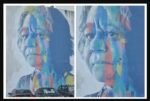


Introduction by Croakey: Walking across Lake Street in Cairns recently, a huge and colourful portrait stopped Dr Angela Baeza in her tracks. It is of Yidinji woman Professor Henrietta Marrie AM, of the Gimuy Walubara clan, who has a long history of contributing to Indigenous rights, health and education.
Below, Baeza, a Diaguita Woman from the Chilean desert, educator, and a Research Fellow at the ARC Centre of Excellence for Indigenous Futures at The University of Queensland, and her colleague Professor Bronwyn Fredericks reflect upon the significance of Marrie’s work across many fields.
Angela Baeza and Bronwyn Fredericks write:
The mural featuring Professor Henrietta Marrie AM was painted by Claire Foxton, a street artist from Wollongong, and is called ‘If We Lose Our Reef, We Lose Ourselves’.
It is made up of all the colours and textures of the Great Barrier Reef. Coral structures, patterns from the sea, pieces of life, everything enclosed in her figure. Yet some elements of this inner universe seem to dissolve.
Honorary Professor Henrietta Marrie is an Indigenous rights advocate. She is an Indigenous role model; not just because she was the first Aboriginal person from Australia to be chosen for a professional appointment with the United Nations, but because she has “broken barriers in Indigenous policy, education, and international advocacy”. She worked in Montreal and Silicon Valley in the United States of America and travelled internationally for committee work, and advocacy.
The mural reminds us that knowledge, people, and country cannot be separated and additionally can traverse time, places and space.
“As an Indigenous woman from the Chilean Desert, seeing this mural does not feel distant but rather very close to home,” says Baeza.
“While I hail from a different country, a different coast, and a different history for my people, the message strikes a chord on both a personal and a collective level. The notion of everything being interconnected was never foreign to us. It was something we always knew to be true.
“Coming from the driest desert in the world, I understand how fragile ecosystems are, mostly under the constant pressures of mining and extraction that challenge landscapes and also our ways of living.”
Visibility matters
Looking at the mural of Professor Henrietta Marrie, which reflects the reef with its colours slowly fading, we reflect on how Indigenous peoples are aware of the landscapes shifting; whether in the desert, forest, or reef, we watch our countries change by situations and forces outside our control.
These are shared experiences that talk about Indigenous resilience, resistance, and responsibility to speak.
It also reminds us of how important visibility is. To understand and see an Indigenous woman, an Elder, honoured in a public space with such depth and respect is more than simply symbolic. It is a message about whose knowledge is respected, whose voices are heard, and whose futures are envisioned.
Marrie is an Elder of the Gimuy Walubara clan of the Yidinji people and Traditional Owner of the land on which the City of Cairns and southern suburbs are now located.
There are photographs and references to her ancestors in numerous facilities, and sites around Cairns. Her life and accomplishments over the decades have been enacted via a play in the JUTE Theatre Company in Cairns in 2028, and there is discussion about a documentary about her life.
Born in Yarrabah on her mother’s Gunggandji country, she spent her early years growing up there until her family moved to Palm Island off Townsville in the mid-1960s. She has used her qualifications and experiences in cultural and resource management, heritage protection, and health provision.
For example, her report with Adrian Marrie, titled A Matrix for Identifying, Measuring and Monitoring Institutional Racism within Public Hospitals and Health Services (2014) has been instrumental in bringing about change in health services in north Queensland, and transforming them.
We encourage people to read the Matrix document and to draw on its important messages, which are still relevant to the work to Close the Gap in the disparities between Indigenous and non-Indigenous health and wellbeing outcomes.
The painting enables us to consider the importance of Indigenous women in education and Indigenous cultures in the contemporary times in which we live.
Women have an influence on education not only through their participation in classrooms but also as cultural carriers and custodians of knowledge, being educators through generations connecting to the Country and as advocates who work as change agents to transform communities and societies.
Many Indigenous women in academia today continuing to challenge hegemonic discourses of justice, truth, and power, and build on Marrie’s work.

Author details
Dr Angela Baeza is a Diaguita Woman from the Chilean desert, educator, and a Research Fellow at the ARC Centre of Excellence for Indigenous Futures at The University of Queensland.
Professor Bronwyn Fredericks is an Indigenous woman from south-east Queensland, and the Deputy Vice-Chancellor (Indigenous Engagement) at The University of Queensland, a theme lead with the ARC Centre of Excellence for Indigenous Futures, and Chair of Croakey Health Media.
See Croakey’s archive of articles on the arts and health; and the cultural determinants of health






Add Comment