






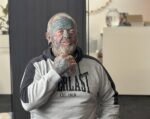


Sharing stories is important for helping to prevent and better treat liver disease and to improve health and wellbeing for Aboriginal and Torres Strait Islander people.
Harp Kalsi-Smith and Summer May Finlay write:
Uncle Kerry was pleased with himself. The weight was falling off him, half his body weight in five months, and he put it down to the gym finally paying off.
“Where did that go?” he said. “I thought I was losing weight in the gym. I felt really happy with myself.”
But it was liver cancer, found by accident, on a scan for something else.
That is how liver disease works. It can progress silently. And this October, for Liver Cancer Awareness Month, Uncle Kerry is putting his story on film so people can know about more about the importance of looking after yourself.
Uncle Kerry Fox, 75, is a Stolen Generations Survivor. He was taken from his mother at two weeks old. His mother had been taken before him. From that fortnight-old baby until his late thirties, his life ran through boys’ homes and then prison.
“I was terrified,” he says of those years. “And I blamed myself for all this. I never blamed the people who was committing these crimes towards me.”
The child who was harmed and decided it was his own fault grew into a man who believed he deserves whatever comes. This belief is all too common amongst many Stolen Generations Survivors.
That belief is what keeps a person away from a doctor 30 years later. For Uncle Kerry, the pain had to go somewhere, and for close to 30 years it went into drugs and alcohol. He worked the whole time. Half the people around him never knew.
Carrying history
None of this is a detour from a story about liver health. It is the story.
When we talk about why liver disease reaches Aboriginal and Torres Strait Islander people at far higher rates than other Australians, we are talking about removal, grief, shame and survival, long before we are talking about anything on a blood test.
The numbers are stark. Aboriginal and Torres Strait Islander people are 2.4 times as likely to be diagnosed with liver cancer as non-Indigenous Australians, and 2.4 times as likely to die from it.
It sits among the leading causes of cancer death in community, and survival tells the harshest part of the story. In the most recent national analysis, fewer than one in ten Aboriginal and Torres Strait Islander people diagnosed with liver cancer survived five years, around half the rate for non-Indigenous Australians. Late diagnosis is one of the main reasons for this.
New evidence shows how many people carry this history in their bodies. In September the Australian Institute of Health and Welfare released updated analysis of the health and wellbeing of Stolen Generations Survivors and descendants, commissioned by The Healing Foundation.
It estimates around 23,300 Survivors aged 50 and over are alive today, one in seven Aboriginal and Torres Strait Islander people of that age. All of them are now in the years when a liver that has carried too much for too long can start to fail.
Survivors report poorer health than other Aboriginal and Torres Strait Islander people of the same age on almost every measure, and the impacts flow on to around 200,000 descendants. The Healing Foundation calls it a contemporary policy issue, not a historical one. Uncle Kerry’s liver would agree.
But trauma is only one part of the picture. It explains why so many Aboriginal and Torres Strait Islander people carry the risk of liver cancer. It does not explain why so few are diagnosed in time.
People at high risk of liver cancer should have a liver check every six months. For many Aboriginal and Torres Strait Islander people, that is simply out of reach. The ultrasound equipment used to watch for liver cancer and diagnose it is often not available in smaller health centres. A check can mean long travel, time away from family and Country, and costs that add up.
Where treatment can be offered, stigma, racism, and economic and cultural barriers still stand between people and care. Many people have also had experiences of the health system that give them good reason to hesitate before walking back in.
Underneath all of it sits a quieter barrier. The liver is poorly understood, in community and among health workers alike. Few people know what it does, what harms it, or that damage found early can often be turned around.
Hardest working organ
Here is the thing about the liver. It does around five hundred jobs and complains about none of them.
It filters every drop of your blood. It sorts the good from the bad in everything you eat, drink and take, including every beer, every tablet, every painkiller. It stores energy and releases it when you need it. It makes the bile that digests your food and the proteins that stop you from bleeding. You cannot live a day without it.
And it does all of this in silence. The liver has almost no pain receptors. It does not ache when it is struggling the way a tooth or a back does. It just quietly keeps working, harder and harder, while damage builds as scarring over years.
By the time signs appear, they are easy to explain away. Feeling tired and losing weight. Uncle Kerry read his own warning sign as good news from the gym.
Most cases of liver cancer happen in livers that have had long term damage from liver disease and lifestyle damage. The liver holds one more superpower, and it is the best one. It is the only organ in the body that can repair itself.
Sadly, once there is cancer, this no longer works. The best way to survive liver cancer is through finding it early. In an ideal scenario, people at risk of liver cancer need to be tested every six months.
Video launch
Even after his diagnosis just before his 75th birthday, Uncle Kerry could not say the word. The liver cancer support team from his treating hospital wrote to him and rang him before his operation and after it.
“They’ll say, do you need help? And I keep going, no, no, no. I didn’t want to admit I had cancer.”
The service did nothing wrong. He was not ready, and picking up the phone would have meant saying it out loud.
That is the shame that sits on liver disease more heavily than on almost any other illness. It is why the Liver Foundation never uses the word helpline, because community told us that asking for help carries stigma of its own. It is a free phone line; the people answering are expert liver nurses; everything is confidential, and the invitation is simply: contact us.
Treatment worked. Uncle Kerry sat in the big chair at the hospital looking at the fish pond, watching children walk past with tubes in their necks and chests, and thought, how lucky am I.
Before his operation, he wrote his story down, in his own way, in case he did not get to tell it. Now he is telling it on camera instead.
His message is one line: “Don’t feel embarrassed. Just give us a call.”
Uncle Kerry’s video launches on Friday, 2 October at Dardi Munwurro in Preston, Melbourne, straight after the weekly smoking ceremony. It is launching where the healing already happens.
That choice came from community too. Do not ask people to come to a health event; they told us. Bring the health conversation to where people already gather, among men and women already on a healing journey. So that is where it begins: a smoking ceremony, a yarn, a story, and a phone number.

What you can do
Watch and engage. See Uncle Kerry’s video when it launches on 2 October and sit with what he has to say.
Share it. Send the video and the phone line number through your networks, your service and your family. If you work in health or community services, put the number where people can see it. Better still, when someone is ready to call, put the phone on speaker and sit with them. The number to call for the Support line is 1800 841 118.
Get your liver checked. You don’t need symptoms to ask, and by the time symptoms arrive, it could be too late. Ask your doctor or your local Aboriginal Medical Service about a liver check, especially if you have ever drunk heavily, used intravenous drugs, had a backyard tattoo or have hepatitis B or C in your family. Remember the liver’s superpower. It can repair itself, but only if you give it the chance.
Uncle Kerry spent most of a lifetime being told, and believing, that he did not matter. His liver kept working for him through all of it. This October, he is asking you to do for yours what nobody did for him for far too long. Pay attention to it early, without shame.
Author details
Harpreet Kalsi-Smith is a brown bodied woman, living on the lands of the Yugambeh people, and has dedicated her professional life to social justice, community development, health equity and multigenerational trauma recovery.
Associate Professor Summer May Finlay is a Yorta Yorta woman and Director of Ngarruwan Ngadju Research Centre at the University of Wollongong. She has over 20 years of experience working in and with Indigenous organisations, tertiary sector, local, state and federal governments. She is a contributing editor and member of Croakey Health Media.
Both authors have been paid as advisors to the Liver Foundation.
See Croakey’s archive of articles on safety and quality of healthcare




Add Comment