

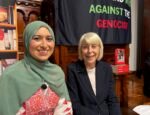


Healthcare workers who contributed to a new book detailing horrific suffering in Gaza spoke at its launch in Naarm/Melbourne on Wednesday, the day after the Red Lines Package of proposed legislation was launched, with the aim of ensuring that Australia’s trade, investment, and defence relationships don’t contribute to genocide, war crimes, crimes against humanity and unlawful occupation.
Marie McInerney writes:
A powerful collection of 40 essays by Australian and New Zealand healthcare workers who volunteered for medical missions to Gaza constitutes “incontrovertible evidence of genocide”, according to Louise Adler, a leading Jewish thinker, former publisher and former director of Adelaide Writers Festival.
Adler was MC at the launch this week of The Weight of Witness: The Experiences of Australian and New Zealand Medics in Gaza in Naarm/Melbourne, which heard calls to action to the health sector and wider community to stand up for the Palestinian people — to “not forget” them and their ongoing trauma, even amid efforts to silence or side-line their champions.
“As the war on Gaza and the West Bank continues, the power of witness testimonies is the only hope we have as we work to pressure indifferent or complicit international community members into taking real action against Israel,” Adler told the packed launch.
“This collection of testimonies makes for devastating and heartbreaking reading, and none of us can say we didn’t know,” she said.
Adler, who quit her role at Adelaide Writers Week this year after its board ‘disinvited’ the Australian Palestinian writer Dr Randa Abdel-Fattah, was also this week involved in the launch in Canberra on Tuesday of the Red Lines Package.
The package is an omnibus Bill introduced across both houses of Parliament by Independent MP Dr Sophie Scamps and Senator David Pocock, which would put pressure on Australia’s involvement in manufacturing parts of the F-35 aircraft used by the Israeli air force in Gaza.
Also backed by First Nations Senator Lidia Thorpe, the package has been developed by academics and other specialists in public and international law, and supported by a range of medical, faith and other organisations, including the Medical Association for the Prevention of War and Amnesty International.
Its proponents say the Bills were developed to ensure that that Australia’s trade, investment, and defence relationships don’t contribute to genocide, war crimes, crimes against humanity and unlawful occupation.
If enacted, they say the package would establish a framework under Australian law in which such relationships “are governed by consistent standards grounded in international law and evidence, rather than selectively applied based on political preferences and the identity of the state”.
Two days after the launch, Labor and Coalition MPs moved an amendment to block a Senate inquiry into the proposed legislation.
In a statement, the Jewish Council of Australia said it was “deeply disappointed by the lack of support from the major parties”.
“As Jews, many of us descended from Holocaust survivors, we remember what happens when governments turn a blind eye or act too late in the face of persecution and mass murder,” said Council executive officer Bart Shteinman.
“Australia should not be repeating the mistakes of the past – it’s time to draw a red line.”
Acts of solidarity
Weight of Witness, published by Readers and Writers Against Genocide after a crowd-sourcing campaign, is an extraordinary, wrenching collection of mini-essays about medical missions which, as one contributor writes, are more than clinical care, “they’re acts of solidarity against abandonment”.
Doctors, nurses and other health professionals from Australia and Aotearoa New Zealand tell why they went to Gaza and then the horror they witnessed: children with horrendous injuries, the foulest of living conditions, starvation before their very eyes, operations without sedation, pain without medication, “no real beginning or end to the suffering”.
One writes of “the scale of obliteration – of bodies, childhoods and the very rules of humanity”, another of miracles “that took place in a world of unimaginable cruelty”.
Dr Wajdi Hadi, a consultant anesthetist, describes his 10 days at Al Shifra Hospital, saying he transfused more blood there than he had in 15 years of practice in Sydney.
A number of contributors write of being exhausted before they even step foot in Gaza, held up by Israeli soldiers at the checkpoint for hours, bags and identities checked again and again.
Melbourne neurosurgeon Dr Ruth Mitchell learns with disgust how multiple units of donated blood from Egypt and Jordan are held up for so long at the border that they are expired.
“A blood donation is a gift of life from another human being’s body, and by obstruction and inaction, it has been destroyed,” she writes.
Mitchell volunteered in Gaza earlier this year, “six months after the supposed ‘ceasefire”. Read more about her experiences in this previous Croakey article.
The health system remains devastated: she and her colleagues took out multiple brain tumours, a brain abscess, and a deep-seated ventral spine abscess, and de-tethered a spinal cord, with few or no micro-instruments.
“There isn’t a single working MRI scanner in the entirety of Gaza,” she records.
Dr Mohammed Awad, a Melbourne neurosurgeon and spinal surgeon who subspecialises in spinal surgery and neuro-oncology, is another contributor to the book.
He spoke at the launch about his experience in Gaza last year, trying to deliver care in a healthcare system that was “completely destroyed”, and that had been made so deliberately.
Awad said he saw imaging rooms where the walls were completely intact, but the Magnetic Resonance Imaging machine in it was destroyed.
“You can’t do that accidentally, and it was the same for CT scans, ultrasound machines, etc,” he said.
Trying to perform complex brain surgery in such an environment was “near impossible”, he said, and on top of that is learning to let go the fear for your own life.
Awad, whose story features in the book, said it was critical for people to recognise that speaking out against Israel’s war against Gaza was not anti-Semitic. He has close Jewish friends who suffered “more of the moral injury than we do because they feel this has been done in their name”.
“The crucial thing we should do is to not forget,” he said, particularly now when Gaza has disappeared from the headlines.
“We mustn’t sit back and say ‘out of sight, out of mind’,” he said. “We’re their voice, we’ve got to speak up for them, we’ve got to remind people what’s happening there, we’ve got to spread the truth…and continue to advocate for what they need.

Moral injury
As Croakey has previously reported, both Awad and leading Melbourne emergency specialist Dr Stephen Parnis were part of one mission that was blocked from entering Gaza by Israeli soldiers because their group was carrying life-saving basic health equipment like cannulas.
Parnis told the launch that, as a veteran emergency specialist, he’s accustomed to “see crowds part” when he is rushing to treat people in an emergency.
“This was the first time in my career, and hopefully the last, where I saw a system designed to thwart me, to undermine the ability to provide care,” he said.
In Australia, he had been “targeted” and frozen out for speaking up about Gaza, including being subject to two complaints to the Medical Board of Australia, for the first time in his long career.
Speakers at the launch also decried the decision of the Australian Health Practitioner Regulation Agency (Ahpra) to adopt a contested definition of antisemitism that many believe will discourage health professionals from advocating for the rights of Palestinians.
A former Victorian President and Federal Vice President of the Australian Medical Association (AMA), Parnis said he is familiar with speaking out on controversial or complicated ethical issues.
Notably, he had spoken out without controversy a decade ago to condemn attacks on health services and professionals in Afghanistan and Syria.
But speaking out on Gaza has been different and can bring both personal and professional costs, he said.
Parnis briefly discussed how he had come to resign last year as chair of the Medical Insurance Group of Australia (MIGA), saying the board had “removed me…. because mud was being thrown”.
He had remained a member of the board, but resigned from that too a few weeks ago, he said, “because nothing had been learned from the attacks that had been made on me”.
“And I said to my board colleagues, ‘The question is not whether you’ve got confidence in me. It’s whether I have confidence in you’,” he said to strong applause at the book launch.
Also speaking at the launch, the book’s editor, Dr Bushra Othman, a Melbourne surgeon who has completed three medical missions to Gaza, reflected on its title.
The ‘weight of witness’ is the sense of moral injury that occurs, “when you see this injustice being put to play, and worse yet, coming back feeling like you live in this parallel universe where people are worried about their coffee costing $7 or not having access to a five-star hotel for their holiday”.
Just as important as going there physically to help the people of Gaza was speaking out about it on the return, she said.
That was particularly the case, Adler added, where there is no public exposure in the international community because foreign journalists are barred from entering Gaza
She hoped that the exposé the book delivers of the abomination being inflicted on Gaza might generate sufficient outrage in Australia “for people to stand up and say ‘not in our name, we will not accept this’”.
See Croakey’s archive of articles on Gaza





Add Comment