







Introduction by Croakey: As the Croakey Conference News Service continues our coverage of the recent Royal Australian and New Zealand College of Radiologists (RANZCR) annual scientific meeting (#RANZCR2026), we are pleased to take you, as were the conference participants, to the rural district of Tairāwhiti-Gisborne.
In the article below, Marie McInerney follows up on presentations at the conference from the Mātai Medical Research Institute, a not-for-profit centre that focuses on developing, using and innovating in advanced magnetic resonance imaging (MRI) techniques for research and diagnostics, and does so in partnership with families and the community.
Mātai means to investigate, inquire, or inspect, and this is in keeping with the Institute’s many clinical and research projects.
They are also using their capabilities to educate their young clients and their families, and model the wonders of STEM education and vocations, with a goal of improving health equity for Māori, Pacific, and rural communities, one MRI scan at a time.
Marie McInerney writes:
The small district of Tairāwhiti-Gisborne on the far east coast reaches of Aotearoa New Zealand’s North Island promotes itself persuasively to tourists as “the textbook definition of a hidden gem – a coastal sanctuary of golden beaches, pumping surf spots, and close-knit Māori communities”.
But Tairāwhiti-Gisborne is also writing a new book, perhaps improbably, as a unique centre for medical and scientific research.
The 50,000 strong community, which is 50 percent Māori, is home to the Mātai Medical Research Institute, a unique health and research centre that is seeking to advance medical imaging capability, safely serve the health of its community, and build a local pipeline of scientists, academics and health researchers.
Two of its team spoke about their work at the recent Royal Australian and New Zealand College of Radiologists (RANZCR) annual scientific meeting (#RANZCR2026) in Ōtautahi Christchurch.
In one presentation, they highlighted the unique Tairāwhiti child wellbeing study, which is working to create a normative database for children, using advanced magnetic resonance imaging (MRI) to investigate variability in structure and function across critical organs such as the heart, lungs, brain, muscles, and bones.
Shaping healthcare
For Mātai chief operating officer and experienced imaging technologist and manager, Leigh Potter, whose Māori connections are Ngāti Porou, Rongowhakaata, Ngāti Kahungunu, Rongomaiwahine, the study is about “more than MRI”.
It’s about “ensuring that our tamariki and our whānau, our children and our families, are represented in the research that will shape healthcare for future generations”, she told RANZCR2026.
It’s also showing how “working alongside our communities can change the way we approach paediatric imaging research”, she said.
For Mātai, the study is “about creating knowledge that better reflects our people, our environments, and our lived realities”.
“When we talk about precision medicine, we need to ask ourselves ‘whose data are we actually using to develop the models and reference standards that guide clinical decisions?’ – because if our Māori and rural communities aren’t represented in those data sets, we risk reinforcing existing biases rather than addressing them,” she said.
That led the team to one, simple question: ‘What does normal actually look like for our tamariki (children)?’, because globally, the datasets used to define growth and disease still underrepresent Indigenous and rural and regional children, which has deep health equity implications, Potter said.
“When our populations are missing from normative data sets, variation could be misinterpreted as pathology,” she said.
“But also, importantly, Mātai is not assuming the children of its community are ‘different’.
“We simply want to understand whether the reference standards we’re using are appropriate for them.”
The Tairāwhiti Child Wellbeing Study is believed to be a world-first, where scanning is “head to toe, in the same session, for the same child”.
Through it, researchers from Mātai and the Auckland Bioengineering Institute (ABI) at Waipapa Taumata Rau University of Auckland have created a roadmap to mimic and analyse the structure and function of children’s brains, hearts, lungs and musculoskeletal systems.
Leigh Potter addresses RANZCR2026. Photo by Marie McInerney
Scanning success
The program began with a pilot study to see whether it was possible to image multiple organs in children: whether the children would tolerate the scans, whether Mātai could make the experience positive for them and their whanau (family), and whether the images would provide the quality needed for advanced computational modelling.
Of the 31 Tairāwhiti-Gisborne children aged seven to 12 years recruited for the study, 30 were able to tolerate the MRI scanning duration of about two hours, giving the researchers confidence, “that this approach was feasible, both from the children’s perspective and scientifically”.
Potter said Netflix had been key to the program’s success, with MRI scans requiring people to lay very still or hold their breath for a long time.
“[The children] actually moan when we take them off the scanner because we’ve interrupted their movie,” Potter told the conference.
Achieving successful imaging in more than 95 percent of scans is a “fantastic result when you’re working with young children,” she said.
“Perhaps even more rewarding is that children actually want to come back.
“These models are helping us to better understand normal developmental variation and to build more representative normative references for Indigenous and regional children.”
Streaming while scanning at Mātai? Not a problem. Image courtesy of Mātai Medical Research Institute
Many benefits
Potter said the program has now moved into a second phase, focused on refining the study and improving the experience for participants, working alongside families, community, clinicians, imaging teams and bioengineers.
They have refined MRI protocols, reduced the scanning time to around 90 minutes, introduced spirometry, and developed a familiarisation video, available in Te Reo Maori, to help children understand what to expect before attending their scan.
As well as exploring whether international reference standards are appropriate for children in Aotearoa New Zealand, the research is advancing practice: for example, it is developing personalised 3D models of children’s lungs, using an advanced MRI technique called Zero echo time (ZTE) imaging.
That, Potter said, is helping researchers to understand normal lung development in children as well as how MRI could provide “a radiation-free way to monitor lung health over time, with potential future applications in childhood respiratory conditions such as asthma and cystic fibrosis”.
There’s another outcome from this work that Potter believes is “just as important as the science itself”.
The centre is introducing its tamariki (children) to medical imaging and research at a young age, and showing them what opportunities exist “right here in their own community”, she said.
“For many of our young people, particularly those growing up in rural communities, careers in science and medicine can feel like something that happens somewhere else.
“But when they come into Matai, meet our researchers, and experience the technology for themselves, they begin to see that these are spaces where they belong,” she said.
That’s already having an impact: Mātai is seeing young people who have been involved with its work now going on to study health and science at university.
“So we’re not just building a research data set; we’re also helping to inspire the next generation of scientists, researchers, and health professionals,” she said.
An incubator
Potter’s Mātai colleague, Dr Daniel Cornfeld, told Croakey at #RANZCR2026 about the unique beginnings and practice of the centre, which has grown to be an internationally connected medical imaging research institute that is based, unusually, in a rural community and unaffiliated with a university.
The Institute opened its doors in 2020, with operations to date secured by more than NZ$40 million in research funding, philanthropic contributions, in-kind support and clinical revenue.
Cornfeld, who is Clinical Lead at Mātai, and Head of Radiology at Gisborne Hospital, said Mātai’s focus is on three main areas: research, clinical service, and community outreach and education, which involves building strong relationships with iwi (Māori) service providers and people in the community, “so that our research is trusted and our clinical services are trusted”.
Initially based at Gisborne Hospital, Mātai moved in 2024 into a new building, on a 2.5-hectare site, co-located with Tōnui collab, a specialist STEMM (science, technology, engineering, mathematics and mātauranga Māori) education partner, which runs dual-language workshops.
Last week the New Zealand Government announced an infrastructure loan of $20 million for the institute, towards the development of a new Innovation Centre, “to support the next stage of a growing health, medtech, technology, research and education cluster in Tairāwhiti in one connected campus”.
“It will create an environment where clinicians and allied health professionals can work alongside researchers, engineers and technology developers; students can learn alongside industry and health professionals; and new ideas can move more readily from research through validation, clinical use and translation,” the announcement detailed.
Mātai already provides scholarships for local Tairāwhiti school leavers, and internships for university students, aiming to build a pathway for young people to move into STEMM, and making sure the institute is an accessible part of the community, rather than an ‘ivory tower’.
“Of course, with younger people, you want them to go away to learn, but then you want them to come back, and do other things,” Cornfeld told Croakey of the community, where jobs and livelihoods have traditionally been shaped mostly around farming, forestry, and vineyards.
“When you start doing things like offering internships for college kids to come back, you realise there are a lot of very qualified candidates, and these are people who are very smart and very talented, and who probably never thought that they could have careers in these types of advanced fields in their hometown,” Cornfield said.
“So what grew out of just wanting to do that research, but back home, became kind of an incubator.”
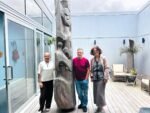
Leigh Potter and Dr Daniel Cornfeld. Pouwhenua by Simon Lardelli. Image courtesy of Mātai Medical Research Institute.
Shared vision
Mātai’s beginnings are also a story of people coming together around a shared vision for what might be possible in Tairāwhiti.
Among its co-founders was Dr Samantha Holdsworth, Mātai’s chief executive and research director, a medical physicist and Associate Professor at the University of Auckland’s Department of Anatomy and Medical Imaging, and a principal investigator at its Centre for Brain Research.
Holdsworth grew up in a farming community about 20 minutes outside Gisborne before spending more than a decade at Stanford University in California, developing advanced MRI techniques to improve the detection and understanding of brain disorders and diseases.
Her return home, she told Croakey, was part of an ambition to bring world-class research and medical imaging capability to a regional community.
Through the collective efforts of local clinicians, researchers, iwi and community partners, philanthropic supporters and many others who believed in what could be achieved, Mātai took shape as a not-for-profit medical imaging research institute, with a commitment to improving health outcomes and creating new opportunities for the people of Tairāwhiti.
Cornfeld said that’s the main hope of the Tairāwhiti child wellbeing study.
While it has a long way to go, the goal is to eventually develop models that can look at a scan from when a child is eight-years-old and be able to predict health measures for when they’re 30.
Reflecting Indigenous data sovereignty principles, the goal is not just medical but to ensure that families who are involved feel comfortable, invested in the outcomes, and safe, including in how the data is used — “in a way they not only agree with but are also excited [about]”.
They need to know and feel that the research isn’t being done on them, it’s being done with them, he said.
Serving community
Cornfeld outlined some of Mātai’s other work.
He is involved in one project that is developing an imaging pathway for prostate cancer diagnosis so that local men don’t have unnecessary biopsies — a pathway not available even in many wealthier parts of New Zealand, he said.
“Because half the population is Māori, then that population benefits more than their national representation would suggest,” he said. “It’s low hanging fruit from an equity point of view but it’s still very effective.”
As well, previously there was no cardiac stress testing in Gisborne because of a lack of sonographers in the remote region. If a patient needed it, they would have to travel to Wellington or Auckland.
Mātai started an MRI stress test perfusion service so the testing could be done locally, which, Cornfield said, also “added a twist” of increased accuracy and the sensitivity.
It’s a combination of research, clinical and community work that Cornfield is grateful to be part of, after having moved to Gisborne in 2015 from Connecticut, where he worked at the 1,600-bed Yale New Haven Hospital, the second biggest hospital in the United States.
In the US, he said, small hospitals are frequently surrounded by big hospitals, “so if something interesting comes in the front door, it goes out the back door, and there’s loads of larger hospitals that want to take those patients because they’re funded.”
In Tairāwhiti-Gisborne, he said, only select cases go to the tertiary centres and then they come back quickly, so the local service is still performing imaging in response to car accidents, cancer cases, cardiac issues and complex postoperative patients.
It means he can do all the advanced work he was doing in Connecticut, while also getting “to enjoy living in a beautiful part of the country with sunshine and beautiful beaches”.
Plus, he is getting to work “in a place where maybe I actually make a little difference”. He said: “My priority is no longer to create billable reports!”
Bookmark this link to follow Croakey Conference News Service’s coverage of #RANZCR2026







Add Comment