

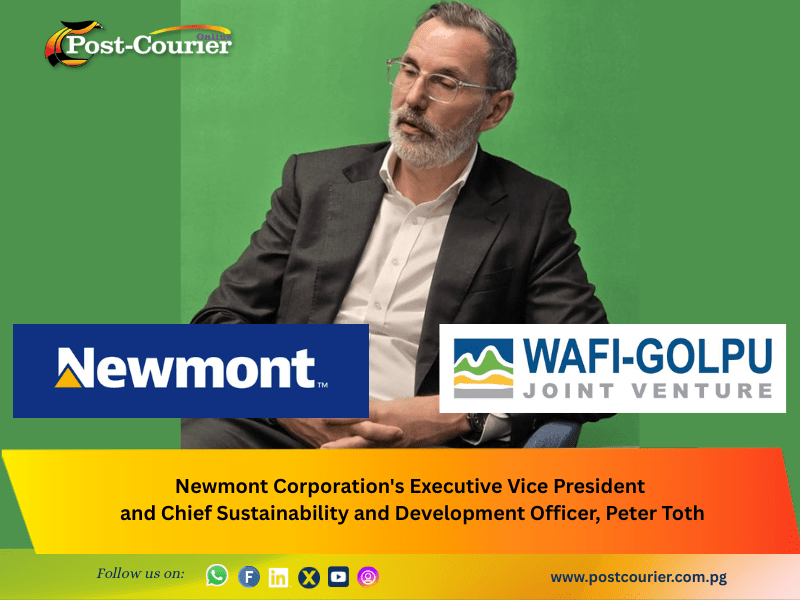


BY GORETHY KENNETH and PHILEMON KASSMAN in Denver, Colorado
NEWMONT yesterday declared Papua New Guinea’s Lihir mine “relatively independent” from geopolitical resource fights, while positioning the Wafi-Golpu project as a future linchpin in the global battle for copper — the “commodity of the next supercycle.”
Speaking exclusively to the Post-Courier in Colorado, Chief Sustainability and Development Officer Peter Toth drew a sharp line between the two PNG assets, as Newmont cements its role as one of the country’s largest taxpayers.
“Lihir is a gold mine. It’s one of the world’s biggest gold mines. And gold is a store of value commodity,” Toth said. “We produce gold and sell it into the international financial market. And relatively independent from the prevailing geopolitical trends, including resource security conversations that are currently taking place.”
That insulation matters for PNG. With global powers scrambling for critical minerals, Lihir’s output — sold into financial markets driven by macroeconomic and National Bank purchasing dynamics — provides stable revenue without being dragged into US-China resource tensions.
“Gold is priced through a variation of macroeconomic as well as National Bank purchasing dynamics,” Toth explained. “So our contribution, Lihir’s contribution to the global gold market is very large, is driven by the international financial market.”
Wafi-Golpu: Copper’s Front Line
The story shifts with Wafi-Golpu in Morobe Province. “Now Wafi is different. Wafi will be a very large copper mine,” Toth said. “And copper clearly being, in my view, certainly the commodity of the next supercycle, it is much more within the context of the current geopolitical conversation around resource security.”
The distinction puts PNG directly into the strategic minerals race. Copper is essential for electric vehicles, renewable energy and defence technology — sectors where Washington, Beijing and Brussels are now competing for supply. “Wafi sits in that context a little bit more than Lihir,” Toth said.
K6.49 Billion and Counting
Toth stressed Newmont’s economic footprint goes far beyond mine gates. “We are a very large taxpayer in Papua New Guinea. We also make a very significant contribution through our payment of royalties to the Papua New Guinea economy.”
Since 1997, Lihir alone has paid over K6.49 billion in taxes, royalties and government payments, including K1.1 billion last year and a record K852 million first tax instalment this year.
But Toth said responsibility for spending that money rests with Waigani. “The distribution of those taxes and royalties falls within the responsibility of the government. But we always actively encourage for those funds to flow back to both the province as well as to the island.”
Hospitals, Schools, Local Buying
Beyond taxes, Newmont runs a local hospital, an international school at Lihir, and prioritizes local purchasing. “We make quite a substantial contribution to the local economy, not just through employment, but also local purchasing,” Toth said. “Just generally engaging with the community and making sure we’re well aligned, so that we’re able to support the community’s needs in that social socioeconomic development.”
With Lihir production set to run into the 2040s and Wafi-Golpu negotiations in final stages, Newmont’s message is clear: PNG has a gold asset insulated from global fights, and a copper asset ready for the world’s next resource battle.
The post Lihir Drives Stable Gold Revenue as Wafi-Golpu Emerges as PNG’s Copper Powerhouse appeared first on Post Courier.





Add Comment