



Implementing injury prevention in football
Brendan Bugeja
Research at La Trobe University has demonstrated a role for physiotherapists in training and supporting coaches to implement tailored injury prevention programs in community sports.
New research has highlighted a potential role for physiotherapists to work with coaches and players to effectively implement injury prevention programs like Prep-to-Play, an exercise-based injury prevention program developed for girls and women playing Australian Rules football.
Designed with input from Australian Football League Women’s players and coaches, and suitable for all players (both female and male) across junior, community and elite levels, the program includes a neuromuscular warm-up with exercises aimed at preventing knee injuries as well as several sports-specific activities to teach safe contact skills and strength-based exercises related to hip and core strength.
The recently published study (Patterson et al 2026) on the implementation of Prepto- Play was led by physiotherapist and researcher Dr Brooke Patterson, a member of Professor Kay Crossley’s research team at La Trobe University’s Sport and Exercise Medicine Research Centre, and was designed to improve implementation of the program across the sport.
‘In all community sport globally, effective injury prevention interventions such as Perform+/FIFA 11+ and Rugby Activate have unacceptably low uptake.
‘Initially, Prep-to-Play wasn’t any different,’ Brooke says.
An earlier study published in 2024 (Patterson et al 2024) surveyed 343 coaches after the 2019 rollout of the program and showed that while most of the coaches were aware of the program and liked it, many felt they lacked confidence in using Prep-to-Play with their players.
‘The resources were great and people knew about them but they weren’t actually feeling that they, as a coach, could do it.
‘Doing a neuromuscular warm-up or strengthening program wasn’t their domain as a coach.’
Brooke says that in many cases, coaches found it too hard to implement, reverting back to what they knew well or had used in their own playing days.
‘Coaches learn best by doing.
‘They can watch something online, but when you’re trying to do something practical with a group of under-16 girls, for example, they need to see it in action.
‘We thought, “We really need to better support coaches” and physios were well placed with their skill set of exercise prescription to do that – they could deliver some practical training for coaches, giving them the confidence and skills to go away and implement the program.’
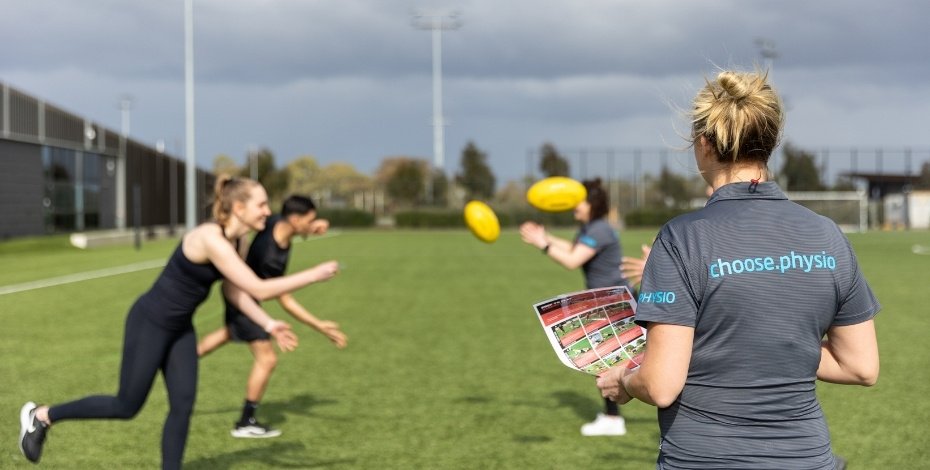
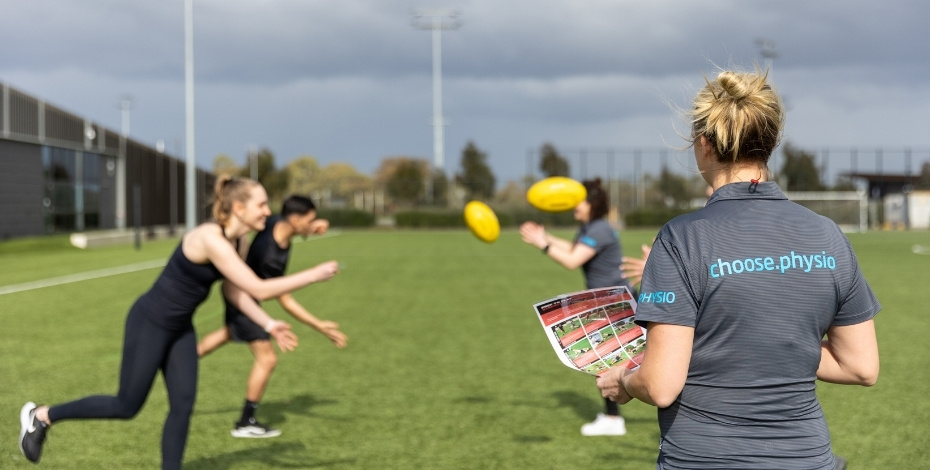
To improve execution, Brooke and her team worked with both physiotherapists and coach educators to design a structured In the Prep-to-Play program, physiotherapists train football coaches to deliver a structured warm-up.
Based on a flipped learning model, coaches started with a little bit of education, observed the Prep-to-Play training program and then had the opportunity to practise it with their peers in a workshop environment before taking it back to their clubs.
Over the next few weeks, the physiotherapist would do two visits with each team to check that the Prep-to-Play program was being implemented as intended and to provide ongoing support.
The results from the implementation study (Patterson et al 2026) show that supported implementation works better than one-off training or online education programs.
In the study, 165 Australian Football League Women’s teams – comprising almost 2500 players – were randomly allocated to transition from unsupported (online education) to supported implementation across two seasons (2021 and 2022).
This study design, known as a stepped-wedge cluster trial, compares outcomes before and after an intervention – in this case, the supported implementation strategy – with each team acting as its own control.
‘Because there were so many pre-existing randomised trials to show that these programs work, the stepped-wedge design enables every team to get the intervention by the end.
‘From an ethical and industry point of view, this was advantageous and it also moves the field further into the implementation space, rather than the clinical effectiveness.’
The researchers looked at several outcomes, primarily the uptake of the program.
In the trial, the percentage of teams using the program rose from 13 per cent in the unsupported phase to 30 per cent in the supported phase.
The secondary outcomes looked at injury rates, particularly anterior cruciate ligament injuries and concussions.
While the effect of the supported implementation on injuries was not clear, a dose–response analysis showed that greater adherence to Prep-to-Play was associated with fewer total injuries (including lower-limb, upper-limb, trunk/ spine and head/concussion injuries).
‘For every 10 per cent increase in the proportion of sessions using Prep-to-Play, injuries were reduced by five to nine per cent.
‘In short, the more the teams used it, the fewer injuries they had.’
Currently, Brooke and her colleagues are evaluating feedback from coaches, athletes, physiotherapists and administrators involved in the trial.
Overall, she notes, the feedback is positive.
Participants report a better understanding of injury prevention and coaches like the structure that Prep-to-Play provides.
‘In addition to the injury prevention, the motivating factor for the coaches was that they’re doing best practice, they’re meeting their duty of care and it’s giving them structure.’
The next step for the research team is to look at a larger implementation of Prep-to-Play to ensure it is sustainable and scalable across Australia.
In May 2026, Brooke and her team, including Kay and others at La Trobe University, were awarded a $4.9 million grant from the Medical Research Future Fund for the protectHER study, which will expand the program nationwide to women and girls playing soccer as well as Australian football.
‘This study has driven the field forward in terms of understanding that you need something more than online education.
‘For most sporting organisations around the world, that is standard practice, but the data shows that we need something more active than that.
‘The other take-home piece is the role of health and exercise professionals in this space.
‘It isn’t typically something that’s covered in undergraduate or even postgraduate courses, although I think that’s changing a little bit, perhaps because of this trial.’
Brooke would like young, enthusiastic physiotherapists who want to get out there in their community and connect with their local sporting clubs to understand that yes, this is a role they can play and they have the skills to do it.
‘We are working with our partner organisations to develop more support for physios so they can upskill themselves to go and play that role in community and prevent injuries.
What we’ve learned is that a lot of physios are great at it but practical training for the physios is still important.
Getting up in front of a group of coaches and athletes to deliver some education, control a group of under-16 girls and get them engaged is a skill that also needs practice.’
While the resources for coaches are freely available on the play.afl website, physiotherapists can also contact the Prep-to-Play team at La Trobe to train as a facilitator of the implementation program and the group is providing the workshop to clubs and teams on a fee-forservice basis.
Brooke says they are in the process of collating all the resources into a paper for publication in the near future.
‘We don’t want to gatekeep the program; we want people to start using it.’
Click here for more information about Prep-to-Play and its implementation. The APA was a major partner in the Prep-to-Play study, contributing cash and in-kind support.
Click here for references.






Add Comment