

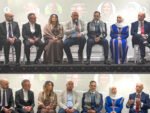


Australian health workers can do much to help improve the healthcare available to people in Gaza, a recent function in Naarm/Melbourne was told.
Marie McInerney writes:
Health workers across Australia have been urged to step up to support urgent and “enormous” healthcare needs in Gaza, ranging from clinical services through to research and the provision of critical shortages of essential medicines and health equipment.
Associate Professor Mohammad Irhimeh, a haematologist and president of the Palestinian Australian New Zealand Medical Association (PANZMA), told a recent fundraising event in Naarm/Melbourne that Gaza continues to suffer critical shortages of healthcare staff and expertise, essential medicines and equipment, despite a notional ceasefire since late last year.
PANZMA, formed in 2020, has deployed 38 medical missions, and facilitated the entry into Gaza of 93 healthcare workers as members of Emergency Medical Teams deployed under the auspices of the World Health Organization (WHO) since October 2023, when Israel launched a military response to attacks by Hamas.
The missions have involved surgeons, anaesthetists, emergency physicians, paediatricians, neonatologists, nurses, from USA, Canada, UK, Ireland, Switzerland, India, Jordan, Qatar, Egypt, Australia, New Zealand and other nations – a number of whom spoke at the Melbourne event about their experiences.
“What began as small group of volunteers has grown into one of the largest Australian-led medical responses in a war zone,” Irhimeh told the event.
However, medical missions are not PANZMA’s only focus: its work also includes medical supplies and equipment, education and workforce development, telemedicine, medical evacuation support, scholarships, and health system strengthening
“If you are a clinician, consider joining us. If you are an educator, help us teach. If you are a researcher, help us generate evidence. If you are a healthcare leader, help us advocate, and if you are a donor, help us build the next project,” he said.
“Healthcare is not only about people, it is about systems, it’s about equipment, medicines, training, infrastructure, supply chains, and sustainability.
“Every mission requires dozens of people, every shipment requires coordination across countries, every evacuation requires advocacy, and every life saved represents hundreds of unseen acts of support.”
Yet, despite the efforts to date and the official ceasefire, “the need remains enormous”.
Palestinian children under fire
The call for help comes as the Independent International Commission of Inquiry on the Occupied Palestinian Territory, including East Jerusalem, and Israel reported this week on the impact of the ongoing conflict on Palestinian children, who it says have been subject to a “systematic and total denial of essential, life-preserving medical services”.
The report, in part titled ‘The essence of childhood has been destroyed’, alleges that Israeli authorities and security forces have deliberately targeted Palestinian children, resulting in genocide, crimes against humanity and war crimes in Gaza.
This has exposed thousands of critically ill, injured and vulnerable children to increased risks of dying from treatable conditions, including infection, neonatal failure, chronic disease exacerbation and traumatic injuries, it said.
The commission, which found last year that Israel had committed genocide against the Palestinian people in Gaza, concludes that “severe physical and mental injuries, mass trauma, orphanhood, separation, disability, repeated displacements, starvation, and the collapse of education and healthcare have erased childhood and will continue to affect children in Gaza throughout their lives”.
It says the targeting of neonatal and maternity care centres in Gaza have directly harmed the survival of newborns and Palestinians’ reproductive future, including rises in miscarriages, birth defects and lasting vulnerabilities among newborns, “resulting in the destruction of Palestinian newborn life and the population’s continuity”.
Its graphic accounts of harm include the late 2023 discovery of the decomposing bodies of four babies in a neo-natal intensive care unit, with the bodies still attached to the life support machines that were out of action due to electrical outage and attacks on the hospital.
“These infants had been reliant on life-support equipment such as ventilators, IV tubes and oxygen monitors. They were found abandoned in advanced stages of decomposition, alongside milk bottles and diapers,” the report said.
The Israeli Government released an 18-page response to the report, rejecting it as the “latest libellous sham” from the commission, saying it is “a propaganda piece” from an agency “whose very purpose is to single out and vilify Israel rather than seek the truth”.
“Using the demagoguery of modern blood libels to defame Israel, the COI actively conceals clear evidence of terrorist atrocities. It completely erases Israeli children who were brutally murdered, kidnapped, and targeted by Hamas, while ignoring Hamas’ cynical use of Palestinian children as human shields and pawns of war,” it said.
Last week the United Nations Security Council debated conditions in Gaza “amid concern that the territory’s humanitarian crisis is being overshadowed by wider regional developments”.
In a statement, the UN said the meeting took place “under a ceasefire that has existed in name since October 2025 – but nearly 1,000 Palestinians have been killed, and most Gazans remain displaced”.
UN chief James Elder said that includes 265 Palestinian children – representing a child being killed, on average, every single day for more than eight months.
For Palestinian children, “this so-called ceasefire has become a cruel and deadly illusion”, he said.
“For Gaza’s children, fear, loss and violence have become so constant that trauma is no longer an episode in their lives. It is woven into the very fabric of their childhood. It is, quite literally, carried in their bodies.”
Future ambitions
Over the last two years, PANZMA has also delivered more than $3 million worth of medical support into Gaza, supplying hospitals with essential consumables and equipment, including neurosurgical instruments, ophthalmology equipment, lab supplies, critical care equipment, chemotherapy, dialysis, and plasma.
One of its biggest roles has been investing heavily in education, to support the training of healthcare workers through workshops, online teaching, special mentorship program, medical scholarships for students who are struggling, student support, and professional development initiatives.
The organisation is “even more ambitious” about its next phase, Irhimeh said.
Subject to approvals and funding, it hopes to build a maternity field hospital at the heavily damaged Al Shifa hospital, two major field clinics in the east and north of Gaza, and to expand its telemedicine medical evacuation program and healthcare education projects “that are designed not simply to respond to the emergencies but to rebuild healthcare capacity for the future”, he said.
That includes an upcoming online training course to address chronic health issues that have been under-treated through the devastating conflict.
Yet PANZMA volunteers still face major hurdles in getting approval to visit Gaza, the fundraising event was told.
That was the experience for keynote speaker Dr Stephen Parnis, former Australian Medical Association vice president, senior Victorian emergency physician, and Clinical Fellow at the Australian Catholic University’s Plunkett Centre for Ethics.
His four-member medical mission team was turned back last year at the last minute at the Jordanian border to Gaza, because one had a laryngoscope, airway tubes and an intravenous cannulae in his bag.
As Parnis detailed earlier this year in an ABC report, they were told that anything defined as “life-saving equipment” had been prohibited by Israel as part of recently imposed changes to conditions placed upon healthcare workers.
“A prohibition on life-saving equipment. I’m not sure I will ever be able to fully absorb those words,” he wrote.
Parnis told the Melbourne event that being turned back at the border was “one of the most painful experiences in my life”.
“It’s called moral injury, this notion that there is an injustice, that you have the opportunity to do something small about it, and you are being denied that,” he said.
It’s something, he said, that many have experienced during the Gazan conflict: “a feeling of powerlessness as we hear the news, see the suffering, see the injustice, not just in the Middle East, but even in our own communities”.
That’s compounded, he said, by the polarisation surrounding the conflict. When he was part of the federal AMA executive ten years ago, condemnation of attacks on hospitals and health workers in places like Syria was “uncontroversial”, he said.
“No one would dare criticise those assertions [then], and yet nowadays we are put at risk if we make those assertions,” he said.
Some medical groups say those risks are now heightened after the Australian Health Practitioner Regulation Agency (Ahpra) recently adopted a contested definition of antisemitism that many believe will discourage health professionals from advocating for the rights of Palestinians.
At the PANZMA event, Parnis acknowledged we live in “difficult, troubled times”, but urged people not to succumb to feelings of powerlessness and hatred, arbitrary judgment, and dehumanising the other.
He took solace and inspiration from the care and consideration shown to him in Jordan by the Gazan healthcare workers left behind in the war zone to deliver care to “a group of people who desperately need care, who have been the subject of enormous punishment, suffering, deprivation, because of their identity as Palestinians”.
It was vital, Parnis said, for healthcare workers to be able to recognise, wherever they are, that atrocities occur when people are dehumanised.
Volunteers’ stories
The event also heard from other Australian healthcare workers who have been part of medical missions to Gaza, including surgeon Dr Bushra Othman, who provided graphic accounts across the Australian media of her “unfathomable” three-week medical mission at the hospital in Deir Al-Balah, in the central Gaza Strip, in 2024.
Othman is editing an anthology of 35 essays from people who have volunteered for medical missions to Gaza in recent years, due to be published in September, pending a fundraising campaign.
The book will “highlight the atrocities that have occurred on the ground, the fact that medi-cide is being played out in front of our eyes, which means the complete destruction of the healthcare system”, Othman told the event.
“It’s a way of being able to document and bear witness to what has occurred to the Palestinian people that can hopefully allow the message to spread further.”
Othram stressed the importance of healthcare workers stepping up: “The antidote to grief and helplessness is action.”
The anthology will include the experience of Dr Mohammed Awad, a neurosurgeon and spinal surgeon who subspecialises in spinal surgery and neuro-oncology and is based at St Vincent’s Private Hospital, who spent two weeks last year volunteering in Gaza hospitals.
He told the PANZMA event about the stress of trying to treat a patient who was experiencing status epilepticus, a critical emergency defined by extended or repeated seizures.
“That’s hard enough to treat in a Western country, but in a country where you’ve barely got drugs, because they’re not available, not allowed in. That’s extremely difficult.”
Awad talked also about the importance of giving exhausted Gazan healthcare workers a break, to take on some of their shifts, and also to help them update their skills, given most are not allowed, or are too fearful, to leave Gaza to further their training in case they are not permitted back.
He and other speakers talked about the decimation of Gaza’s health workforce, with so many senior doctors either in prison, injured, dead, or having had to flee.
“The healthcare system currently is being run by the equivalent of our junior doctors,” he said.
Awad said he had been told by Gazan colleagues “the biggest thing we value from you being here….is you being here…to support us”.
Go for it
Nadia Mouchaileh, a senior aged care pharmacist at Austin Health and Adjunct Lecturer at Monash University in Melbourne, is leading PANZMA’s main education initiative – developing an advanced clinical masterclass series that will be delivered online and delivered to frontline healthcare workers in Gaza.
It will involve 13 workshops to be delivered online by Australian experts, covering a range of chronic diseases, such as diabetes, kidney problems and cardiovascular disease, she told the event.
“Very understandably, over the last two and a half years, much of the focus has been on trauma care, and there has been very little capacity to focus on chronic disease management, despite these conditions still existing,” she said. “They haven’t disappeared.”
Another speaker, Damian Walsh, a nurse who volunteered in Gaza, had a simple message for any healthcare professionals who are considering volunteering with PANZMA.
“Go for it,” he said. “You’ll be scared, you probably make mistakes, sometimes you might feel useless, but you work with amazing people that are really committed tirelessly and dedicated to patient care.
“I’m absolutely a better practising nurse and person for having travelled to Gaza.”
See Croakey’s archive of articles on Gaza





Add Comment