



In a previous Croakey article, University of Sydney academic Dr Supriya Subramani advocated for a public health response to the harms of populism, following One Nation leader Senator Pauline Hanson’s address to the National Press Club this week, which included statements of climate denialism and other misinformation.
Croakey asked a range of health and medical leaders and organisations for their thoughts on the roles and responsibilities of the health sector, some of the challenges and barriers, and insights into what might be effective, or not.
Below are comments from Cath Maloney, Services for Australian Rural and Remote Allied Health; Associate Professor Aletha Ward, University of Southern Queensland; Associate Professor Carmel Williams, University of Adelaide; Professor Ginny Barbour, Editor-in-Chief of The Medical Journal of Australia; Michelle Isles, Climate and Health Alliance; Professor Nick Talley, Dr Kate Wylie, Doctors for the Environment Australia; Professor Fran Baum, University of Adelaide; Mark Chenery, Common Cause Australia; Adjunct Professor Terry Slevin, Public Health Association of Australia; Australian College of Nursing; Australian Medical Association; ACOSS.
Speak out
Cath Maloney, CEO, Services for Australian Rural and Remote Allied Health
It’s critical that health leaders speak out to challenge claims that risk undermining population health – whether on climate, the efficacy of public institutions, or equity. If we don’t speak out, silence can allow misinformation to take hold, particularly in rural and remote communities that are already facing barriers to care.
From SARRAH’s perspective, this isn’t about politics. It’s about protecting access to safe, equitable and evidence‑based care, especially for rural and remote communities who are disproportionately affected by wholesale decisions and reforms that don’t consider rural and remote contexts and nuances.
Health leadership is crucial to provide clarity, stability and direction when communities are facing uncertainty and complex challenges. Health leaders need to provide respectful, apolitical and evidence-based responses to challenge the assumptions on which populist views are founded. This needs to be sustained over time to break through to those vulnerable people most likely to be impacted by misinformed policy decisions. We should not lean into the narrative, nor give it any legitimacy or credence.
As for why people are not speaking up more, and some of the barriers: When people are feeling strongly or reacting emotionally to populist points of view that resonate with them, it’s hard to counter those emotions with logic. They’re not receptive to hearing the evidence, which has become too easy to dismiss out-of-hand.
People have become mistrusting of authority and so they’re disinclined to believe government reports or scientific evidence. This started during the COVID pandemic and it seems to have passed from fringe into mainstream culture now. We see this with dropping vaccination rates, for example.
It would be helpful for the health peaks to take a united front to support each other. Something like the Climate and Health Alliance, but a time-limited, voluntary alliance brought together to specifically counter misinformation on health and related issues (like climate) in an apolitical way. I think I could contribute to that, and at least support those health leaders with a bigger profile than mine to speak for us, knowing what it is likely to cost them personally.
Regarding One Nation’s wish to close SBS and cut back ABC: The media played a critical role in preserving public health and safety during the pandemic. We heard the good and the bad during lock-downs, but throughout, the media was a critical lifeline of information – especially in rural and remote communities where isolation is common and access to information is harder.
We must have apolitical, unbiased mechanisms to disseminate information regarding health issues. Politicians must be held accountable and the media must be permitted to scrutinise their actions and decisions in respectful, unbiased ways.
If these public broadcasters are silenced, we risk creating greater disparities in our democracy – resigning truth in journalism to those who can afford to look behind the paywall. A two-tiered media sector, mirroring our two-tiered health system, available only to those who can afford to pay.
The Coalition and media should stop “leaning in” to the narrative One Nation is spruiking. This only serves to give credence where none is deserved. This is too important, and based on what we are hearing peoples’ lives will depend on it – this has moved way beyond what’s needed to win back votes.
To be truly unbiased coverage, every piece of misinformation should be balanced by the evidence. Everything needs to be fact-checked. I am seeing this more frequently in the less widely-circulated media but not always in mainstream. Not countering misinformation – every time – is simply helping to spread it.
Tackle misinformation
Associate Professor Aletha Ward, School of Nursing and Midwifery, University of Southern Queensland
Health and medical organisations can no longer afford to sit on the sidelines when misinformation threatens public health.
When elected representatives dismiss climate change as a hoax, health professionals should call it what it is: misinformation. Not an alternative political perspective. Not a legitimate scientific disagreement. Misinformation.
Climate change is already harming Australians through extreme heat, bushfire smoke, floods, food insecurity, mental health impacts, displacement and increasing pressure on health services. Health professionals are seeing these impacts every day. To deny climate change in 2026 is not scepticism. It is reckless disregard for evidence and it places communities at greater risk.
The health sector has a responsibility to speak clearly about this. We do not need to become partisan commentators, but we do need to defend public health. Remaining silent while evidence is distorted or dismissed does not make us neutral. It simply creates space for misinformation to spread unchallenged.
I am increasingly concerned that the community is treating climate misinformation as a political issue rather than a health issue. Climate change is not an environmental issue sitting somewhere outside the health system. It is a public health issue, a patient safety issue, a workforce issue and a health equity issue.
The parallels with the United States should concern all of us. We have seen what happens when attacks on science, expertise and public institutions become normalised. Evidence is sidelined. Experts are discredited. Public trust erodes. Communities are harmed. Australia cannot not wait until its institutions are weakened before health leaders find their voice.
The media also has a responsibility. False balance serves nobody. Climate change is not a debate between two equally valid positions. When public figures make claims that are demonstrably false and contrary to established evidence, journalists should say so clearly. Calling climate change a hoax is not controversial. It is wrong.
The same concern applies to abortion and reproductive healthcare. Health policy should be informed by evidence, not ideology. When healthcare becomes a vehicle for political point-scoring, it is patients who ultimately bear the consequences.
For me, the question is no longer whether speaking up is political. The question is whether remaining silent in the face of misinformation makes us complicit in preventable harm.
Stop the normalisation of misinformation
Professor Ginny Barbour, Editor-in-Chief of The Medical Journal of Australia and an Adjunct Professor at QUT
What we are seeing with the rise of populist parties, here and overseas, is a dangerous normalisation of misinformation and mistrust in expertise. Evidence-based, rigorously tested scientific and medical advances underpin our modern life and we all benefit from them at an individual and societal level.
I am very concerned that when politicians deliberately undermine science and medicine for any reason, it is not they that will be harmed. Rather, the harm occurs to those that are least able to speak up for themselves, such as children who need vaccine protection and communities who will be harmed by lack of action on the climate crisis.
We have to ensure politicians are challenged when they speak misinformation, but we also need to be prepared to engage individually with those who are listening to these politicians, to understand why these messages might have appeal.
Challenge and push back
Associate Professor Carmel Williams, University of Adelaide
It’s really important that the public health community recognises disinformation, misinformation and the risk of AI in impacting population health and wellbeing, including through undermining and challenging the democratic process, which is so critical for the operation of our societies
Disinformation and misinformation can amplify particular interests and are being used to progress the interests of those already more powerful and to disenfranchise the larger parts of the community that don’t really have a strong voice either in the political system or though the way that media operates and the communications
It also reinforces the critical role of independent public interest journalism to be able to challenge and push back.
It’s difficult for people working in the public sector to air those concerns even though they might have them. So that highlights the critical role of public health institutions outside of government to be able to identify and correct misinformation that is shared by people like Pauline Hanson – such as the Australian Health Promotion Association, the Public Health Association of Australia and the Australian Medical Association.
All of those really powerful organisations that have credibility within the community need to be challenging these comments that have the potential to really undermine the health and wellbeing of the public and to further marginalise those community groups that are already marginalised.
The idea of getting rid of SBS, a public broadcaster dedicated to providing accurate information in ways that supports the cultural diversity of Australia is disgusting. The idea that people in the cities should have to subscribe to the ABC…that seems really undermining access to free reliable public information. The idea that public information should be commercialised for profit is appalling.
A lot of Pauline Hanson’s suggestions mirror some of the commentary and policy positions of Trump…the consequences of his actions are that communities are more segregated, there’s more divisiveness within the US and those people who are already struggling more as a consequence of these policies. That’s a risk for the health and wellbeing of the Australian community more broadly.
In some quarters of the public health community, there’s not always a recognition of the powerful role that politics plays on public health. And when there is a recognition, some quarters of the PH community feel uncomfortable to act on it.
The media plays a critical role in sometimes amplifying this misinformation and disinformation, and they need to be very careful. It reinforces the critical role of independent media, such as ABC and SBS and other independent public interest journalism organisations, as fundamental to the way our societies operate; without them we run the risk of becoming a society run by the rich.
Call out health impacts of climate
Michelle Isles, CEO of the Climate and Health Alliance
We know that climate change is the biggest risk to health in Australia; heat in particular, and health workers are on the frontline.
It is dangerous for someone who is purporting to lead and have power to deny climate change. It will put more Australians at risk from premature death and chronic illness, the long tail of health impacts from climate events.
I urge the health sector to step up in calling out health impacts of climate, and making sure Australians appreciate the dangers in the short and long term. It will be exacerbated by those who trumpet mistruths for political gain.
The challenge is to cut through and compete against the advertising and media machine, which is where Pauline Hanson has risen to prominence.
Calls to action
Distinguished Laureate Professor Nicholas J. Talley AC, a gastroenterologist and public health physician, researcher and educator
We’ve got not just One Nation but also the Coalition acting as if the facts don’t matter. This anti-factualism really worries me; it seems to be taking hold amongst a subset of the population, a major subset perhaps, it’s very frightening.
We need to call out any factual mistakes that are being made by our political representatives; they are factual mistakes that affect health, that includes climate change. We are experts in the health impacts of climate change. We need to call out errors loudly. We can’t just be quiet; this idea that we can just ignore the anti-factualism, the anti-science movement is a big error.
The more we can call this out and try to increase the understanding of the general population about what is truth, what is factual.
I think health experts are feeling worried about speaking up; there’s lots of reasons for this, concerns about being sanctioned by Ahpra or employers, will I be attacked on social media?
We need to be more collective; we need to look at ways we can support each other to speak out; I know we have got organisations like the AMA and the Colleges but we’re not doing enough. I’m going to challenge everybody to say, why aren’t we speaking out more; why aren’t we speaking up every time a politician makes a factual error, to say these are the facts and this should be corrected; and continuing to do so.
Re media silence, we should call that out too… we need to move away from sensational journalism to fact-based, truth-based journalism.
When people are attacking social cohesion, that needs to be pointed out. It’s a health issue for the whole country, if we don’t do that; all we need is for social cohesion to break down, then we will face terrible problems.

Motivations questioned
Dr Kate Wylie, Doctors for the Environment Australia
Peddling climate denialism in the light of ever increasing health harms is unethical and misleading.
Our elected representatives have a responsibility to tell the truth and the evidence for climate is unequivocal and extensive.
We are experiencing health impacts now (infectious disease, pollution, heat, food and water insecurity etc) and to deny that is to deny the lived experience of the Australian people
One cannot but help question Pauline Hanson’s motivations considering her biggest donor is Australia’s richest woman and mining magnate Gina Rhinehart, who echoes Trumps “Drill baby drill” mantra and supports his cruel divisive culture.
Grow people’s movements
Professor Fran Baum, Peoples Health Movement Australia
Health and medical organisations and professionals should speak up because there are many ways in which the policies outlined by Pauline Hanson represented misinformation – for example “lazy workers”, claiming abortions the day before a baby was due to be born, and that threats from a multicultural Australia will be a threat to health.
The most effective way is to recognise that populist politics appeal to people because of they do feel alienation from the current political regime. The People’s Health Movement is committed to participatory democracy and recognises that the current neo-liberal political economy is creating increasing wealth and income inequities which in turn are fuelling increased health inequities.
Our charter (PHM’s guiding light) says: “Strong people’s organisations and movements are fundamental to more democratic, transparent and accountable decision making processes. It is essential that people’s civil, political, economic, social and cultural rights are ensured.”
Growing inequities need to be recognised and policies which will reduce the wealth and income inequities need to be instituted. The Federal Budget took a small step towards this but more needs to be done.
Broad conversations about how rich people and corporations should be taxed are needed. After the Budget, the loudest voices came from rich people. Where were the voices of workers?
PHM believes that these conversations show that the underlying issue is a class rather than primarily a generational issue. As the People’s Health Charter says: “Political, financial, agricultural and industrial policies which respond primarily to capitalist needs, imposed by national governments and international organisations, alienate people from their lives and livelihoods.”
The question is, how can we have a progressive health movement in Australia that sees that health is about supporting health to flourish through all aspects of their life including housing, education, culture, work, leisure.
The PHM Charter calls for “a world that respects, appreciates and celebrates all life and diversity; a world that enables the flowering of people’s talents and abilities to enrich each other; a world in which people’s voices guide the decisions that shape our lives. There are more than enough resources to achieve this vision.”
So if we redistribute resources, we could have the fairer world Hanson speaks of.
I would love to see a group of health organisations point out to Pauline Hanson that she is the product of an immigrant to Australia at some point in the last 250 years and that English is an introduced language. I can only imagine what Aboriginal and Torres Strait Islander people must feel when they hear her talk!
One strategy is to point out that rural and regional Australia only survives because of immigrants to run businesses, provide health care and bring more children to the community.
PHM will speak up but our progressive stance is unlikely to get us covered by News Corp. Corporate and rich peoples’ interests have a megaphone through News Corp publications.
I think many health organisations are afraid of speaking up in case they are seen as “political” or “ideological” yet PHM believes that health is essentially political and to say nothing is a political stance.
We can learn from the recent history of the Trump Administration that peoples’ resistance is vital to the attacks on health but also recognising that Trump and the Republicans won over social media influencers by promising to reduce vaccines and promote natural (unevidenced-based) remedies.
PHM can see some positives (as well as health damaging impacts) in the withdrawal of USAID because we have always seen it as a continuation of US imperialism and that often those that benefitted were US people employed with USAID funding and the type of public health programs were often selective and didn’t always support the strengthening of national health systems. The abrupt ending wasn’t great but if countries can develop more indigenous solutions, then there may be some benefits.
Likewise, PHM has a long term position of critiquing WHO constructively through our WHO Watch program (designed by our very own David Legge) and we regretted the US influence on many of WHO policies but we still deplore the withdrawal of funding.
Communications advice to health professionals and media
Mark Chenery, Co-Director, Common Cause Australia
I would be cautious about jumping on every mistruth and exaggeration spouted by Pauline Hanson. One of the tactics of populist politicians like her is to say outrageous things in the hope of generating attention.
If health professionals respond with outrage to everything she says, we’re playing right into her hands by giving her even more attention.
That doesn’t mean we stay silent. It means we focus on proactive not just reactive messaging.
Proactive messaging is what sets the frame. Reactive messages get you stuck in your opponent’s frame.
Proactive messaging is about asking yourself, what’s the conversation you think Australia needs to be having right now? Then make that the focus of your messaging instead of responding reflexively to whatever Hanson and co decide they want the nation talking about each day.
This is right out of the Trump playbook. He uses outrageous lies and exaggerations to make himself top of conversation each day. Hanson is well aware of this, as are her advisors, and she’s more than happy to follow in Trump’s footsteps.
Health professionals need to be clear about the narrative they want to tell about health, equity and social justice. Once we’re clear on that, we need to stick to our story instead of playing whack-a-mole to right wing soundbites.
Most myth busting is really just myth building. Every time we repeat a myth – even to explain how it is wrong – we strengthen it by activating the exact same neural pathways for the original myth. When neurons fire together, they wire together, so repeating myths is the surest way to embed them further in the brains of your audience.
If I told you NOT to think of an elephant what do you do? You think of an elephant. We are incapable of thinking in negatives – we have to consider an idea first, in order to reject it. Unfortunately, at the neurological level that means the idea is being hardwired just a little bit more in our brains – making it more likely to pop into our consciousness the next time we think about that topic.
Instead of repeating myths, we need to repeat the truth and tell convincing stories about why it’s true and why the truth matters.
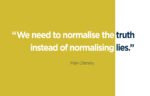
We need to normalise the truth instead of normalising lies. Hanson is trying to make it sound like anti-immigrant and anti-First Nations sentiment is normal and widespread across Australia. We need to tell stories that show this isn’t the case.
If Hanson wants Australians to talk about whether climate change is a hoax, then we should be talking about how Australians are on the cutting edge of the renewables transition – with more solar panels on our rooftops than anywhere else. People don’t just support climate action – they are doing it themselves.
Everything you say should make Hanson and other right-wing populists look out of touch with the reality on the ground.
What populists like to do more than anything is position themselves as politicians of the people, standing up to condescending elites who think they know better than the common folk.
With that in mind, one thing health professionals should absolutely not do, is respond to Hanson’s lies with a barrage of facts. Not only does responding with facts mean we’re not escaping her carefully chosen narrative, but it also makes us look like ‘elites’ talking down to the ‘common folk’.
Again the solution is not to myth bust, but to advance our own narratives. To talk about things that will really make life better for Australians.
Don’t amplify
Adjunct Professor Terry Slevin, CEO of the Public Health Association of Australia
We have taken the view that taking the time to respond to every outrageous statement coming from PHON and its leader, would be only giving her/them more attention than she deserves. Further that it may give greater credence than any of her parliamentary members or policies warrant.
Call it out
Australian College of Nursing
Q: Does the ACN believe it and other health organisations and professionals should speak up to challenge disinformation disseminated by Pauline Hanson and other populist politicians?
ACN believes that any misinformation or falsehood that could harm the health and wellbeing of individuals or communities should be called out publicly. We did it throughout the COVID pandemic.
Q: If so, what is the most effective way of doing this? What NOT to do?
Ensuring the public debate is balanced. Form alliances to add strength to messaging. Harmful misinformation should not be ignored.
Q: What are some of the barriers for health organisations and professionals in speaking up?
There is always concern regarding possible backlash from colleagues, members or health professionals who may not share your concerns or have a different view.
Q: What do you think can be learnt from the recent history of the Trump Administration and how the health sector has engaged with that administration’s impacts upon health, whether in the US or globally?
It is important to call out misinformation where there are dangers to the public health, especially in cases where there is clear evidence. The prime example being vaccination.
Q: In particular, would the ACN like to respond to Pauline Hanson’s statements that:
– climate change is a hoax?
– that Australia is and should be a monocultural society?
– that the National Indigenous Australians Agency should be abolished, together with programs and funding specifically for First Nations people
– that Welcome to Country is divisive?
– that immigrants are responsible for many problems facing Australia?
She also raised concerns about abortions and many other issues affecting the community’s health and wellbeing.
ACN has a strong policy platform on the health impacts of climate change.
ACN, in partnership with CATSINaM and our First Nations nurses, believes that health programs for First Nations people should be delivered in a culturally safe way.
ACN believes Australia is a successful and welcoming multicultural society. Australia relies heavily on overseas-trained health professionals – nurses, doctors, allied health, and other professionals – to complement our workforce to ensure access to care for all Australians.
Q: Pauline Hanson wants to see SBS shut down and the ABC cut right back. What are the public health implications of these proposals?
ACN supports the need for a depth in our media offerings, especially the roles they play in keeping people informed during natural disasters, pandemics, and extreme weather events that affect the health of the population.
Q: How should the media be covering these issues?
In a balanced way. With evidence.
Evidence matters
Statement provided by Australian Medical Association
The AMA will always champion a health care system and workforce that provides all Australians with accessible, high quality, and affordable care. The AMA’s long standing position on climate change is well known and we will continue to champion policies that promote an inclusive society.
Sustainable and effective health care policies that help achieve that should be evidence-based, properly costed and funded, and take into account the impacts, in the short and long-term, they could have on communities across Australia.
Good healthcare is not advanced by misinformation or unqualified advice, and the AMA will continue to give informed, trusted and independent views in the public debate.
ACOSS statement
ACOSS strongly condemns and rejects divisive and harmful rhetoric used by Pauline Hanson in her Press Club speech, which does nothing to address systemic policy failures.
Acting CEO Edwina MacDonald said: “ACOSS proudly celebrates the rich diversity of our community. First Nations peoples, migrants, people of all faiths, and people of diverse genders and sexualities all contribute enormously to the social, cultural and economic fabric of the country.
“People facing cost-of-living pressures deserve real, compassionate solutions, not inflammatory rhetoric designed to invoke fear and fracture our society.
“Political leaders must set a standard of decency and use words that build solidarity, not division.
“Scapegoating and dog-whistling won’t help build affordable homes, improve services or lift people out of poverty, but it will distract from the real work of creating a fairer country for everyone.
“The leadership, cultures and perspectives of Australia’s diverse communities enrich and strengthen us, and help build a more connected, resilient and inclusive society. We encourage all political leaders to reject this rhetoric and pursue conversations that embrace all communities instead of turning people against each other.”
Croakey has also sought comments from the Australian Health Promotion Association, the Royal Australasian College of Physicians and the Royal Australian College of GPs. This post may be updated.
Also read: Why a public health response is needed to address the harms of populism





Add Comment