

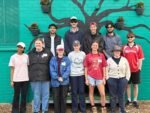


Introduction by Croakey: You can teach medical students about the social determinants of health in a lecture theatre – or you can put them to work in a community garden in a country town, to gain a deeper, more holistic understanding of health.
The latter approach is recommended by Associate Professor Keith McNaught, who is based at Curtin Medical School’s Kalgoorlie campus in Western Australia.
He describes below the benefits for students and communities of ‘Growing Health Together’, a rural placement for third year medical students, and also puts a question about the role of environmental advocacy in clinical training.
“If we’re serious about training doctors who understand nature as a legitimate, evidence-informed therapeutic tool, such as the ‘green prescribing’ approach to healing that’s gaining traction across primary care, then we can’t teach that credibly while ignoring the breakdown of the natural systems we’re asking patients and health professionals to reconnect with,” he writes.
“Planetary health and human health are the same conversation, just at different scales. I don’t think every rural placement needs to be reframed as climate education, but I do think there’s a case for medical schools to quietly build environmental literacy into clinical training.”
Keith McNaught writes:
For a town of 1,000 people, a Shire meeting that draws 50 residents is a big deal. That’s what happened in Brookton, south-east of Perth in Western Australia’s wheatbelt region, when locals gathered in 2019 to talk about turning a disused tennis court into something useful. The idea was simple: a community garden.
What nobody in that room could have predicted was that six years later, third-year medical students from Curtin University would be hauling mulch and building wicking beds alongside them, and that the project would end up teaching me as much about medical education as it has taught our students about rural health.
The Brookton garden’s momentum stalled when COVID-19 arrived but was regained once Curtin Medical School came on board, and the garden became the site for what is now called Growing Health Together, a placement embedded in our Year 3 Community Engagement Program.
Students spend three days and two nights living in a rural town, working shoulder-to-shoulder with volunteers doing unglamorous gardening tasks: shovelling gravel onto paths, building raised beds out of repurposed industrial containers, mulching, and planting.
In 2025 we ran the program in Brookton and Pingelly; this year the program expanded to a third site, Gingin.
It’s not a just “nature appreciation” excursion. It’s structured medical education, with pre-placement readings on therapeutic gardening as social prescribing, the social and nutritional role of community gardens, and Indigenous use of medicinal flora (also see here).
The evidence suggests the program is very effective in engaging medical students to think differently about holistic medicine, and in significantly increasing their awareness of rural life, through the work shadowing, camaraderie and joy of outdoor work in a community setting.
My story

I grew up with parents who were passionate gardeners with no money to spare, and who eventually turned our large one-acre home garden in a rural area, some 30 minutes south of Fremantle, into a commercial nursery.
From them, I learned about plant propagation and grafting, which became passionate hobbies. Much to my wife’s chagrin, this means I can turn up at locations with my trailer loaded with free plants to share. I think it’s safest not to expand on my interest in guerrilla gardening here!
In addition to my work in medical education, I’m an accredited horticulturalist and a registered therapeutic health practitioner. I strongly support the push to have both those industries properly recognised and regulated as professions.
My background in mental health counselling turned out to be just as pivotal to this project: I’ve always craved time in the garden for my own mental health, and I’ve come to see it as a reflective, almost spiritual experience, full of metaphors for grounding, growth, observing, connecting and re-creating.
I’ve spent years watching city-trained doctors arrive in rural practice without much feel for how health is actually lived in small communities.
You can teach the social determinants of health in a lecture theatre, but food access, transport, isolation and thin services land very differently when a student has just walked to the local IGA in a Wheatbelt town and realised how hard it is to buy fresh vegetables.
The garden gives students something to do with a community, a way to be involved and understand more deeply than can achieved by theory or observation. That distinction matters more than I expected when we started.
Student and community perspectives
Ask a student and you’ll get a similar story from each site: an awkward first hour, then the ice starts to break once everyone has a task in hand.
In our published evaluation of the Brookton and Pingelly rotations, one student put it plainly: shared, practical work “gets rid of that barrier quite quickly”.
Others described feeling genuinely welcomed, with one saying the experience made her feel “part of the family”. On the community side, hosts spoke of students as a kind of social catalyst, bringing energy that reconnected volunteers, local kids and each other around the shared task of creating a garden.
Gingin has since joined Brookton and Pingelly as a third site. We haven’t formally evaluated that rotation yet, but the shape of the placement, the intent, and the community and student response is the same: real work, real relationships, real results.
To date, our formal evaluation has concentrated on the students, though we did interview ten community members alongside the 22 students in the Brookton–Pingelly study, and their reflections point toward something worth investigating properly.
Hosts described a sense of renewed engagement around the garden itself, with volunteers, local children and each other drawn back into a shared task. Several remarked that progress which might normally take months was visible within days.
My own observation, offered honestly as anecdote rather than evidence, is that these gardens do function as a quiet form of social prescribing: they give isolated residents a reason to turn up, a task to share, and a conversation that starts from soil rather than symptoms.
Healthy food access is a slower thread to trace, since a wicking bed takes a season to prove itself, but the appetite among host communities for making the partnership recurring suggests they see value beyond the students’ three-day visit.
What I would like to test formally is whether that early social reconnection holds and deepens over subsequent seasons, and whether it measurably improves things such as loneliness, food security or informal support networks in the town. That is the next stage of this work, and one I think matters as much as anything we have learned about the students themselves.
The Brookton-Pingelly study surveyed 22 Year 3 students before placement and interviewed all 22 of them afterwards, alongside ten community members. Most students already leaned toward rural careers going in (20 of 22 said they’d consider Rural Clinical School or rural electives), so this wasn’t a case of converting sceptics.
The immersion sharpened and deepened that interest: students described clearer insight into rural social determinants of health, stronger reflection on professional identity, and, for several, a stated shift toward being open to smaller towns, not just regional centres.
Community members reported visible progress in days rather than months, renewed engagement around the garden, and a clear appetite to make the partnership ongoing.
Keep in mind that the students were a small, self-selected cohort with everyone in the placement ranking it as their first preference. As a result, I view the findings honestly rather than triumphantly. Our students are generous and unpretentious, and taking them on rural programs in genuinely akin to being away with friends.
But the results, for both students and host communities, are consistent and, I think, worth taking seriously.

Doctors as environmental advocates?
I’ll be honest that this project started as a rural health idea, not an environmental one. But it’s become impossible to keep those two spheres of thought separate.
If we’re serious about training doctors who understand nature as a legitimate, evidence-informed therapeutic tool, such as the “green prescribing” approach to healing that’s gaining traction across primary care, then we can’t teach that credibly while ignoring the breakdown of the natural systems we’re asking patients and health professionals to reconnect with.
Planetary health and human health are the same conversation, just at different scales. I don’t think every rural placement needs to be reframed as climate education, but I do think there’s a case for medical schools to quietly build environmental literacy into clinical training.
Croakey readers will know this territory better than most: there’s a lot of good work already published in Croakey’s environmental determinants of health archive.
I’d also point to a piece Croakey ran recently on nature-based therapy for people living with dementia, describing a Tasmanian nature hub project that reminds us that the “nature as medicine” idea isn’t confined to rural GP training; it shows up wherever health systems are willing to look outside the clinic.
Short term, I want the program to keep running, properly co-designed with each host community, with materials and logistics sorted well before students turn up so the benefit doesn’t evaporate the day they leave.
Longer term, we need to track whether the intentions students voice after placement (openness to rural practice and to smaller towns, stronger connection to community) are reflected later, in Rural Clinical School enrolments and internship choices.
Earlier this year I was recognised with the 2026 Australian Institute of Horticulture Award of Excellence for this work. I’m genuinely pleased, but the award means less to me than watching a shy Year 3 student figure out, over a weekend of mulching, that rural medicine might actually be for them.
If you work in medical education and have wondered whether relationship-based placements such as this warrant curriculum space, I encourage you to try it and evaluate it honestly.
Building relationships is a critical skill for health professionals, one that formal teaching can describe but rarely instil, and I have come to see programs of this kind as some of the most valuable time we give our students, not the most dispensable.
If you’re a member of a rural community garden or wellbeing initiative and think a partnership like this might work for you, get in touch – the model travels reasonably well between towns, provided the planning happens early.
We also know community gardens face challenges from time to time, and Brookton’s headquarters (a very old and dilapidated tennis clubroom) is no longer safe to use. Our program can pause for a year, and our next project there is a nature playground.
If you’re a Croakey reader who cares about environmental determinants of health, I’d genuinely welcome your thoughts on how far medical schools should go in building environmental advocacy into clinical training. That’s a conversation I don’t think we’ve had properly yet.
• The author thanks and acknowledges Colette Rhoding for contributions to the article.
Also read
How a community garden is creating something greater than garden beds. Describing her placement at Brookton last year as a third-year medical student, Cassidy Young wrote that “community is the foundation of rural health”.
“Supporting rural healthcare workers means recognising their strength comes from being embedded in a community that values them,” she wrote. “Projects that foster connection, trust and a sense of shared purpose don’t just make people feel good – they build a stronger rural health workforce. This doesn’t start in hospitals, but in gardens, sheds, backyards and over shared meals. These are places where people, and medicine, grow.”
Author details
Keith McNaught is an Associate Professor at Curtin Medical School, where he serves as Director of Primary Care (GP, Rural and Remote) and Director of the Rural Health Multidisciplinary Training program, based on Curtin’s Kalgoorlie campus. His work centres on rural health workforce development and designing place-based programs for rural, regional and remote practice. He regards gardening as a living art, and through initiatives such as Growing Health Together, which places medical students in community gardens across the Western Australian Wheatbelt, he explores therapeutic horticulture as a way to teach future clinicians about patience, shared labour, and the quiet rhythms of care. Keith’s professional background spans education, mathematics and healthcare. A sustainability degree, combined with a Mental Health Counselling degree, saw him embed therapeutic horticulture into his community work and teaching and learning programs.

See Croakey’s archive of articles on the environmental determinants of health





Add Comment