


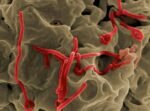


The Ebola outbreak in the Democratic Republic of Congo (DRC) and Uganda is spreading at an alarming rate, highlighting the imperative for global cooperation and solidarity, reports Dr Lesley Russell.
Lesley Russell writes:
Just a week ago I wrote an article for Inside Story on how poorly prepared the world is for the next pandemic, as exemplified by the growing Ebola outbreak in the Democratic Republic of Congo (DRC) and Uganda.
The situation since then has only heightened the extent of the failure to learn the lessons from COVID-19 and previous epidemics, while also highlighting the absolute necessity for global cooperation and the consequences of the withdrawal of the United States from leadership in this area.
The outbreak is spreading at an alarming rate.
A 30 May statement from Médecins Sans Frontières (MSF) sums up the current situation: “Two weeks after the declaration of the Ebola disease outbreak in Ituri province, DRC, the situation is deeply alarming and a legitimate source of anxiety for communities and frontline health workers alike.
“Never before has an Ebola outbreak recorded so many cases so soon after its declaration. Like everyone in the affected areas…[MSF] teams are witnessing a response that has not yet caught up to the rapid spread of the epidemic.”
As of 31 May, DRC is reporting 282 confirmed cases of Ebola and 42 confirmed deaths and Uganda is reporting nine confirmed cases and one confirmed death. But these numbers reflect little about the actual situation, especially that in DRC which has little capacity for testing and reporting.
The Africa Centres for Disease Control and Prevention states there have been more than 1,000 suspected cases of Ebola in DRC since the outbreak was declared on 15 May, including nearly 250 deaths.
There are fears that – in the absence of effective containment measures – the outbreak will spread, not just to neighbouring countries but to those that are a mere plane ride away. To date, it appears that suspected cases in Italy and Brazil have tested negative.
Reports from those with experience of the 2014-2016 Ebola outbreak (see here) and those on the ground (see here) make clear that the withdrawal of so much American assistance has left African governments and independent organisations less able to mount an effective response.
Test kits and protective equipment are very hard to obtain, the front line at hospitals and treatment centres is completely overwhelmed, and there is little understanding or cooperation from patients and relatives about the need for isolation. The outbreak is centred on a mineral-rich region fought over by armed groups, which complicates relief efforts.
In DRC, most cases to date have been in people between 20 and 39 years old, and two-thirds have been in female patients (perhaps because they are carers). This is the 17th outbreak of Ebola in the DRC since 1976; there have been two previous outbreaks of Bundibugyo virus, one in Uganda (in 2007) and one in DRC (in 2012), with death rates of 25 percent and 50 percent respectively.
There is no vaccine for the Bundibugyo strain of the Ebola virus and treatment consists of supportive care. But in DRC the fluids and electrolytes needed, along with medicines to support blood pressure, reduce vomiting and diarrhea, and to manage fever and pain are scarce. That five patients (four nurses and a laboratory worker) have recovered from the disease under these conditions is small reason for optimism.
Uganda has now closed its border with DRC and efforts are underway to mobilise funds to pay for health supplies.
Dr Jean Kaeya, director-general of the Africa CDC, told a virtual press conference that almost US$500 million had been pledged by the centre’s partners to support the fight against the outbreak, although now that figure has fallen to around US$290 million after a number of donors changed their minds.
Kaseya called this Ebola outbreak a “serious test” for the Africa CDC and the African Union.
World Health Organization response
Coinciding with the visit of WHO Director-General Dr Tedros Adhanom Ghebreyesus, the WHO has opened a 42-bed Ebola treatment centre in Bunia, the capital of Ituri province in DRC, in conjunction with local authorities and partners. Once fully operational, this facility will be capable of caring for 65 to 80 patients confirmed or suspected of suffering from Ebola.
The WHO said it had received 4.6 tonnes of aid at the airport in Bunia. UNICEF, the United Nations children’s agency, says it is sending 100 tonnes of aid. These efforts will begin to make a difference, but there is so much more to be done.
Following the Director-General’s visit, the DRC government and WHO released a joint statement reaffirming a shared commitment to protecting populations, strengthening coordination of the response, supporting affected communities, and mobilising national and international partners to bring the outbreak under control and reinforce health security. Read more about the WHO response here.


United States critiqued
In contrast to the response of the Obama Administration to the last major Ebola outbreak – personnel and resources poured into the affected countries, a whole-of-government effort led by a White House Ebola czar with major roles for USAID and THE US CDC, and a leadership role in coordinating the global response – the current US response is described as “winging it”.
An article in The Atlantic (paywalled) states that, by responding independently to this outbreak, the United States is both showing the limits of that approach and proving the case for the WHO and international cooperation.
“Were the US still a member of the WHO, its federal health officials likely would have been able to start responding to the crisis sooner and better positioned to direct resources where they were most needed; were USAID still intact, its officials would have been in Congo, managing the outbreak before it ballooned.”
Instead, American officials did not learn of the outbreak until nine days after the WHO did, and almost a month after the first person died.
The Trump Administration’s primary focus is on keeping Ebola out of the US. Secretary of State Marco Rubio said: “We cannot and will not let any cases of Ebola to enter the United States. The state department and other agencies… are working very, very hard to contain this crisis to the countries where it’s currently located, particularly the Democratic Republic of the Congo.”
“The U.S. cannot allow EBOLA infected people back. People that go to far away places to help out are great – but must suffer the consequences!” Trump wrote in a 2014 tweet.
Apparently, nothing or no-one since has changed his mind (or made him more empathetic about volunteer medical workers).
The Trump Administration will bar immigrants and legal permanent residents who had been in Congo, Uganda or South Sudan in the previous 21 days from entering the United States. The Administration will also keep American citizens who might have been exposed to Ebola out of the country.
To this end, despite the existence of 13 purpose-built facilities around the US, Americans who are exposed to or contract Ebola will not be brought to the United States for monitoring or treatment.
The original plan was for US military to build a field hospital in Kenya at the Laikipia Air Base, to be staffed by US Public Health Service personnel, to bypass the longstanding practice of medical evacuations to specialised American hospitals.
But a Kenyan court has temporarily blocked this plan in the wake of warnings that the arrangement (done in the absence of any consultation with Kenyan officials) posed “grave and imminent risks” to local public health.
Nonetheless, the US Public Health Service Commissioned Corps has announced it is deploying a specialised Ebola response team to Kenya to support this facility.
To date two American missionaries – one exposed to Ebola and the other seriously ill with the infection – have been respectively isolated in the Czech Republic and treated in Germany.
Experts are concerned the Kenya plan will put American lives at risk, trading effective biocontainment, proven clinical and public health standards and world-class care for political ideology.
However, despite these retrograde decisions, the Trump Administration is now providing financial aid and assistance to address the Ebola outbreak.
Announcements in the past two weeks include some US$112 million in bilateral foreign assistance (for PPE procurement and delivery, border screening and surveillance, contact tracing, and diagnostics supplies) and US$50 million to the UN Office for the Coordination of Humanitarian Affairs (OCHA) to fund up to 50 Ebola response clinics in affected areas.
The State Department is also providing US$300 million through OCHA to DRC and Uganda for broader humanitarian efforts in the affected region.


Questions for Australia
For the time being at least, Australia will not follow the US and Canada in imposing entry restrictions on travellers from Ebola-hit areas.
“Australia sets its border measures based on Australia’s circumstances,” a spokesperson for the Department of Health, Disability and Ageing told SBS.
The Government has said it is rolling out public health signage about the virus at airports alongside the usual surveillance measures. But will that be sufficient?
A lot of reliance seems to be placed on the fact that no cases of Ebola have ever been detected in Australia.
Then we read of “relief as Australia survives its first potential Ebola scare”: a man, who had recently travelled in the area of DRC and Uganda, presented to the emergency department of a Melbourne hospital with symptoms consistent with Ebola. He was apparently quickly isolated and then tested negative.
But what if he had presented to a general practice or an urgent care clinic? And what if he had tested positive? There is a Biocontainment Centre within the Westmead Health Precinct in NSW but I am not aware of any other clinical facility in Australia.
Australia has emergency response management plans for communicable diseases, but these do not specifically include Ebola and have not been updated since 2022. There is guidance for managing departing and returning aid workers, dated December 2018. Again, Ebola is not specifically mentioned, although it is covered as a viral haemorrhagic fever.
My Google searching indicates that Australian-based NGOs are fund-raising to provide support for Ebola-affected areas, but I have no indication of specific aid projects or additional funding provided by the Australian Government.
Treatment and vaccines
In the absence of current treatments and vaccines for Ebola disease caused by the Bundibugyo virus variant, there has been a considerable focus on possible preventive and therapeutic candidates.
The WHO has taken a lead on this work, convening a series of meetings with the WHO R&D Blueprint technical advisory group and the Strategic Advisory Group of Experts on Immunization (SAGE) and its Ebola vaccine working group.
These experts have released guidance on what drugs and vaccines should be tested for efficacy (their detailed advice is here) but many of the therapeutics are monoclonal antibodies and therefore unlikely to be readily affordable and available in developing countries.
The Coalition for Epidemic Preparedness Innovations (CEPI) has announced it is providing three entities with some US$62 million in funding to help manufacture and test candidate Bundibugyo vaccines.
This includes US$50 million to support development and initial clinical testing of Moderna’s mRNA vaccine candidate, up to US$8.6 million to fund preclinical testing and other development activities to rapidly prepare for Phase 1 trials of an Ebola vaccine developed by the University of Oxford and manufactured by the Serum Institute of India, and up to US$3.2 million for preparations necessary to generate the starting material for a vaccine from the International AIDS Vaccine Initiative (IAVI).
The IAVI candidate uses the same technology as Merck’s vaccine Ervebo, which is already approved for the Zaire strain of Ebola that caused the massive 2013 epidemic in West Africa. There has been some interest in trying to determine whether this vaccine would offer some cross-protection, but WHO said it should not be used outside carefully designed clinical trials.
See also this article from the US National Academies of Sciences, Engineering and Medicine on proven treatments for other strains of the Ebola virus.
Damning verdict
Médecins Sans Frontières sums the current situation up this way: “To bring the situation under even partial control, there must be an immediate expansion of testing capacity.
“This must be accompanied by a rapid, coordinated and tailored scale-up of the overall response, supported by experienced medical and humanitarian organisations, alongside guaranteed and sustained access for the swift entry of medical supplies and humanitarian staff into affected areas.
“This outbreak is unfolding in a context where medical needs are already acute, and we are now at real risk of a silent escalation of other critical health problems people face every day. So many health facilities are overwhelmed, and access to regular, non-Ebola care is affected while many people remain at home, too afraid to seek care.”
In a recent comment in The Lancet, Jan Engeland of the Norwegian Refugee Council, addresses the broader issues, calling for “a much-needed reboot in international solidarity” to address humanitarian crises.
“I have never seen such a gap between documented acute need for medical and other humanitarian assistance, and global solidarity to meet those needs.
“In decades of humanitarian crises, this gap has never been so vast. To be blunt: tens of millions of people are today left on their own, meeting their hour of deepest need with nowhere to turn.
“Millions of people do not have real international or local assistance, and receive only what their communities and extended families can muster between themselves. This is a stark and damning verdict on our so-called international community.”
PostScript (on 5 June): Since this article was published, the DRC, WHO and others reporting on Ebola have revised case numbers based on positive testing results. Reports from the region suggest that testing capacity is still lagging well behind local needs. Dr Lesley Russell will dig into some of the complexities involved in The Health Wrap next week.

• Dr Lesley Russell is a health policy analyst and author of a regular Croakey column, The Health Wrap. Follow on X at @LRussellWolpe.
Further reading


See Croakey’s archive of articles on Ebola and infectious diseases






Add Comment