


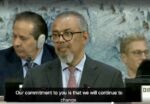


In his opening remarks to the 79th World Health Assembly – held in Geneva from 18-23 May – Director-General Dr Tedros Adhanom Ghebreyesus said that “from conflicts to economic crises to climate change and aid cuts, we live in difficult, dangerous and divisive times”.
Health workforce inequities, chronic conditions, and efforts to strengthen the emergency preparedness of primary healthcare were just some of the other issues on the #WHA79 agenda, reports Jason Staines.
Jason Staines writes:
The 79th World Health Assembly (WHA79) convened in Geneva under the theme “Reshaping global health: a shared responsibility”, but the meeting unfolded against a backdrop of mounting pressure on the global health system itself.
Delegates gathered amid escalating conflict, shrinking aid budgets and wider concerns about the Trump Administration’s impacts upon global health, outbreaks of Ebola and other infectious diseases, growing concern about the health impacts of climate change, and debates over how artificial intelligence should be governed in healthcare settings.
At the same time, the World Health Organization (WHO) and the wider multilateral health system are confronting severe financial strain. WHO’s Health Emergencies Programme faced a reported funding gap of more than US$550 million across 2024 and 2025, while the organisation’s contingency fund for emergencies entered 2026 with only US$19.5 million available.
Meanwhile, WHO officials warned that outbreaks are accelerating while the systems designed to respond to them are being weakened.
Alongside the formal adoption of more than 20 decisions and 13 resolutions, governments, advocacy groups, health organisations and professional bodies used the Assembly to push competing priorities around health financing, ethical workforce recruitment, climate-linked disease, non-communicable diseases (NCDs), digital governance and humanitarian protection.
Below is a selection of key themes, debates and resources emerging from WHA79.
WHO funding crisis and global health governance reform
A major theme running through WHA79 was the future of the global health architecture itself. The Assembly adopted a new Global Health Architecture Reform initiative intended to improve coordination between WHO, UN agencies, global health partnerships and financing institutions.
However, the process drew criticism from some governments and civil society groups, who argued the reform agenda lacked ambition and avoided structural questions around duplication, competition and power. Civil society groups also criticised their exclusion from the central taskforce overseeing the process.
Several Global South countries warned that “streamlining” must not weaken WHO’s country-level presence or reduce support for lower-income countries already dealing with aid cuts and health system strain. Pakistan warned delegates that “lean must not become synonymous with less”.
The broader funding crisis also hung heavily over discussions. Reports presented during the Assembly highlighted dramatic declines in international health assistance from major donors, alongside rising humanitarian and outbreak response needs.
Further reading and resources
- WHO Global Health Architecture Reform initiative
- Global Climate and Health Alliance concerns about climate exclusion from reform discussions
- WHO discussions on the “economics of health for all”
- Health Policy Watch analysis of the reform process
Ebola, outbreaks and emergency preparedness
Infectious disease outbreaks remained central to the Assembly agenda, with WHO officials discussing outbreaks including Ebola in the Democratic Republic of the Congo (DRC), mpox, cholera, Marburg virus disease and Rift Valley fever.
WHO Director-General Dr Tedros Adhanom Ghebreyesus provided a direct message to communities in Ituri province in the DRC, where the latest Ebola outbreak is concentrated. He said the outbreak involves the Bundibugyo strain of Ebola, for which there are currently no approved vaccines or treatments.
He also issued a direct appeal for ceasefires to allow health workers and humanitarian teams safe access to affected communities.
Preparedness and primary healthcare integration featured strongly throughout WHA79. The WHO and partners launched a new Emergency-Ready Primary Health Care Framework designed to embed outbreak preparedness and emergency response capacity into routine healthcare systems.
The role of artificial intelligence in epidemic intelligence and outbreak detection also emerged as an important theme during preparedness discussions.
Further reading and resources
- Tedros’ message to communities in the DRC
- WHO discussions marking 10 years of the Health Emergencies Programme
- Emergency-Ready Primary Health Care Framework and Operational Guide
- WHO outbreak updates on Ebola, mpox and cholera

Conflict, attacks on healthcare and humanitarian protection
The WHO reported verifying more than 1,300 attacks on healthcare globally last year, with hundreds of health facilities damaged or destroyed. Officials warned that attacks on healthcare workers and facilities are undermining outbreak responses and humanitarian operations, particularly in conflict-affected regions.
Australia used the Assembly to support stronger protections for humanitarian and health personnel. Australia’s Ambassador for Global Health highlighted the Declaration for the Protection of Humanitarian Personnel, while Ambassador Clare Walsh said Australia had backed WHO efforts in conflict zones and called for the protection of humanitarian workers.
WHO officials also warned that conflict, displacement and climate shocks are increasingly colliding into what one regional official described as an expanding “polycrisis”.
Further reading and resources
- WHO reports on attacks on healthcare
- Australian statements on protection of humanitarian personnel (and here)
- WHO discussions on emergencies in Lebanon, Ukraine and the occupied Palestinian territory
- WHO Health Emergencies Programme materials
Climate and health
Climate change was repeatedly framed during WHA79 as a growing public health emergency. Discussions linked climate change to respiratory disease, infectious disease spread, heat-related illness, food insecurity, mental health impacts and pressure on already fragile health systems.
At a Geneva Health Forum event alongside the Assembly, experts described how longer pollen seasons, worsening air pollution and extreme heat are contributing to respiratory illness and severe asthma events. One expert described the cost of climate change as being “paid by our lungs”.
The Pan-European Commission on Climate and Health called for climate change to be treated as a public health emergency of international concern. The Global Climate and Health Alliance argued that climate and health are “inseparable in practice and should so be in policy”, while criticising the limited integration of climate considerations into some WHA reform discussions.
Climate-related health concerns also intersected with broader debates around fossil fuels, urban planning, air quality and adaptation financing.
Further reading and resources
- The Lancet report from the Pan-European Commission on Climate and Health
- Global Climate and Health Alliance statements
- Geneva Health Forum discussions on respiratory disease and climate
AI, digital health and precision medicine
The WHO Director-General said the future of health is increasingly digital, but stressed the need for safeguards to “keep humans in the loop”, protect vulnerable populations and maintain equity.
Several WHA resolutions incorporated AI-related governance concerns, including discussions on pharmacovigilance, teleradiology and precision medicine.
A new pharmacovigilance resolution aims to modernise global medicine and vaccine safety surveillance systems using AI and real-world data, while also addressing misinformation and public trust concerns.
Teleradiology discussions focused on expanding access to specialist diagnostic expertise through digital systems, particularly for lower-income or conflict-affected countries.
Delegates also adopted a landmark resolution on precision medicine, while warning that genomic datasets and advanced medical technologies risk reinforcing inequities if low- and middle-income populations remain underrepresented.
Further reading and resources
- WHO discussions on AI and digital health governance (and here)
- WHA resolutions on precision medicine and pharmacovigilance
- Teleradiology discussions and digital diagnostics initiatives
- WHO materials on equitable access to precision medicine

Workforce shortages and ethical recruitment
WHA79 updated the WHO Global Code of Practice on the International Recruitment of Health Personnel for the first time in 16 years, with lower-income countries and health professional groups warning that wealthy countries continue to rely heavily on recruiting health workers trained elsewhere, often weakening already fragile health systems in source countries.
The updated code expands protections to include care workers and applies ethical recruitment principles during emergencies and humanitarian crises.
The World Health Professions Alliance argued that voluntary measures are no longer sufficient and urged high-income countries to make targeted co-investments in the health workforce systems of source countries.
Several countries raised concerns about aggressive recruitment of nurses, doctors and allied health workers from countries already facing workforce shortages. The issue has particular relevance for countries such as Australia, which rely heavily on internationally trained health workers.
Further reading and resources
- WHO Global Code of Practice update
- WHPA statement on ethical recruitment
- WHO workforce shortage projections
- Country statements from Jamaica, Eswatini and other countries
Non-communicable diseases and ageing
WHA79 also expanded discussions around NCDs and ageing. Member states adopted the first-ever WHA resolution dedicated specifically to stroke, recognising the growing burden of stroke globally and the major inequities in access to prevention, acute care and rehabilitation.
The Assembly also formally recognised steatotic liver disease (formerly known as fatty liver disease) as a major NCD challenge linked to obesity and diabetes.
Discussions around ageing highlighted concerns that policy responses are not keeping pace with demographic change and the growing overlap between ageing and chronic disease.
Mental health and social media harms also featured prominently. Several countries called for stronger WHO guidance around the impacts of social media on mental health, particularly among young people.
Delegates also discussed suicide prevention, commercial determinants of health and “health taxes” targeting tobacco, alcohol and other harmful products.
Further reading and resources
- WHA resolution on stroke
- International Federation on Ageing report on ageing and NCDs
- WHO discussions on social media and mental health
- International Diabetes Federation materials from WHA79
- WHO discussions on steatotic liver disease


From resolutions to reality
Despite the breadth of issues discussed at WHA79, a recurring theme throughout the Assembly was the widening gap between ambition and available resources.
Delegates adopted technically ambitious resolutions covering outbreak preparedness, stroke care, workforce ethics, precision medicine, emergency care and digital governance.
But many observers warned that implementation will depend on political will, sustained financing and stronger international cooperation at a time when aid budgets are shrinking and geopolitical tensions are rising.
In his closing remarks, Tedros reminded delegates that “every resolution you adopt … only has value when it changes what happens in a clinic, in a community, or in a household”.
More from social media


See this joint statement by the British Office Taipei, the Australian Office Taipei, the Canadian Trade Office in Taipei, the French Office in Taipei, the German Institute Taipei, the Japan-Taiwan Exchange Association, the Lithuanian Trade Representative Office, the New Zealand Commerce and Industry Office and the Polish Office in Taipei, reaffirming support for Taiwan’s meaningful participation in the work of the World Health Organization and Taiwan’s participation as an observer in the World Health Assembly.
The statement says: “As this year’s 79th session of the World Health Assembly commences in Geneva, Taiwan remains largely excluded from the world’s international health system. Infectious diseases and health hazards do not respect borders. Global cooperation is required to keep the whole world safe. Taiwan is a highly capable, engaged, and responsible member of the global health community and was invited to participate as an observer in WHA meetings from 2009 to 2016.
“Taiwan’s distinct capabilities and methods – including its significant public health expertise, democratic governance, and advanced technology – bring considerable value that would inform the WHA’s deliberations. Taiwan’s isolation from the WHA, the preeminent global health forum, is entirely unjustified. This undermines inclusive global public health cooperation and security, which the world demands, and which is enshrined in the founding documents of the WHO.
“Taiwan’s meaningful participation in the fora and technical committees of the World Health Organization would bring benefits not just to people in Taiwan, but also around the world.”


See Croakey’s archive of articles on the Trump Administration’s impacts on health, and on the WHO






Add Comment