





Introduction: As Professor Bronwyn Fredericks engaged recently with an art installation titled Cell Culture, she was reminded that the questions and concerns that people had about Dolly the sheep more than 20 years ago are echoed in contemporary debates about artificial intelligence and other technological developments.
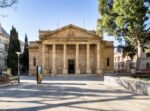
The installation is currently on display at the Art Gallery of South Australia, on Kaurna Country.
Bronwyn Fredericks writes:
Fiona Hall has transformed a series of old storage containers, mostly older styles of Tupperware that can be found in a grandparent’s or parent’s cupboards or second-hand shops, into an art installation titled Cell Culture.
Produced in 2002 for the Adelaide Biennial, the installation is exhibited in a large glass cabinet that’s almost two metres in length in the Art Gallery of South Australia.
The installation is a series of smaller pieces made of white plastic storage containers, glass beads, plastic, and wood. Some of the pieces within the body of work look like a plant, animal or fictional creature – for example, those in images 1 and 2 below.

I overheard a child say to the adult with them that one of the pieces (image 1) looked like “a jellyfish”. It was made from a moulded container that may have been used for jelly or a mousse in the past.
Other containers in the work may be associated with storage of food and items found in the everyday. For example, I have an old Tupperware container I use for odd nails, screws, bolts and bits used in hanging paintings. Hall creatively reimagines these everyday items and adds other mediums to explore scientific debates.
The individual art pieces are clever and collectively the work reflects creativity, and an intersection of science, culture and art. They also have a sense of fun.
I can only imagine the fun and excitement that Fiona Hall may have had in imagining and manipulating the materials into fabricated forms. She has brought together the sturdiness of white plastic containers with tiny white beads and add carefully crafted additions, like the long, delicate, beaded tentacles on the jellyfish, and other containers. See images 3 and 4 below for further examples of the delicate beading on the plastic containers.
The once sturdy containers used for storage can no longer be used in this way or treated in the same way. One cannot simply drop these containers in a draw anymore, or use them for storing foods, or other items.
Via a form of bricolage, the artist beings together knowledge, materials, and technology, and weaves in visual interest.

In these works, Hall challenges the use of art galleries and museums; by transforming everyday items into artistic forms and installing them in a place which generally hosts and exhibits works regarded as special, precious, scientific objects or artistically brilliant.
This also challenges our assumptions of what can be exhibited in such places, and how they are exhibited and therefore challenges the authority often imbued within such places. Some viewers of the work may question whether it really is art, if it belongs in the gallery or not, and whether it is a joke or not. I love this about it.
The work was produced during a decade when questions were being raised around biotechnology, and social and genetic engineering. Who can forget all the questions around genetically modified foods, and genetically modified cattle and sheep, including Dolly the sheep, who was cloned from an adult somatic cell in 1996.
The questions and worries people had then still surface today in some of the questions posed in the literature and media about artificial intelligence, cloning, social and or genetic engineering, and biological experimentation. It is obvious that people still have ethical concerns about the field, which haven’t been answered.
Hall doesn’t address these via Cell Culture, rather she invites the viewer to think about the issues for themselves, as I did. The work is still visually engaging some 24 years later, and its ability to challenge us to consider what is real or could be real.
• Cell Culture is at the Art Gallery of South Australia (AGSA) in North Terrace, Adelaide, South Australia. Check the AGSA website for their opening hours. Bronwyn Fredericks visited the exhibition in June 2026.

Author details
Professor Bronwyn Fredericks is an Indigenous woman from South-East Queensland and Deputy Vice-Chancellor (Indigenous Engagement) at the University of Queensland. Her research focuses on health and education, grounded in the lived realities of Indigenous peoples and driven by a commitment to social justice. Previously, she served as a Commissioner with the Queensland Productivity Commission, and is a Fellow of both the Academy of the Social Sciences in Australia and the Australian Academy of the Humanities. She is Chair of Croakey Health Media.
Previously at Croakey
- After the Rain: an incredible experience and creative achievement
- Artistic interrogations of artificial intelligence highlight environmental health impacts
- When digital archiving fails: the art of technological obsolescence
See Croakey’s archive of articles on the arts and health






Add Comment