

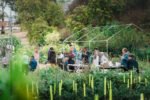


The power of nature to improve wellbeing for people with dementia is being explored as part of a collaborative research project in lutruwita/Tasmania, report Georgia McGrath and Dr Pauline Marsh from the Venture Out Living Lab at the Wicking Dementia Research and Education Centre.
“With around 425,000 people currently living with dementia in Australia (with numbers steadily increasing), nature connection offers all individuals an opportunity for improved quality of life and participation in meaningful and enjoyable activities,” they write.
This article is published as part of Croakey’s Primary Healthcare: Community matters (#PHCmatters) initiative, which puts a focus on strengths-based stories from communities.
Georgia McGrath and Pauline Marsh write:
People with dementia and those who support them are connecting with nature in southern lutruwita/Tasmania as part of a Living Lab research project that aims to improve wellbeing and quality of life.
Located in a variety of community green spaces, ‘Nature Hubs’ are outdoor environments where people can connect with nature and each other.
Three pilot Nature Hubs are offering both structured and unstructured activities to help people connect to nature, with the aim of increasing wellbeing, quality of life and reducing social isolation.
One Nature Hub has regular nature-based art activities whilst another has self-guided dementia-friendly walking trails. All Hubs aims to be dementia-inclusive; for example, with wayfinding signage, seating, sensory prompts to touch and smell different plants or opportunities to sit quietly and listen and observe nature.
The Derwent Valley Nature Hub, at the Derwent Valley Community Gardens in New Norfolk, about a half-hour drive north-west from nipaluna/Hobart, is one of the pilot sites.
Here the garden is always open to the public, so people with dementia and care-partners can access the space at any time.
In our project we use a term suggested by Dementia Australia, ‘care-partners’, to refer to those who support people living with dementia either informally or in formal roles. We prefer this term over ‘carers’ because it suggests a more reciprocal relationship, and affords people more dignity and autonomy.
Having access to familiar spaces can help to ensure people with dementia know what to expect and feel comfortable navigating and enjoying the space.
The Hub has hosted a guided nature-based program as well as one-off gatherings bringing people together for morning tea and activities.
One care-partner who attended regularly with her mother told us: “It’s nice to have a place where she’ll jump out of the car, and she’ll want to be in that space, that’s really important. And I love that I can come through it … I love that connection with nature.
“When you’re caring for someone, you do become a bit insular, and it gives me an opportunity as a carer as well to communicate with other people and get a bit of social interaction as well. It’s very good for my health as well as hers.”

Community of practice
Researching the impacts of nature participation has been a key focus of the Venture Out Living Lab at the Wicking Dementia Research and Education Centre in Tasmania.
The Venture Out Living Lab was formed in 2023 by a team of dementia studies researchers and passionate community members and advocates who knew that people with dementia who connected with nature felt calm, confident and happier.
They also knew that more inclusive outdoor spaces were needed. This led to formation of a Consumer Advisory Group and a 70-plus member Community of Practice who collaboratively developed the Nature Hub model of engagement.
The Community of Practice includes members from local councils, neighbourhood houses, nature-based organisations, dementia support organisations and advocacy groups. This collective supports nature and outdoor space providers to create bespoke enabling environments.
Guided by principles of dementia-inclusivity, the Nature Hub sites undergo dementia-inclusive training, site assessment and modification, and support from the research team to develop plans to foster nature connections for people with dementia and their care-partners.
Dementia-inclusivity is based on five Nature Hub principles: dignity and choice, familiarity and culture, accessibility and safety, flexibility and adaptability, and rest and stimulation balance.
This helps transform spaces into places where people can engage safely and independently, reducing risks and addressing barriers such as stigma and misinformation.

Nature matters
People living with dementia can often become increasingly isolated from others, as well as the natural environment. Outdoor and natural spaces that were once important in a person’s life can become increasingly more difficult to get to, but increasingly more important.
As one care-partner whose parent has dementia told us: “She had a very active life, a lot of horses and horse riding and snake handling, lots of animals and outdoor spaces. And to have her stuck indoors, I think it would be equivalent to torture.”
Whilst many people can experience barriers to accessing nature, people with dementia can face additional barriers due to cognitive changes, dementia stigma, fears of embarrassment, and overprotection from care-partners, albeit well-intentioned.
This leads to a more interior life, where people living with dementia, and care-partners, can become increasingly isolated and restricted, which impacts negatively on quality of life.
The flow on effects includes poorer physical and mental health, which leads to preventable hospitalisations and hastens entry into aged care.
Research suggests connecting with nature can change this situation for people living with dementia. Benefits include improved physical, psychological, emotional, spiritual and cognitive wellbeing. Moreover, being in nature can increase focus and concentration, reduce cognitive load and stress levels, and lead to greater social connections and life satisfaction.
We acknowledge that First Nations people have long communicated the importance of connection with nature and Country for health and social and emotional wellbeing, and that non-Indigenous Australians have much to learn from Indigenous people about nature, health and wellbeing.
Colleagues at the Wicking Centre are part of a First Nations-led project that promotes Elder-led cultural storytelling to guide care for Aboriginal people with dementia in residential communities. As these researchers note, storytelling is a powerful, compelling and authentic way for non-Indigenous staff to learn new ways of thinking about care.
We recognise there is potential to work closely with First Nations communities and colleagues to learn more about nature and health and to adapt the Nature Hub model to the needs of all people.

Dignity of risk
The latest national health report card released by the Australian Institute of Health and Welfare, Australia’s health 2026, reports that dementia is now the most common cause of death in Australia.
With around 425,000 people currently living with dementia in Australia (with numbers steadily increasing), nature connection offers all individuals an opportunity for improved quality of life and participation in meaningful and enjoyable activities.
In the last few years, key changes in aged care policy and practice (see, for example, here and here) have foregrounded the importance of choice and risk for older people. This includes ensuring older people have the independence to live the life they choose, and to support them to take positive risks that help achieve this.
The concept of the Dignity of Risk is embedded into practice changes, highlighting the importance of providing opportunities for positive risk taking – including the risks associated with opening doors and enabling people to venture out.
Through research, partnerships and co-design work within communities, the Venture Out Living Lab will continue to build and grow the Nature Hub model and adapt it to meet diverse needs and interests of people.
The Living Lab will continue to source funding for research and work with partner organisations to expand the model as an effective, adaptable way of improving the health, wellbeing and quality of life of people living with dementia and their care-partners.
The Venture Out team is undertaking a focussed ethnographic, longitudinal research study to better understand the impacts of nature connection, and to inform how we can create sustainable, community-led approaches to reverse isolation and disconnection.
By doing so, the Living Lab hopes to continue advocating for increased opportunities and support for nature connection, alongside early diagnosis of dementia, and community-led reduction of stigma and other barriers, to help to improve quality of life and longer-term wellbeing outcomes for people with dementia.

• To learn more about Nature Hubs and the Venture Out Living Lab, see https://ventureout.dementia.utas.edu.au/ and watch our videos https://www.youtube.com/@VentureOutNatureHubs
Author details
Georgia McGrath is a Research Assistant with the Venture Out Living Lab at the Wicking Dementia Research and Education Centre. She has broad experience across public health, including within evaluation, health promotion and physical activity research.
Dr Pauline Marsh is an interdisciplinary health geographer, who explores innovative, community and nature-based solutions to improving wellbeing and quality of life. She co-leads the Venture Out Living Lab, and the Nature Connection Storytelling Project.
See Croakey’s archive of articles on the environmental determinants of health





Add Comment