





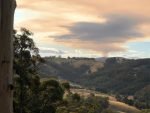

As we approach summer, our thoughts increasingly turn to preparation for bushfires – and experts say this should include measures to reduce the risks from exposure to bushfire smoke.
Below Dr Dwan Vilcins and Dr Adèlle Liebenberg bust some common myths about bushfire smoke, in advice that is especially relevant for firefighters.
Dwan Vilcins and Adèlle Liebenberg write:
Australians are no strangers to bushfires. The smell of smoke drifting through an open window. Hazy skies. Ash settling on the car, on the barbecue and everywhere in between. The distant, and sometimes not so distant, sound of sirens.
When the smoke arrives, most of us instinctively close the windows, postpone our afternoon run, or dig out our P2 masks left over from either COVID or the previous bushfire season.
But here is the problem: when it comes to bushfire smoke, our senses (eyes, ears, noses), are not particularly great at detecting exposure.
Smoke is much more than just a grey-brown-black cloud we can see hanging in the air. It is a complex, evolving mixture of particles, gases and vapours. Some we can smell. Some irritate our eyes and throats. And others give us very little warning at all of their presence.
And the mask you are wearing? It may be very good at filtering out one part of that mixture, whilst doing nothing about the other.
As researchers working in occupational and public health, we spend a lot of time thinking about: what are people exposed to, how much of it are they breathing in, what damage is it causing to their health, and what can we realistically do to reduce their exposure?
These questions matter enormously for firefighters, who face repeated exposure across their working lives. However, as another bushfire season approaches, exposure to bushfire smoke becomes a matter of importance for the rest of us too.
During the Black Summer bushfires, smoke from the fires was estimated to have contributed to around 430 deaths. This highlights the far-reaching consequences of smoke events.
Bushfire smoke is more than what we can see. Protecting ourselves means understanding what is in the air, how it affects our lungs, what our respirators can and can’t do, and how we can reduce the amount we breathe in.
Common misconceptions
Here are a few common misconceptions about bushfire smoke, and how to deal with it.
Misconception 1: If I can’t see or smell any smoke, the danger has passed.
Bushfire smoke is more complicated than it looks. The smoke is not made purely of different sized particles resulting from the fire and incomplete combustion; rather it is a complex combination of particulate matter, gases and vapours, and the composition depends on the nature of and the habitat that is burning.
Some of the constituents found within bushfire smoke are quite toxic, some are odourless and most are not visible to the naked eye. And whilst our senses are useful warning systems, they are not great as air-quality monitors.
The term most of us are familiar with is PM 2.5. But what does this mean?
The term refers to particulate matter, particles with a diameter of 2.5 micrometres or less, which can be inhaled and reach deep into the smallest part of the lungs such as the bronchi and alveoli, bypassing your body’s natural defence mechanisms against larger inhalable particulates that can easily be removed through sneezing or coughing.
In these regions of the lung, the particulates cause local irritation and inflammation, and this is when many people develop respiratory distress such as asthma and difficulty breathing. PM2.5 makes up approximately 90 percent of the total particulate mass generated during bushfire smoke.
These particulates are extremely small and lightweight, usually highly toxic, invisible and can drift for hundreds of kilometres in the air and remain suspended for an extended period of time (up to weeks). They also settle onto surfaces and become house dust, allowing these toxic particles to persist in homes for long periods.
Firefighters are usually up close and personal to the fires, and subsequently have repeated exposures to bush fire smoke, whether through wildfires or through preventative burns.
How much, how often and for how long you are exposed to these airborne contaminants makes all the difference between good health, a trip to the emergency room, and possibly long-term, debilitating health issues.
You can monitor air quality during smoke events by using apps such as AirRater or on the website of your State Government’s air quality monitoring network. While these are not perfect, as they can often be located some distance from your home, they can alert you to start enacting your smoke plan.
What you can see and smell is only part of the story, and the mask you reach for may only protect you from part of the smoke but not all of it.
Use the AirRater app
Misconception 2: I’m wearing a mask; I’ll be protected.
Firstly, all masks are not equal! A surgical mask or a cloth mask will not filter out all the hazardous airborne contaminants from the air you breathe.
The correct type of protection for use during bushfire events are called “respirators”. For it to be efficient in protecting your lungs, the quality, fit and sizing are critical.
An appropriately fitted P2/N95 respirator can substantially reduce exposure to hazardous particles. It does not protect against gases commonly found in bushfire smoke such as carbon dioxide, carbon monoxide, formaldehyde, polycyclic aromatic hydrocarbons (PAHs) and hydrogen cyanide.
Furthermore, poor fit dramatically compromises a respirators’ performance. Australian public health advice recommends that P2/N95 respirators should be used when smoke exposure cannot be avoided, rather than surgical or cloth masks.
If you find yourself reaching for a P2/P95 mask, here are a few things to check before you put it on:
Choose a reputable P2/N95 that has been approved for use in Australia. These undergo significant quality testing to ensure they filter out the appropriate particulate matter.
Follow the manufacturers’ advice on how to wear and dispose of the respirator.
Prior to use, inspect the respirator for damage and puncture marks. Don’t use it if it is damaged.
When donning the respirator (putting it on), make sure it seals tightly around your nose and face. If you have a beard or wear thick layers of make-up, this can prevent an adequate seal between your face and the mask, reducing the efficiency of the mask and increasing the risk of exposure.
Remember that a P2/N95 respirator is not a “one-size fits all” solution, as peoples’ faces have different shapes and sizes.
These respirators also don’t make smoky areas “safe”. The first line of defence is still to reduce the time you spend in smoke, and to keep your indoor air as clean as possible by keeping the doors and windows shut.
It is not recommended that children below the age of two years wear face masks. For slightly older children you should monitor your child for safety and use them for very short periods. If your child has existing heart or lung conditions, consult with their doctor before using a mask.
Close windows and doors. Photo by Nicolas Solerieu, Unsplash.
Misconception 3: The fire has been extinguished; the risk of exposure is over!
Ash, soot and residues will settle after a while. Contamination from bushfire smoke can end up on clothing, boots, equipment, vehicles and surfaces.
NSW Health specifically advises people returning to fire-damaged properties to use protective clothing and P2/N95 respirators, avoid unnecessarily disturbing ash, bag protective clothing after use, clean footwear and wash their hands (NSW Government).
The same applies to firefighters. Smoke and soot can travel with them on their protective clothing, equipment and vehicles. That is why decontamination matters.
Whilst firefighter agencies have procedures and processes in place to decontaminate their gear, for the public the best protection is usually avoiding the smoke in the first place. Additional steps you can take are:
Keep an eye out for air quality measures, and reduce outdoor activities when conditions are poor.
Keep indoor air clean by using recirculated air or HEPA filtration where appropriate, and wear a properly fitting P2/N95 respirator where exposure to bushfire smoke cannot be avoided.
Try to avoid indoor activities that generate air pollutants. Avoid smoking, incense burning, and long periods of cooking. Make sure you use an extractor fan while cooking on the stove top.
Thoroughly clean the dust from your home after a smoke event. Use a wet cloth to dust surfaces and vacuum and mop floors. Ask your family to remove their shoes at the door to avoid tracking in fallen ash.
Mopping helps. Photo by Masjid Maba
Make a smoke plan
Bushfire smoke is more than what we can see. Protecting ourselves means understanding what is in the air, how it affects our lungs, what our respirators can and can’t do, and how we can reduce the amount we breathe in.
It is worth taking the time to develop a smoke plan, especially if you have chronic health conditions or live in a bushfire prone area.
The best way to protect your lungs isn’t to find a respirator to allow you to remain in the smoke for longer. It is to breathe as little smoke as you reasonably can. For most of us, this means going indoors and possibly changing our schedule for the day.
Firefighters don’t have that option. Their job requires them to race towards the smoke and the flames when the rest of us are trying to escape. So next time you see a firefighter, take a minute to thank them for their service.
Author details
Dr Adèlle Liebenberg is a Senior Lecturer in Occupational Health and Safety and Academic Program Director for Occupational Hygiene at the University of Wollongong. A Certified Occupational Hygienist and Fellow of the AIOH, her research focuses on occupational exposures, firefighter health and the prevention of work-related disease.
Dr Dwan Vilcins is an environmental epidemiologist and Research Fellow at the University of Queensland, where she leads the Environmental Epidemiology Research Group. Her research focuses on air pollution, bushfire smoke exposure and the associated health impacts, particularly among children and vulnerable populations.
See Croakey’s archive of articles on the climate crisis; and on bushfires






Add Comment