




Introduction by Croakey: How do we rebuild our relationships with place, Country, the planet and one another?
This question, so central to our health, is at the heart of a new book, The Psychology of Place: Rebuilding Sense of Place in a Post-Colonial World, which brings together 40 contributors across countries, disciplines and knowledge traditions to explore what a sense of place means across different worldviews.
Dr Iain Butterworth, who is trained in community psychology and has worked in population health since the early 1990s, is editor and lead author of the book, and shares some of its backstory below.
Croakey readers also have the opportunity to participate in workshops with Butterworth and several of the book’s authors at the upcoming 11th Global Conference of the Alliance for Healthy Cities, to be held at the UNSW Kensington campus, on the lands of the Bedegal people, from 1-3 September.
Readers are also invited to participate in a #CroakeyGO, walking journalism with a place-based focus as part of the conference program, whose theme is ‘Healthy Cities for All: Equity, Innovation and Action’.
Iain Butterworth writes:
Around the world in 2026, fires, floods, storms and heatwaves have hit continents, oceans and arctic regions with an unprecedented intensity. Yet amid growing alarm about climate change, one of its most profound consequences remains largely overlooked: the disruption of our psychological relationships with the places (and the planet) we call home.
In November 1988, I went to my first climate change conference, and also possibly Australia’s. I was a 25-year-old undergraduate student of environmental and community psychology, based at Curtin University in Perth.
The conference series was called ‘Greenhouse ’88: Planning for climate change’. It was commissioned federally by the then ‘Commission for the Future’ and the CSIRO. Each Australian capital city held an event. Little appears online from the Perth conference, but the Adelaide proceedings are held at the National Library of Australia.
I do remember the conference forecasting the likelihood of extreme weather, droughts and fires. However, having grown up during the Cold War, the threat of nuclear annihilation felt much more prescient in 1988.
Nevertheless, delegates shared a distant anxiety about what climate change might mean for us throughout our lives.
As a student of environmental psychology and the son of an architect, I was already deeply interested in the relationship between people and place. However, at Greenhouse ’88, I don’t recall there being any discussion of the impacts of climate change on people’s psychological relationships with places. Discussion was very much framed as a distant warning.
In 1988, much of white Australia also celebrated the bicentenary of Europeans’ arrival onto this continent, thereby detonating a 60,000-year-old international federation of some 250 sovereign First Nations.
I was young and my whiteness was invisible to me then. I don’t remember anything at Greenhouse ’88 that acknowledged First Nations and the enduring concept of Country. Indeed, I’m not sure that it was even on the radar of white Australia at the time.
The point of all this is that the foundational scientific evidence and predictions that were likely presented in November 1988 (such as the WA Department of Agriculture’s own 1987 research report) have come to pass.
The drastic heatwaves and fires currently ravaging Europe, and North America, which have forced 220,000 people to evacuate their homes in France, were long predicted. Media coverage has focused overwhelmingly on the drama, rather than widespread fear, climate anxiety and grief.

Blind spot
Since Greenhouse ’88, the implications of climate change for emergency management have become increasingly clear. Throughout my professional life, climate change has featured increasingly strongly in my work in government, academe and consulting.
However, the impact of climate change on people’s psychological relationships with places has been largely downplayed by settler-colonial society. It’s something of a blind spot.
In 2005, Professor Glenn Albrecht defined solastalgia as the homesickness we feel for a place in which we’re still living – yet which has changed irrevocably. People do not simply lose a house or a road. They lose familiar landscapes, memories embedded in that place, routines, community identity, belonging, security, and a sense of continuity between past, present and future.
In 2022, Palawa architectural adviser Sara Lynn Rees kindly pointed out to me that this is what colonisation has always meant for First Nations Peoples. They have long had to deal with the devastating psychological consequences of being displaced from their cherished homelands, and/or not being able to care for Country while still dwelling on it.
Emergency management policy and planning documents frequently acknowledge the mental health consequences of climate change. However, they very rarely, if ever, talk about the impact of climate change on people’s psychological relationships with place.
Alison Barrett’s Croakey article about the 2024 report of the Select Committee inquiry on Australia’s Disaster Resilience provides a case in point. The inquiry highlights the need for better mental health support. Within that report, ‘mental health’ is mentioned 53 times. However, ‘grief’ is not mentioned at all. Neither are place attachment, place identity, place dependence or ‘solastalgia’.
The report outlines the crucial role of volunteers and first responders in building community resilience. However, because responders are frequently responding to crises in their own townships, they are likely to experience the same place-based grief as those to whom they offer emergency support.
Recently, Professor Dan Guttman, Associate Professor Janet Stanley and I reviewed several leading Australian and international climate adaptation and disaster management frameworks. We found that they overwhelmingly framed climate adaptation in the anodyne language of adjustment.
Virtually none explicitly acknowledged the profound psychological consequences of climate disruptions on people’s place attachment, place identity, place dependence, grief or solastalgia. Yet these psychological dimensions are core to community resilience, adaptation, and collective action.

As Dr Roslyn Prinsley and Naomi Hay reported in Croakey, the ANU’s 2023 issues paper, Relocating Australian Communities at Risk: Strategies and Actions in Time, provides a welcome contrast.
Arguing for a National Relocation Strategy, the paper notes that “some people may choose not to relocate due to various factors including financial, emotional, psychological, social, cultural, and intergenerational considerations”. Residents of increasingly unviable communities must address solastalgia: the ‘psycho-emotional’ aspects of relocation.
This report is particularly welcome because it acknowledges Indigenous conceptions of Country:
First Nations communities, as the traditional custodians of this land, have cultural and ancestral connections to place and have cared for Country for many thousands of years. Their knowledge will play a key part in developing strategies for potential relocation scenarios and resettlement in the context of climate change.
In this way, the ANU issues paper responds to Professor Pat Dudgeon, Dr Abigail Bray and Professor Roz Walker’s invitation for us all to “learn from the world’s oldest psychologies of flourishing“.
Indigenous psychologies are fundamentally place-based. Country is central to identity, meaning, kinship and wellbeing. Western psychology can be decolonised by learning from Indigenous knowledge systems.
Positioning myself
In 1967, I settled in Boorloo Perth as a four-year-old white British migrant, welcomed under policies designed to build a white nation. Like many settler-colonial Australians, I grew up loving Australia’s landscapes while knowing almost nothing about the First Peoples on and in whose Country I lived.
Meanwhile, as I studied environmental psychology at Curtin in 1988, Bardi psychologist Professor Pat Dudgeon was leading a groundbreaking Aboriginal Bridging Program supporting First Nations students there.
It was only decades later, during the extended COVID lockdowns of 2021, that I had time to reflect deeply on Western relationships with place and how they shape urban planning, public health, psychology and Reconciliation.
I wondered: can Western ideas about “sense of place” capture the psychological impact of removal from ancestral Country – or of remaining while losing the capacity to care for it?
Perhaps only now, as the Anthropocene ravages us locally and globally, are settler peoples beginning to appreciate what Indigenous Peoples have long understood: relationships with Country are essential to social and emotional wellbeing.
 These questions led me to curate The Psychology of Place: Rebuilding Sense of Place in a Post-Colonial World (Cambridge University Press, 2026).
Launched at RMIT University on 17July, the book brings together 40 contributors across countries, disciplines and knowledge traditions to explore what a sense of place means, how it changes and how it can be measured.
Across different worldviews, we ask one shared question: how do we rebuild our relationships with place, Country, the planet and one another?
At its heart, this book is about health. Where we live, work, learn and connect profoundly shapes our wellbeing, yet public discussion remains focused on healthcare rather than the places in which everyday life unfolds.
Place is where the social, cultural, political, historical and environmental determinants of health converge. As communities confront climate change, housing insecurity, inequality, displacement and social fragmentation, understanding the psychology of place is no longer a niche academic pursuit.
Governments and agencies responsible for climate adaptation, emergency management, planning and public health should explicitly recognise place attachment, place identity, grief and solastalgia in policy, preparedness and recovery.
They should resource locally led processes, guided by First Nations knowledge and authority, that help communities articulate what they value about the places they call home; and decide how it can be protected, restored, redesigned or, where unavoidable, relinquished.
By bringing contemporary scholarship into dialogue with Indigenous Knowledge systems, the book seeks to inspire practical action towards healthier, more equitable and liveable places.
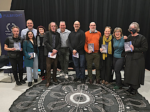
• Caption details for feature image, from L: Michael Frazzetto, Someih Ibrahimi; James Butterworth; Alison Vivian; Michael Halloran; Iain Butterworth; Michael Donovan (Gumbaynggir); Uncle Ray Woods, Yuradyuri (Wiradyuri) Elder; Mandy Gadsdon (Yawuru); Michelle Howard; Anna Stevenson (Ōtautahi Christchurch).
Author details
Dr Iain Butterworth PhD, trained in community psychology, and has spent 30 years connecting planners, policymakers, researchers, and citizens to build healthier communities. A Fulbright Scholar, he works across governments, universities, and NGOs to establish applicable research findings on planning and liveability. Iain is Editor and Lead Author of The Psychology of Place: Rebuilding Sense of Place in a Post-Colonial World, Published by Cambridge University Press in May 2026. He lives on Taungurung Country in central Victoria. Declaration: The author used AI to help search for relevant articles published through Croakey, and to help prepare Table 1, and reduce the word count.
See Croakey’s Primary Healthcare: Community matters (#PHCmatters): a systems approach to covering primary healthcare, and reporting strengths-based stories from local communities






Add Comment