




Adelaide University researchers are developing an artificial intelligence-enabled virtual reality platform that will allow people with aphasia and other communication difficulties to practise everyday conversations in simulated environments.
The Virtual Interactive platform to Treat Anomic Language (VITAL) is being designed as a virtual town square – with shops, cafés, restaurants, hairdressers and other settings where users can practise finding words, asking questions and interacting with others.
Funded through a National Health and Medical Research Council (NHMRC) Ideas Grant, the project aims to investigate whether virtual reality can improve communication confidence, social participation, wellbeing and quality of life for people experiencing word-finding difficulties.
Anomia, or difficulty retrieving words, is a common feature of aphasia, a language disorder that can result from stroke, traumatic brain injury or certain types of dementia. About 140,000 Australians live with aphasia.
Adelaide University professor Maria Kambanaros, who is leading the research, said everyday interactions could become challenging for people living with the condition.
“Something as simple as ordering a coffee, asking a question in a shop or chatting to someone you don’t know can require enormous effort when you have aphasia,” Professor Kambanaros said.
“You know what you want to say but just cannot make the words come out. It can be extremely stressful and isolating because it limits a person’s ability to connect and communicate with others.
“VITAL is all about creating a safe and realistic place where people can practise everyday interactions repeatedly, but without the pressure or fear of getting something wrong.
“Our goal is not only to improve someone’s ability to find the right words, but to help people communicate with greater confidence in their everyday lives.”
The platform is being co-designed with people with aphasia, their families and communication partners, speech pathologists and researchers.
Through interviews, group discussions and workshops, participants will help determine which environments and activities are included, how conversations operate and how the technology can be made accessible and comfortable to use.
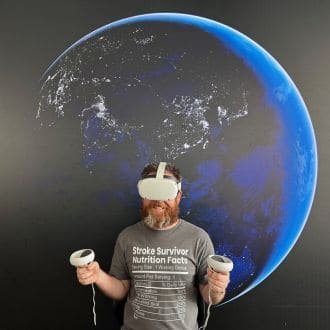
VR in action. Image supplied.
Adelaide University project manager Dr Matthew Berryman, a researcher, software engineer and stroke survivor who has experienced word-finding difficulties himself, developed the idea for a virtual café where he could practise speaking.
The environment allowed him to repeatedly order coffee and interact with a salesperson and barista while applying techniques taught by his speech therapists.
“I practised ordering a coffee again and again, without worrying about holding up a queue or feeling embarrassed if the words didn’t come out the way I wanted them to,” Dr Berryman said.
“Then recently, when I went into a real café and ordered a coffee, I noticed something had changed. I felt more confident, more fluent and more at ease.
“I know this was only a small everyday interaction, but for me it was a significant moment. And it showed how this kind of technology could potentially help others living with communication difficulties.”
Dr Berryman said virtual reality could provide an intermediate environment between structured speech therapy sessions and unpredictable conversations in the community.
“You learn language and communication strategies in therapy, but eventually you have to take those skills out into the community, where conversations are often unpredictable and there’s far more pressure,” he said.
“Virtual reality gives us an opportunity to create that middle ground – somewhere people can practise, make mistakes, try again and build their confidence before facing the same situation in real life.”
The research team is also exploring whether other people, including stroke survivors and speech pathologists, could enter the virtual environment to participate in real-time interactions and telehealth sessions.
Professor Kambanaros said the longer-term objective was to develop more accessible approaches to communication therapy that could support people beyond traditional clinical settings.
“Communication is fundamental to how we participate in our communities and maintain our relationships and independence,” she said.
“If we can use technology to give people more opportunities to practise communicating in ways that are meaningful to them, we have the potential to make a real difference beyond the therapy room.”





Add Comment