



Introduction: After a massive week for migration policy discussions, it is worth taking time to read Minister Tony Burke’s speech to the National Press Club (which includes some interesting insights into the trends driving housing shortages, as well as highlighting the importance of immigration for regional and city economies).
Also, see this analysis of the Government’s plans by Michelle Grattan, as well as this critique by demographer Honorary Professor Peter McDonald.
Meanwhile, former Howard Government Immigration Minister Philip Ruddock and journalist Anthony Brewster are due to launch a book, ‘Nation Building: How Immigration Made Australia’, on Monday.
Ruddock says Pauline Hanson’s politics “challenged the direction of Australia’s multicultural settlement” and “elevated racism to the mainstream”, reports Politico’s Canberra Playbook.
For public health researcher Penelope Smith, it was perfect timing to attend a conference about regional Australia in Canberra this week, which had a strong focus on the importance of migrants as workers.
Below she covers some of the topics covered, and not covered, highlighting the importance of bringing public health perspectives to such events.
Penelope Smith writes:
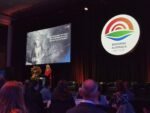
More than 400 people from regional Australia attended the eighth Regions Rising National Summit in the Grand Hall at Parliament House with the theme, People Power.
The Summit is organised by the Regional Australia Institute, which describes itself as “the nation’s first and only independent think-tank dedicated to empowering Australia’s regions”.
The Institute and their sponsors supported 27 students and not for profits in the regions to attend their flagship event. Along with two other people from North East Victoria, I was one of those lucky people. I am a PhD candidate based in the regions, enrolled in a regional university (University of Tasmania), with my research focused on migrant health workers coming to live and work in the regions.
CEO Liz Richie used her speech to highlight the recently released Regional Population Planning Report, which argues for a coordinated national settlement approach along with investment in infrastructure and planning.
Within this report an argument is made for the importance of working-aged skilled migrants to support an ageing population and address workforce shortages in the regions.
Speakers on the day, in various ways, argued against a reduction in migration and pushed for more thoughtful visa policy.
While there was a desire to push back at current decision making around cuts to migration numbers, the identification of the role of racism was curiously and disappointingly absent throughout the day’s discussions.
The framing of the migrant only as a worker to resolve workforce gaps apparently meant the event was unable to address One Nation’s influence directly.
Public health perspectives
From a public health view, this event was in competition with the PHAA Public Health National Conference and the National Rural Health Conference, which were held in the same week.
While its content touched on health and included speakers from healthcare, from Marathon Health and Western Queensland Primary Health Network, the program did not have a focus on health or healthcare.
I knew the Summit would be a different world, a different language, a different conversation to what I am accustomed.
But public health is a world which stretches and should seriously consider what ‘multidisciplinary’ means in real terms, so I came to the event with a central goal in mind.
I was there to listen to how this group positions the participants of my research (skilled health workers coming to live and work in regional Australia) so that I might know how to share my findings and advocate for this group.
This is the lens through which I am writing about the discussions, acknowledging that many other frames could be used, such as the importance of climate action and ecosystem repair, which were also discussed.
In the conference program, the RAI CEO Liz Ritchie stated: “People Power is not a slogan – it is a truth about what drives regional Australia forward, and a reminder that our future prosperity depends on the strength, leadership and ambition of our communities.”
Opening the event, MC Madeline Morris said those in the room represented “…strong and inclusive communities” who sought to attract talent to their region, and so the focus remained throughout the day very much on place, people and communities.
Ngunnawal Elder Aunty Violet Sheridan gave a warm, inviting Welcome to Country. She chose to highlight inclusion, speaking specifically about welcoming and including asylum seekers in her area. She asked the audience to have the “…patience to sit down and talk to each other”.
Kristy McBain spoke in her capacity as Minister for Regional Development, Local Government and Territories, and also as a person who grew up and continues to live in regional Australia.
She reflected that “in the regions people get involved because they are desperate for change”. She spoke about an “optimal level of population growth”.
Communities flourish
The Regional Australia Institute’s CEO Liz Ritchie opened her speech by centring the migrant and sharing a story of a migrant travelling from Rome to work on the Snowy Mountain Hydo scheme. “Big things don’t get built by government alone,” she said. “They get built by people power.”
While her speech focused on the RAI’s Regional Population Planning Report, the value of migrants coming to work in the regions was something she emphasised throughout: “Migrants are bringing vital working-age talent to regional communities.”
Workforce capacity across all professions and worker migration were recurring topics throughout the presentations and panel discussions, with the panel session ‘Enablers of Regional Productivity’ offering the most striking discussion of these issues.
Peter van Vliet, CEO of Migration Institute of Australia, spoke about 70,000 unfilled vacancies in the regions, noting “these are the ones we know about”.
He referred to Government changes to migration this year, highlighting deprioritising regional visas and pausing working holiday visas. These decisions go against what the regions are asking for and needing, he said
He cited recent press releases from the National Farmers Federation and Australian Dairy Farmers appealing to the Government to rethink their visa decisions.
Van Vliet also spoke about a 2024 Grattan Institute report which pushed against regional migration and speculated about this report’s influence on the Government. It said that: “Pushing migrants to the regions often also harms their long term career prospects, and especially those of their spouses. And many regional points-tested visa holders do not stay in the regions for long.”
A question from the floor asking about workforce challenges in child care extended the visa conversation to a discussion about what it means when workforce groups categorised as unskilled fall outside the skill levels in some visas available for business and communities in the regions.
Questions were also raised about settlement support.
The panel recognised that regional migration is different from migration to cities, and that when local communities put support in place for new migrants – both from within Australia and from overseas – the overwhelming experience is that communities flourish.

The unspoken
As a person of colour who has taught newly arrived migrants in both professional and volunteer capacities, worked alongside and for First Nations Australians, and undertaking a PhD focused on the experiences of newly arrived migrant health workers, I was puzzled by the question hanging in the air throughout the day: Why is the Government making these decisions?
My mind was flooded with personal experiences of racism and prejudice, as well as anecdotes from friends, colleagues and research participants, statements from key leaders and the evidence from research publications about the extent and impact of racism in Australia.
At times it felt like those on the stage were hinting to those on the floor to open up a conversation about the role of racism and prejudice.
The event’s theme, ‘People Power’ offered a perfect framing opportunity for what could be done, together, to address the prevalence and impacts of racism.
On one hand, I walked away from the event excited to hear how migration and migrants were valued in the room. The Regional Population Planning Report’s second key finding is “migration is now central to regional population growth” and it also included a policy recommendation: “Increase overseas migration to the regions”.
Liz Ritchie was clearly passionate and willing to argue for the importance of migrant workers. “We must use our people power to silence the politics to redirect the talent we so desperately need,” she said.
But on another level, I was confused and concerned about the lack of recognition of the role of racism and prejudice in current discourse and decision-making around migration.
It felt I was in an alternate universe to that experienced the month prior when I attended the inaugural Democracy in Colour Racial Justice Network Strategy Retreat in Naarm.
While that meeting framed First Nations people and other people of colour from a deeply human viewpoint, the Regions Rising National Summit framed people either as members of the community or workers. Migrants were workers firstly, and community members hopefully later, if they chose to stay.
This framing of the migrant changed the way in which the conversation could be undertaken. It also undermined our capacity to fight back, together, against the changes being made.
To truly exercise people power requires us to name and to tackle racism. This is why it is so important that public health expertise is at events like this, and can contribute to challenging and reframing narratives, and widening the range of solutions under discussion.

See Croakey’s archive of articles on rural and remote health





Add Comment