



Introduction by Croakey: The UK has issued joint statements with both France and Spain stressing the urgency of climate action in the wake of devastating fires and heatwaves affecting their countries.
Its joint statement with France said the “unprecedented wildfires and heatwaves being experienced across Europe as a consequence of the global climate crisis… demonstrated the risks posed to Europe by climate change”.
The statement said the UK and France recognised that “tackling the causes and consequences of climate change is essential to safeguarding the security, stability and resilience of our societies for future generations and supports us today as we secure our energy supplies and tackle the cost of living”.
The joint statement between the UK and Spain was in a similar vein, stating that “this summer’s wildfires demonstrated that climate change was now a national security emergency facing Europe and threatening our way of life”.
“Both parties agreed that tackling the climate crisis was an urgent policy priority for all countries – to tackle the cost of living, protect health and wellbeing, and to ensure European economic and energy security,” said the statement.
It also stressed “the importance of adopting the necessary measures to drastically reduce our dependence on fossil fuels”.
Meanwhile, scientists from the University of Tasmania – Professor David Bowman, Dr Calum Cunningham and Dr Grant Williamson – say the size and energy release of these fires will drive a spike in greenhouse emissions, as burned vegetation releases carbon to the atmosphere.
“No country has yet solved the challenge of responding to wildfires made worse by climate change,” they write. “The intense fires gripping France and Spain show how urgent it is to be prepared.”
Their article below was first published at The Conversation.
David Bowman, Calum Cunningham and Grant Williamson write:
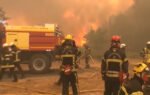
Hundreds of thousands of people have fled their homes in southwestern France and Spain as extreme wildfires intensify. At least three people have died, including two firefighters. Many houses have been lost.
While this region is no stranger to fire, our analysis shows these wildfires are off the charts. A very hot summer primed many areas for fire. When they ignited, they spread ferociously. The area of land burned in France is already 40 percent larger than the previous record year.
Some fires pose threats to large cities such as Bordeaux in France and Madrid in Spain. For the first time ever recorded in France, a fire thunderstorm (pyrocumulonimbus) formed over fires and made them worse. French President Emmanuel Macron described the fires as “unprecedented”.
A Spanish firefighter told AP the fires were extremely hard to fight: “The fire is so virulent and has such power that no matter what you do, you can’t put it out.”
Authorities are scrambling to control the fires before another heatwave begins later this week.

How bad are these fires?
We have compiled data for this article showing just how unusual these fires are, compared with previous wildfires.
Three of the 15 largest wildfires since the European Union began recording data 20 years ago have burned during the past month.
In France, the energy output from the fires measured by NASA satellites is double the previous record for July.
With another month or two left in the fire season, France is on track for its worst season since satellite records began in the early 2000s.

 The Iberian Peninsula (Spain and Portugal) and France’s Mediterranean regions are well known to be wildfire-prone.
Last year, our research predicted wildfires would worsen in these areas under moderate climate change of 1.5°C and 2°C above average pre-industrial temperatures. Global warming has hit 1.5°C over the past three years.
What we didn’t expect was the appearance of massive, intense fires along the more humid Atlantic coast of France, near Bordeaux. These fires are worse than we predicted.


Key questions
Spain and southwestern France are in the grip of severe drought and recurrent intense heatwaves well outside the range of records kept since 1940. Temperatures across the region have been around 4–5°C above average for June. This is what we would expect as the climate changes.
More heatwaves are forecast as the European summer wears on. As a result, 2026 is likely to become a clear outlier for extreme heat in western Europe.
Uncontrolled wildfires are not a surprise after a prolonged drought and extreme heatwaves. Arid conditions and dry ground make it much easier for vegetation to burn.
We don’t know how these fires started. But we do know densely populated areas are reliable sources of ignition. Fires can start from a tossed cigarette, lightning strike, car backfire or if someone deliberately lights them.
It’s possible to reduce the chance of ignitions when conditions make intense fires likely, but it’s not realistic to stop them altogether.
Huge fires like these do a great deal of damage, in both the short and long term.
Because many of these fires threaten towns and cities, authorities have ordered mass evacuations. This protects human lives, but makes it more likely houses and other structures will burn if there’s no one to defend them.
We don’t yet know how many houses have been lost. But the scale of the fires suggests there will be significant losses.
We also don’t yet know how bad the toll from smoke will be. Millions of people have been exposed to harmful wildfire smoke. Big fires like these prompt many people to seek care at hospitals for respiratory and cardiovascular issues. There’s a small but noticeable effect on mortality.
Climate implications
The size and energy release of these fires will drive a spike in greenhouse emissions, as burned vegetation releases carbon to the atmosphere.
Across the Northern Hemisphere, forest fires are becoming more intense and more common. Wildfires are currently hitting Canada and the United States. In recent years, fires have ignited in unexpected places, such as Scotland and even Greenland.
Intensifying fires make it harder for us to tackle climate change. Forests are vital natural stores of carbon. But they are now shifting in some places to a net source of carbon.
If unchecked, this could trigger a dangerous feedback cycle that would further destabilise Earth’s climate.
There is little doubt climate change has made France and Spain’s wildfires worse. They represent yet another reason to redouble our efforts to tackle climate change and stabilise our climate.
For authorities responding, it will be vital to use adaptation responses to reduce risks from the next wildfire crisis. These include reducing fuel loads and fire hazards, using methods such as prescribed burning, forest thinning and incorporating green firebreaks into urban landscape design.
No country has yet solved the challenge of responding to wildfires made worse by climate change. The intense fires gripping France and Spain show how urgent it is to be prepared.

Author details
David Bowman is Professor of Pyrogeography and Fire Science, University of Tasmania. He receives funding from the Australian Research Council, New South Wales Bushfire and Natural Hazards Research Centre and Natural Hazards Research Australia.
Dr Calum Cunningham is Research Fellow in Pyrogeography, University of Tasmania, and receives funding from the Australian Research Council.
Dr Grant Williamson is Research Fellow in Environmental Science, University of Tasmania, and receives funding from the NSW Bushfire and Natural Hazards Research Centre, and Natural Hazards Research Australia.
See Croakey’s archive of articles on the climate emergency, and on bushfires





Add Comment