




Each system works, but the workflow doesn’t – and clinicians are the ones holding that together, says a new industry whitepaper on access and workflow commissioned by Imprivata.
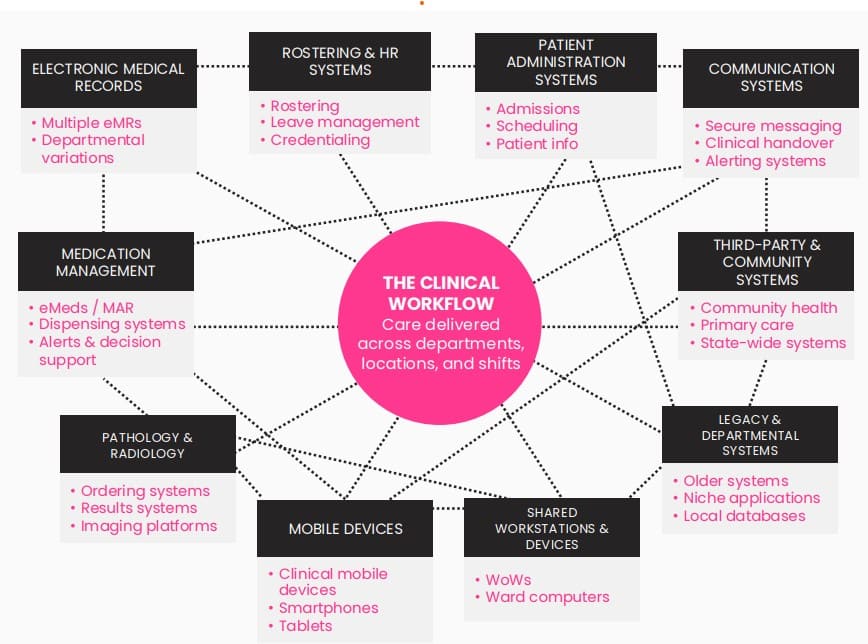
“Clinicians, administrators and IT teams often move between multiple systems, devices and workflows that were never designed to work seamlessly together.
“As hospitals continue to digitise care delivery, access has become more than an IT or cybersecurity issue. It now directly affects clinical workflows, staff efficiency, patient safety and the overall experience of care,” the paper says.
The hidden burden of access in Australian hospitals is based on independent qualitative research commissioned by Imprivata and conducted by Honeycomb Strategy to better understand how Australian hospitals currently manage access across clinical environments, the challenges created by fragmented systems, and the operational realities shaping access management adoption across healthcare organisations.
Research participants included clinicians, digital health leaders, IT stakeholders and operational decision-makers involved in the implementation, management or evaluation of clinical systems and access workflows.
One hospital IT leader told the researchers, “We run on a core set of platforms for inpatient, outpatient and community care, but behind that there are around 200 separate clinical applications”.
Another IT leader said, “We have over 200 apps that we manage at Eastern Health, that we use day to day”.
An Assistant Director of Nursing is also quoted, “I am not aware of any incidents for patient safety that have occurred as a result of access management, but that is because our staff fill the gap, and that’s where the frustration comes from, so where there’s a deficit in the system, rather than fixing the system or fixing the process, our staff do extra work.”
Fragmented care
Care delivery is fragmented and clinicians are the ones doing the integration, says the research paper.
“The effects of fragmented access environments are felt across every level of hospital operations.
“What begins as workflow friction for staff can ultimately affect patient care, operational efficiency and an organisation’s ability to deliver secure, connected healthcare experiences at scale.”
The whitepaper acknowledges challenges are not in recognising the problem but prioritising it.
“Improving access is frequently acknowledged as important, but not always urgent enough to displace larger or more immediate organisational pressures. This does not reflect a lack of awareness or belief in the value of access management solutions. More often, it reflects the realities of healthcare environments where organisations are balancing multiple transformation priorities simultaneously while continuing to deliver uninterrupted patient care.”
The whitepaper covers key issues facing hospitals around access workflow:
- The reality of access in Australian hospitals – How fragmented environments affect clinicians, patient care, and hospital operations
- What’s holding hospitals back? – The operational, cultural and technical challenges shaping access management strategies and adoption across Australian healthcare organisations
- Making access work in complex healthcare environments – How leading hospitals are addressing access challenges, reducing workflow friction, and creating more seamless and secure clinical experiences






Add Comment