






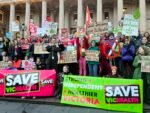

Introduction by Croakey: The Victorian branch of the Australian Medical Association has thrown its weight behind the campaign to keep VicHealth as an independent health promotion agency.
In a statement released today, published below, AMA Victoria urged the Carroll Labor Government to reconsider the decision to absorb VicHealth into the Department of Health.
The statement said the Liberals, Nationals, Victorian Greens and One Nation had all committed to retaining VicHealth’s independence.
Croakey notes, however, that One Nation has committed to abolishing Diversity, Equity and Inclusion (DEI), and also Environmental, Social and Governance (ESG) programs, which wouldn’t align well with VicHealth’s priorities, which include tackling racism and discrimination.
In a recent interview with Croakey’s Marie McInerney, Health Minister Ingrid Stitt remained adamant that Labor would fold VicHealth into the Health Department.
She said this would be done carefully so as not “to lose any of the fantastic things VicHealth have been able to achieve and drive in the community”.
As many Croakey contributors have noted, it is precisely VicHealth’s independence from government that has allowed the agency to work effectively across sectors and with communities, and beyond the silos of government departments.
“Whatever the election result, the next government needs to protect VicHealth’s independence, fund prevention properly, and be accountable for the results,” said Dr Simon Judkins, President of AMA Victoria.
AMA Victoria has not spoken up publicly for Treaty, despite Aboriginal health leader Dr Jill Gallagher AO urging health organisations and workers “to stand with Aboriginal people and publicly support Treaty – to advocate for its protection, regardless of the outcome of the election”.
Judkins told Croakey that he personally supported Treaty, recognising its importance for self-determination, health and equity, but the AMA Victoria Council was yet to consider its position.
In a statement published last year at Croakey, VicHealth hailed the passage of the Statewide Treaty Bill through Parliament as “a transformative moment for health and equity across our state”.
“Self-determination is central to good health. It ensures Aboriginal and Torres Strait Islander voices, knowledge, and priorities guide the design of policies and programs that influence their health and futures,” said the VicHealth statement.
At that time, the United Nations Human Rights Chief Volker Türk urged other leaders to follow Victoria’s “historic step” in developing Australia’s first formal treaty with Indigenous Peoples.
“This is a very significant occasion for all Australians. It represents a major step toward justice and equality. It addresses the continued exclusion of and discrimination against the country’s First Peoples – the result of colonisation,” he said in a statement.
Minister Stitt told Croakey that Treaty is hugely important for the self-determination, health and wellbeing of First Nations people, warning that “there’s a lot on the line” at the election.
Predictions that Labor is facing such a backlash that even the Premier may lose his seat raise questions about how the health sector might mobilise in support of Treaty after the election.
The real significance of the AMA Victoria statement on VicHealth may lie in putting pressure on the Liberal and National Parties to keep their promise of support, should they form government.
Statement by AMA Victoria
Doctors welcome the Victorian Coalition’s commitment to keep VicHealth independent while calling on all parties to protect dedicated, long-term funding for the work that keeps Victorians well.
In its response to AMA Victoria’s election priorities, the Liberals and Nationals confirmed: “Under the Liberals and Nationals, VicHealth will continue as an independent body. Their work in early intervention and education is vitally important for keeping people out of hospital.”
The Victorian Greens and One Nation have also committed to retaining VicHealth’s independence. Doctors are calling on the Carroll Labor Government to reconsider its decision to absorb VicHealth into the Department of Health.
That decision followed the Silver Review’s recommendations in December 2025. VicHealth remains an independent statutory authority, with existing funding arrangements confirmed through June 2027.
“We need more staffed hospital beds. We also need to do more to stop people getting sick enough to need them,” AMA Victoria President Dr Simon Judkins said.
“When a hospital needs more beds or staff, the pressure to act is immediate. The benefits of preventing cancer or heart disease can take years to show. That’s why prevention needs its own funding and an independent voice.”
Three eminent Australian health scientists, Sir Gustav Nossal, Professor Fiona Stanley, and Professor Rob Moodie, wrote this week to Premier Ben Carroll and Opposition Leader Jess Wilson about VicHealth’s future.
They urged the Premier to pause the proposed abolition pending an independent evaluation, and called on the Coalition to commit explicitly to retaining VicHealth as an independent, fully funded statutory authority.
“Prevention operates on longer horizons; to succeed, it requires deep partnerships with communities, local government, schools, sporting clubs, the arts sector, multicultural organisations, and researchers,” the scientists wrote to the Premier.
They pointed to VicHealth’s work to replace tobacco and alcohol sponsorship in sport and the arts as an example of what an independent prevention body can achieve.
Secure funding matters
Judkins said commitments to independence must be matched by secure funding for VicHealth’s specialist expertise, community grants, and long-standing partnerships.
“Keeping VicHealth independent is important, but it also needs the resources to do its job. Prevention can’t be an afterthought when budgets are tight,” Judkins said.
AMA Victoria’s election priorities also call for sustained investment in immunisation, cancer prevention, cardiovascular health, and other proven measures that reduce avoidable illness and hospital demand.
This includes funded outreach through general practices, community health services, and trusted local organisations in communities where immunisation and cancer screening rates are low.
“Victorians should be able to see how much the state spends on prevention, which communities that money reaches, and what difference it makes. That should be reported publicly every year,” Judkins said.
“Whatever the election result, the next government needs to protect VicHealth’s independence, fund prevention properly, and be accountable for the results.”
• Declaration: Dr Simon Judkins is a member of Croakey Health Media
Croakey will publish a wrap of Victorian election scorecards and related news next week.
Watch this interview
See Croakey’s archive of articles on the Victorian election; and on VicHealth; and on Treaty






Add Comment