






The vulnerability of animals in times of war and conflict is highlighted in a powerful exhibition in Cairns featuring the work of three Queensland artists, according to First Nations scholars Professor Bronwyn Fredericks and Dr Angela Baeza.
In reflecting on the exhibition, they write: “Discussions of the lives lost in times of war and conflict should also include the lives of animals, and plants, and everything else within the natural world.”
They also highlight the toll that military endeavours, including atomic testing, has taken on Indigenous people, as well as the lack of protections afforded to Indigenous people in many spheres.
Bronwyn Fredericks and Angela Baeza write:
The Paradox of Things exhibition at the Cairns Art Gallery is a different kind of exhibition from what we are both used to seeing in art galleries. It shows a sense of fun, sarcasm, wit, style, and clever artistic practice, all mixed into pieces that send potent messages on topics such as the toll of conflict and war upon animals.
The three north Queensland artists included in The Paradox of Things – Barbara Dover, Julie Poulsen and Jennifer Valmadre – incorporate mixed-media, old objects, lost and found, along with items that may be treasured by some people and discarded by others, and layer and weave them via assemblage and bricolage techniques.
They make the viewer question the use and significance of everyday things, and items that may be understood as mundane, such as cups and saucers, needles and threads, and small trinkets and travel souvenirs.
Viewers are invited to reconsider what is familiar, and are also challenged to think, explore and contemplate an issue, a contradiction, or situation and some of the joys, traumas, and complexities of the human experience.
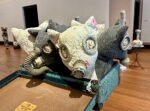
One such work was ‘Almost safe’ by Barbara Dover (see images below). We discussed it with each other, just as we heard others in the gallery talk about it after us. It highlights the struggle of animals in war and conflict zones around the world.
‘Almost safe’, Barbara Dover, 2026, found objects, blanket, doilies. Photos by Bronwyn Fredericks, 30 October 2026.
The work features hand sewn animals made from a blanket, doilies and other found objects, wearing what we thought were gas masks and leaning out of a box, as per the photos above and below. The animals are positioned as vulnerable and trying to survive in times of war and conflict.
Dover highlights contradictions in the discussions around safety and peace, which generally refer to people, and do not include animals, or people and animals.
We watched people view the artwork in silence, as we had done. Some would discuss it with someone else if they were with other people.
The work is simple and stirring, and profound, and speaks louder than words could. It is confronting and demonstrates the defencelessness and vulnerability of animals in times of war and conflict between people.
They are not party to the discussions of humans, nor the political or ideological intentions of leaders who enact actions.
Nonetheless, they are subject to the consequences, including forced movement and displacement, bullets, missiles, and other flying objects, toxic chemicals, injuries, starvation from food and water deprivation, lack of human contact, and death. They also witness this in their own offspring and families, and in humans.
They are the victims of human decision-making and, more often than not, overlooked.
‘Almost safe’, Barbara Dover, 2026, found objects, blanket, doilies. Photos by Bronwyn Fredericks, 30 October 2026.
Dover’s work raised questions for us about animals in all wars, and in all military conflicts, along with harm also done to the natural world. While the number of human lives lost or harmed are quoted in the media, the number of animals and plants rarely gain a mention.
However, animals are also affected by the violence and disruption of war, experiencing significant distress and suffering, as found in a recent study from Ethiopia’s Tigray region.
The findings remind us that the impacts of conflict ripple across entire ecosystems. Dover’s ‘Almost safe’ highlighted for us that discussions of the lives lost in times of war and conflict should also include the lives of animals, and plants, and everything else within the natural world.
Questions and concerns raised
Remembrance Day this year raised questions for Bronwyn about animals in past wars and conflicts. It is widely accepted that World War 1 brought different types of dangers, and injuries for soldiers, and civilians, along with military horses, and dogs.
This saw uniforms worn by the miliary develop and the use of more protective equipment. Some military animals were also provided with protective coverings in World War 1 to minimise their harm, and injury. This is documented in the Australian War Memorial, and historical documents and narratives dating from the Boer War (1899-1902).
Animals such as horses, dogs, mules, donkeys, camels and pigeons have all been trained to undertake important roles in past wars and conflicts and were used by Australia in the Boer War (1899-1902), and every war and conflict since.
There is even a special day in Australia for animals of war with the National Day for War Animals first being held on 24 February 2019 after being named in a Parliamentary speech and coinciding with International War Animals Day, which commemorates the ‘deeds and sacrifices of animals in war’.
The fact there is a special day and that uniforms were changed for people and some animals, and protective gear developed for animals too demonstrates that humans have known of the injuries and harms done to animals in wars and conflicts for decades and decades.
The Australian War Memorial’s collection of gas masks for use in World War 1 is testament of this reality.
Such protective equipment was not given to the Indigenous people on the lands where Britain tested atomic weapons in the 1950s and early 1960s, including the Montebello Islands in Western Australia, and Emu Field and Maralinga in SA.
Plutonium was also used in Maralinga, which has a “radioactive half-life of more than 24,000 years” and can be extremely hazardous to humans, and no doubt also animals.
We may never know the full harm of the testing they did, and the harm that continues to Indigenous peoples, plants, animals, and the ecologies of the sites bombed.
The masks on animals, as in the animals portrayed in ‘Almost safe’, change their appearance. The once cute, loveable creatures transform into part-machine via the metal, rubber, glass and elastic. They become vulnerable, their safety compromised, and their lives threatened.
The animals in the box also incorporate a homely blanket and doilies, those things which symbolise comfort, tradition, nurturing and care. These stand in contrast to the equipment worn by the animals to protect them from known dangers, and harm.
There are also contrasts in this for us in the harms done by the ripples of colonisation, including land dispossession, exploitation, over-incarceration, under-education and under-employment, talent wastage, and the ongoing talk, reviews, papers, and reports on closing the gap between Indigenous and non-Indigenous peoples.
We ask, where are the protective mechanisms for Indigenous peoples, where is the minimisation of known harms, where are the interventions based on the evidence, where are governments, business, universities and organisations learning in to make real change when they know the harms continue, and when they know they contribute to them?
The history archives are testament that they all put some lives, including some animals’ lives, above Indigenous lives in Australia.
This artwork ‘Almost safe’ in its entirety represents a paradox within an exhibition full of examples of paradoxes. The issues raised within ‘Almost safe’ are clever and thought provoking.
The complexities and challenges demonstrated in this work are repeated in Barbara Dover’s other works, and in the works by Julie Poulsen and Jennifer Valmadre.
The Paradox of Things exhibition requires time to see it, dwell within it, and reflect. It is on at the Cairns Art Gallery until 28 November 2026.
Author details
Professor Bronwyn Fredericks is an Indigenous woman from south-east Queensland, and the Deputy Vice-Chancellor (Indigenous Engagement) at The University of Queensland, a theme lead with the ARC Centre of Excellence for Indigenous Futures, and Chair of Croakey Health Media.
Dr Angela Baeza is a Diaguita Woman from the Chilean desert, educator, and a Research Fellow at the ARC Centre of Excellence for Indigenous Futures at The University of Queensland.
See Croakey’s archive of articles on art and health







Add Comment