




The Biennale of Colour and Light Exhibition, which is “dedicated to championing and elevating women abstract artists across Victoria”, was vibrant and engaging, but left Professor Bronwyn Fredericks with some questions.
Bronwyn Fredericks writes:
An explosion of colour, energy, movement, and light!
That is how I found The Biennale of Colour and Light Exhibition, which opened on Saturday 17 October at the West End Space in West Melbourne.
The Biennale, established in 2016, was developed to offer people identifying as women artists from across Victoria the opportunity to showcase their artistic practices in a collective exhibition.
The current Biennale includes 86 artists, including early career, emerging, mid-career, and established artists. The guest judge for the 2026 Biennale of Colour & Light Exhibition is Filitsa Giannopoulos, who was also one of the speakers at this year’s Biennale.
What particularly interested me was how the banality of the everyday, and some of the experiences of everyday life are embedded in the display.
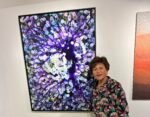
Many artworks consider what it is to be human, and live a human life, along with our connections to other people, and other living entities. They do this via explorations of colour, textures, shapes, movement, and feelings (see the photos below, for example).
As all the participating artists identify as women, numerous works also explore what it is to be a woman, representation, and grit.
The 2026 Biennale offers a huge array of visual experiences, and generated feelings in me that were no doubt similar and different to other people at the opening, and who will view the exhibition over the next month.
I found some of the works difficult to grasp in terms of what the artist was trying to convey and others easy to comprehend. The exhibition is a showcase of women artists in Victoria and that is a worthwhile contribution.
I did ask a staff member at the gallery if there were any Indigenous women in the exhibition and was told there weren’t. This left me with questions as to why Aboriginal and Torres Strait Islander women were not included in the exhibition.
I also question why the Acknowledgement of the Wurundjeri people as the Traditional Custodians of the land on which the gallery resides is on the bottom of the last page of the catalogue, just above where the sponsors appear?
L: Kim Wall, Russet Pear, 2026, wool stoneware stuffing. R: Pamela Rataj, The White Piece, 2025, apoxysculpt, wire and wood, in front of Hal, Red Bloodwood, 2026, oil on canvas. Photos: Bronwyn Fredericks, 17 October 2026.
Different styles
The participants all have different artistic styles, approaches, and abstractions, which demonstrates their sense of experimentation, abstract, concrete, expression, minimalism, and realism.
While colour and light are in the title of the biennale, they are not the only concerns of the artists, the exhibition, and the curator. The biennale offers us the opportunity to shape it into what they want it to be via an eclectic kaleidoscope.
The focus on colour and light provides opportunity for connections between the elements, textures, artistic practices, and human experiences within the kaleidoscope of works (see photo below).
They offer us, the viewers, words and language to talk about the exhibition, and enable some of the artists to talk with and connect with each other while some stand in isolation.
Artworks in The Biennale of Colour and Light Exhibition. Photo: Bronwyn Fredericks, 17 October 2026.
Wanting more
Colour itself a can be a huge communicator, and the scientific literature demonstrates that colour can be powerful, depending how it is used. It can convey messages, or symbolism, and stimulate specific behaviours.
Colour and light enable us as the viewer a way to navigate the exhibition, examine it, and maintain the gaze and make meaning.
The exhibition does have limitations, including a lack of information on the individual artworks in the catalogue. The only information available related to who the artists are, and what the object is made of and the size.
I found myself wanting more information about some of the works. For example, what was the thinking behind the work, where was it produced, and did a certain experience lead to the work?
Maybe, this absence of explanation was part of the abstraction? Maybe the curator, artists, and individual works just lend themselves as the exhibition does in its entirety, to the viewers to reflect and draw their own conclusions?
While I was left wanting and had questions after viewing the exhibition, I was glad to view it and to support the artists who identify as women, and women artists.
• The Biennale of Colour & Light exhibition opened on Saturday 17 October and is on until 8 November 2026 at the West End Art Space, West Melbourne.
Author details
Professor Bronwyn Fredericks is an Indigenous woman from south-east Queensland, and the Deputy Vice-Chancellor (Indigenous Engagement) at The University of Queensland, a theme lead with the ARC Centre of Excellence for Indigenous Futures, and Chair of Croakey Health Media.
See Croakey’s archive of articles on the arts and health





Add Comment