







*** Aboriginal and Torres Strait Islander readers are advised this post with videos contains mention of people who have passed ***
The sixth international conference of the Healthy Environment and Lives (HEAL) Network was held online this week, bringing together scholars and knowledge holders from across Australia and globally.
Leading up to this event, a series of HEAL Hub meetings was held around Australia, including a three-day Cultures of Care workshop in Lutruwita/Tasmania that featured diverse cultural perspectives on nature, Caring for Country, conservation, health and wellbeing, and related connections and intersections.
It brought together researchers, policymakers, Indigenous scholars, practitioners and leaders from Australia and Japan, to explore how different cultures can work together to strengthen community engagement in biodiversity conservation, climate resilience and sustainable futures.
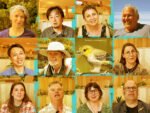
The Croakey Conference News Service will report more on the Cultures of Care discussions in a forthcoming article; the post below compiles footage from a field trip on 21 October to Lunawanna-Alonnah or Bruny Island, as well as interviews with workshop presenters and participants.
The field trip included a tour of Inala Conservation Reserve, where the rare and critically endangered forty-spotted pardalote is a focus of conservation efforts.
Elsewhere, Palawa Elder Rodney Dillon also shared cultural knowledge and history, including about Murrayfield Station, an Indigenous-owned sheep farm, where care for habitat and wildlife, such as spotted quoll and bandicoots, is prioritised.
The videos below share some gorgeous island views, as well as interviews with workshop participants conducted in the University of Tasmania’s stunning new campus, The Forest, where nature is embedded into the learning environment. Also see this playlist.
Setting the scene
Dr Emily Flies, convenor of the Cultures of Care workshop and a senior lecturer at the University of Tasmania, talks about the benefits of nature for health and wellbeing, including how it helps her personally.
She calls for nature to be considered in all policies, it shouldn’t be separated between the environment, health and economics, as it is the foundation for all of those things. She also calls for everyone to have opportunities to know and engage with nature, from early childhood through to adults.
Flies is speaking just before workshop participants board the ferry to Lunawanna-Alonnah, Bruny Island.
Protecting birds and habitat
Workshop participants travel from Nipaluna Hobart to the island by ferry and bus. At Inala Conservation Reserve, they learn about the forty-spotted pardalotes, and watch them flying in and out of nesting boxes.
Scientist and conservationist Dr Andrew Hingston acknowledges the Nuenonne people and the importance of restoring Country.
At The Neck, psychologist Dr Tracy Spencer encourages the group to engage mindfully with the stunning environment – water, sun, sand and skies. (See this video interview about her work, also featured below.)
Caring for Country
Palawa Elder Rodney Dillon speaks about his ancestors, the history of colonisation, the many generations of knowledge embedded in stone tools, self-determination and farming, and efforts to restore Country, including support for wildlife. He also talks about mutton birds and the impact of marine heatwaves on kelp forests and the changing ocean floor environment.
The video includes footage from Truganini Lookout, The Neck, a cultural site and Murrayfield farm (see this ABC report from 2023).
A love story
Jacqui Wilson, Chief Connections Officer at Conservation Volunteers Australia, reads a short story that she had just written that morning about Gavin the rock, and Kelly the kelp.
The story was in response to Uncle Rodney Dillon’s description of the impact of marine heatwaves killing the kelp, and leading to rocks on the ocean floor being de-stabilised, rolling around and creating disturbance.
Volunteers with her organisation often share stories about the healing powers of nature. Conservation Volunteers Australia is moving to weave health and wellbeing into their work in environmental conservation.
Weaving and wellbeing
The weaving of different knowledges was a recurrent theme at the workshop.
Marine scientist and public servant Dr Dirk Welsford discusses how much he enjoys weaving using plant fibre, after learning a technique from First Nations people.
It provides respite from “the head work” and worries of his day-job, and is a tangible way of expressing a connection to nature.
“It changed the way I looked at nature, not just looking as a scientist,” he says, but now also looking for fibres for weaving, often from discarded and recycled vegetation.
While Welsford initially focused on weaving baskets, he later ventured into more environmentally focused projects, such as the endangered Maugean skate (as photographed below). This is also an example of weaving as a conversation-starter.
For more on weaving, see this recent Croakey article, Woven Together: Undivided We Rise.
Photo courtesy of Dr Dirk Welsford
Connections matter
Health leader Kate Garvey shares personal and professional reflections from the workshop, and about the importance of “relational infrastructure” to support ongoing connections between community, research, and policy that enable change.
Garvey, who has worked in public health in different Australian states and moved to Lutruwita/Tasmania about 13 years ago, says the way we lead our lives is sometimes counterproductive to human health – for example, fast paced lives that are often disconnected from nature.
She talks about the importance of reciprocity and the shared responsibility of caring for place: “Places that are in good condition are good for people and what’s good for the planet is good for people.”
Garvey, who has worked often with HEAL, also discusses the importance of supporting people who are in the right place and doing what they like – that it’s a bit like “catching a wave” from a policy perspective.
She describes the transformation of the Hobart rivulet, largely as a result of volunteers who value that place. On the morning of the interview, she and others on a HEAL walking tour saw a platypus at the rivulet.
Nature prescribing
Nature prescribing should be recognised and funded as a mainstream health intervention, according to Dr Tracy Spencer, a psychologist and the director of Mindfulness Programs Australasia, a Tasmanian organisation delivering mindfulness training for groups for the past decade.
Spencer, who has lived and worked in rural and remote areas, says there are strong evidence bases both for the health benefits of mindfulness and for connection to nature.
“I would like to see nature prescribing become mainstream, and for our health services to recognise that this is not just a legitimate form of healthcare but a really powerful, accessible and self-manageable form of healthcare,” she says.
Whether it’s called nature prescribing or green prescribing, it should be funded and made available, she says.
Spencer cites the work of A Dose of Nature, a mental health charity in the UK, that she says has demonstrated significant outcomes for stress, depression and PTSD (read more in this article in The Guardian earlier this year).
Spencer also describes the importance of nature for her own self-care: “I… feel all the restorative benefits of being in nature, whether it’s my morning walk, whether it’s going on a hike. I do a lot of cold water dipping as well.
“It’s been integrated into my life, just through where I’ve lived and how I’ve interacted with those spaces.”
As for future work involving the different fields represented at the workshop, Spencer stresses the importance of working collaboratively – “that’s what forests do”.
Young people and climate grief
Daphne Bruggemann describes her PhD research at the University of Tasmania investigating relationships for young people between nature connection and climate anxiety or grief. It is possible that young people who are more exposed to nature are also more likely to be aware of climate impacts upon nature, she says.
The importance of her field of research is underscored by the latest climate health stocktake by the MJA Lancet Countdown, which has a big focus on the mental health impacts upon young people of the escalating climate crisis.
The 2026 Oceania Report of the MJA–Lancet Countdown on Health and Climate Change: Children Already Impacted, With a Lifetime of Exposure to Come reports on a survey of 16,230 young Australians aged 14–19 years. Half said they are worried or sad about the impacts of climate change, including its threat to people. About one in seven said such feelings are negatively affecting their daily life.
The report says climate change is shaping child health in Australia and New Zealand through rising temperatures, increasingly frequent and severe extreme weather events and worsening environmental conditions.
“Children are biologically, developmentally and socially more vulnerable than adults, meaning that climate change functions as a core child health issue rather than an environmental add-on,” it says.
“Risks begin in pregnancy and early life, accumulate across childhood and adolescence and intersect strongly with social disadvantage, shaping long term health and well-being trajectories.”
Despite this, the authors say that children’s needs are often insufficiently centred in climate policy and planning and evidence for child-focused post-disaster interventions remains limited.
Parents, caregivers, health professionals, educators, schools and communities have a critical role in reducing children’s exposure to climate-related risks, supporting well-being, improving safety and advocating for systems-level change, they say, in recommendations that link directly into many of the discussions at the Cultures of Care workshop.
Japanese perspectives
Japanese perspectives and knowledge about nature featured prominently in the workshop, with presenters contributing in person and online.
Applied ecologist Associate Professor Masashi Soga, from the University of Tokyo, discusses the importance of nature for health and wellbeing, including for his own family and his joy in experiencing Tasmanian landscapes.
Policymakers in Japan are very interested in the benefits of nature experiences for peoples’ health and wellbeing, he says.
Professor Munemitsu Akasaka, who is visiting the University of Queensland until next March from the University of Tokyo, discusses the benefits of connecting people with nature, for their wellbeing and also to increase support for biodiversity conservation.
He describes the importance of nature for him as a young child, and also for helping to sustain him as an adult during COVID. And he hopes to see more collaboration between Japanese and Australian researchers on nature-health research.
Forest therapy
A compassion-based forest therapy program has been helpful for people with post traumatic stress disorder (PTSD) from climate-related events, according to Associate Professor Eric Brymer, from Southern Cross University.
Feeling “held by the natural world” is an important component of the program, rather than it being focused on changing behaviour, he says.
“The changes they feel come from that immersion and interaction [with the natural world],” he says.
Brymer, who is also involved in social prescribing research through the Australian Social Prescribing Institute of Research and Education (ASPIRE), discusses the importance of systems and ecological approaches around nature, conservation, health and wellbeing, rather than a focus on individual behaviour change.
Watch all the interviews at this playlist.
Follow our ongoing coverage of #HEAL2026.
The Healthy Environment and Lives (HEAL) Network enlisted Croakey Conference News Service to report on the three-day Cultures of Care workshop, which was also supported by the National Environmental Science Program’s Sustainable Communities and Waste Hub and Resilient Landscapes Hub as well as Common Nature, and the University of Tasmania.







Add Comment