





On 4 November 2026 the High Court of Australia ruled 6 to 1 that Uber owes about $81 million in NSW payroll tax on fares it passed on to its drivers.
Since then, doctors and practice owners have been asking me the same question: does every medical practice now pay payroll tax?
No. But every practice should check how its money runs. In our experience, most fixes are a sentence or two in the agreement and a change to how the front desk handles the money.
Uber has said the decision could affect intermediary businesses “including medical practices and mortgage brokers”, news.com.au reported. That is Uber’s argument to make. Genuine arrangements are not Uber, and practices should not be stampeded into paying tax they do not owe.
A note on words
The service entity is the business that provides the rooms, staff, equipment and systems that practitioners use.
It is sometimes mistakenly referred to as the practice or the medical centre. You are probably a service entity if you charge practitioners a service fee plus GST: a flat fee, a percentage, or both. It is like a landlord and its tenants, such as Westfield with Coles and Woolworths.
It also operates like barristers’ chambers, where each barrister runs their own practice while sharing rooms, clerks and support staff.
The practitioner is the doctor, specialist, dentist or allied health practitioner who treats the patient.
Three reasons not to panic
1. Making money from someone else’s work is not enough. The High Court said a benefit to a business, on its own, does not mean the work is supplied to that business. Its example was a shop that does well because the bus stops outside. The bus is not working for the shop. A service entity that only earns rent and service fees from practitioners is in a similar position.
2. Uber lost because of what its drivers promised Uber. Each driver promised Uber to complete every trip once it started, to Uber’s standards, and Uber had substantial control over them. A genuine tenant doctor promises the service entity nothing about how they treat patients.
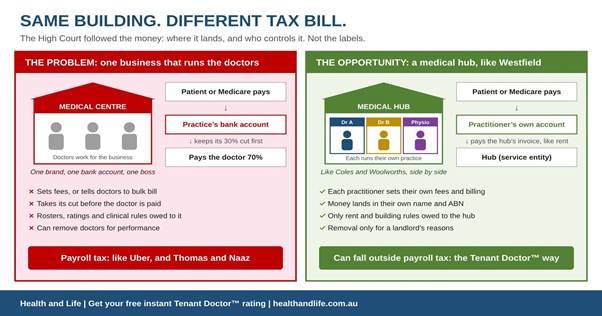
3. Thomas and Naaz already showed the way out. In that 2023 NSW case, most doctors had their Medicare benefits paid into the company’s account. The company kept 30% and paid them 70%, and those payments were taxed as wages (Revenue NSW case summary). Three practitioners at the same practices processed their own Medicare claims, then paid the company its 30%, and were not assessed (NSW Court of Appeal summary). No court ruled on their position, but the Court of Appeal said this showed “a ready mechanism to avoid that result”.
Same buildings, same kind of work, different result. The difference was how the money was run.
The problem and the opportunity: where the money lands, and who controls it, decides the tax bill.
Related
Mixing business with medicine
Card surcharge ban lands on 1 October. What actually changes?
Before you sign your tax return: 10 questions about how doctors get paid
Five questions to ask today
Answer for how your practice runs today, not what the template says. In our view, if you can honestly answer yes to all five, the Uber decision is unlikely to change much for you.
Does each practitioner’s money go straight into their own account, in their own name and ABN, with the practitioner as the only signatory?
Does each practitioner set their own fees, including whether to bulk bill?
Does the service entity send the practitioner a tax invoice for its fee, rather than keeping a cut before paying them?
Has the practitioner promised the service entity nothing about how they treat patients? No quality targets, no ratings, no clinical rules.
Can the service entity remove a practitioner only for landlord reasons, such as unpaid fees or a safety breach?
If you answered no or not sure to any of them, do not panic. They are usually fixable.
Three traps to check
1. Who decides to bulk bill?
Deciding a practitioner’s billing is deciding their price, and control over price is what the courts look for. In Thomas and Naaz, the doctors had agreed in writing to bulk bill. If the practice made or pressured its practitioners to bulk bill, you may have a payroll tax problem. Watch for:
a policy or agreement that says practitioners will bulk bill;
a website, sign or Google listing saying “we bulk bill”;
better sessions or terms offered only to practitioners who bulk bill;
registering the location for the Bulk Billing Practice Incentive Program, which requires every GP there to bulk bill all eligible services.
The fix: each practitioner decides and publishes their own fees, and agrees in writing before the location joins any program that would bind them.
2. Accreditation paperwork
Accreditation standards are written as if the practice runs everything. If your accreditation file has practitioners promising the service entity they will follow its clinical rules, it can undo a well written agreement. Do not drop accreditation. Instead, put each system in the right name:
Billing, complaints, recalls and reminders, and clinical governance should run in each practitioner’s own name. Position descriptions and workload monitoring should apply to employees only.
The RACGP released its Standards for general practices (6th edition) on 26 August 2026. The arrangements for moving accreditation to the new edition are still to be published, so there is time to fine-tune.
3. Software and records
Revenue NSW has told medical centres it now matches data with the ATO, so your records need to tell the same story as your agreement. Whatever software you use, check that it:
issues a valid tax invoice for every service fee;
matches each charge to the signed agreement;
never describes a practitioner’s own money as a “disbursement”;
keeps practitioners’ money in its own ledger, reconciled to the bank.
Health and Life offers the Doctors Pay (Service Fee) Calculator, an efficient calculator with automated bank reconciliation, designed to support tax-compliant service fee arrangements and reviewed by registered tax agents and lawyers, and therefore declares a conflict of interest.
Does payroll tax even apply to you?
Payroll tax applies only when total wages, including deemed contractor payments, exceed your state’s threshold, for example $1.2 million in NSW (payrolltax.gov.au). Exemptions may apply (Revenue NSW ruling PTA 041), and Queensland, NSW (as a rebate), Victoria, South Australia and the ACT give relief for bulk billed GP services. Relief generally does not cover private billing, non-GP specialists, dentists or allied health. Superannuation and employment law use different tests. The PDF version, which we email you with your rating, explains each of these.
Correct as at 5 November 2026. Rules and thresholds change, so check with your state revenue office.
What to do this week
Pull out the signed agreement for each practitioner, not the template.
Check where Medicare and patient payments actually land.
Answer the five questions above, or take the detailed questionnaire and get your instant rating.
Ask your lawyer to fix any wording that does not match how you actually run, then re-sign. New wording applies from the date it is signed. Do not backdate. For earlier years, ask your adviser whether a voluntary disclosure is needed.
David Dahm is a chartered accountant and registered tax agent specialising in medical and allied health practice advisory since 1992. Find a full copy of this article, including references, here: https://www.healthandlife.com.au/dont-panic-uber-payroll-tax/.
This article is general in nature and does not constitute legal, tax, or financial advice. Every practice should obtain tailored advice from a qualified lawyer and a registered tax agent before acting on the matters discussed.
The post No, Uber’s High Court loss doesn’t throw every medical practice under the payroll tax bus appeared first on Medical Republic.






Add Comment