





Introduction by Croakey: At a time when so much of the news is dominated by warfare and other forms of violence, as well as the technology of killing, we need far more public conversations and explorations of how to better support and enable peace-making.
The 2026 Brisbane Peace Lecture was an opportunity to examine the connections between youth justice, self-determination and what peace requires for First Nations children and communities, report the authors below, whose accounts of the event are interwoven.
Their reflections include that “peace is often built through everyday acts of care, compassion and solidarity”, and that “peace, justice and self-determination are deeply connected”.
And they stress the importance of ensuring First Nations children and young people can grow up connected to family, culture, community, and Country, and free from contact with carceral systems.
The article is by Dr Angela Baeza, Dr Krystal Lockwood and Dr Pekeri Ruska, writing separately and together.
Angela Baeza writes:
The United Nations commemorates the International Day of Peace on 21 September. First established in 1981 as part of the United Nations General Assembly, it was declared internationally as a day to suspend military activities and urge for peace.
In 2026, the theme was ‘Invest in Peace – For Everyone, Everywhere, Every day’. Brisbane celebrated the 2026 International Day of Peace at St John’s Anglican Cathedral.
With more than 300 people attending, Dr Peter Catt MC’d the ceremony, with presentations from the United Nations Association of Australia Qld Division President Palani Thevar, the United Nations Youth Australia President Steph Archer, and Annette Brownlie, UNAAQ Peace and Security Programme Manager.
The evening also honoured Julie Hislop, recipient of the 2026 Think Global, Act Local for Peace Award.
For many years, Hislop has quietly supported Aboriginal children, young people and families affected by the ongoing impacts of colonisation, child removal and justice systems.
Her work is a powerful reminder that peace is often built through everyday acts of care, compassion and solidarity.
The Peace Lecture was delivered by two First Nations women, Dr Pekeri Ruska, and Dr Krystal Lockwood (co-authors of this article).
Ruska is a Goenpul woman from North Stradbroke Island. Her research engages with and expands upon existing theoretical discussions of Indigenous sovereignty and builds upon these foundations to demonstrate Indigenous sovereignty in practice.
Lockwood is a Gumbaynggirr and Dunghutti woman whose work explores both the impacts of carceral systems and the ways First Nations peoples, families and communities create and sustain just futures.
Both are Research Fellows in the Centre of Excellence for Indigenous Futures at the University of Queensland.
The lecture, with the theme of ‘Youth Justice Reimagined: First Nation Futures Unbound’, focused on the disproportionate incarceration of Aboriginal and Torres Strait Islander children in Australia’s state and territory youth justice systems.
From L: Pekeri Ruska, Krystal Lockwood, Annette Brownlie, Steph Archer.
Krystal Lockwood writes:
When thinking about the relationship between peace and youth justice, I kept returning to a simple question: What do we owe First Nations children?
Drawing on criminology, child wellbeing research, and First Nations perspectives, I argued that Australia already knows a great deal about what helps children thrive. Decades of inquiries, reports, and research have delivered the same messages.
We know the importance of strong relationships, safety, belonging, culture and opportunity. Yet the children who come into contact with carceral systems are often those who have had the least consistent access to these conditions.
Histories of trauma, exclusion, family disruption, disability and unmet need frequently precede contact with police, courts and detention. First Nations children remain disproportionately exposed to both these experiences and the harms associated with child protection and youth justice system contact.
This leads to a conclusion that is difficult to ignore: “The challenge facing Australia is not a lack of evidence, but a failure to act on what is already known.”
First Nations perspectives offer a deeper understanding of why these things matter and what they tell us about justice.
Community-led research consistently demonstrates that culture, Country, family, community and self-determination are powerful protective factors associated with wellbeing and thriving. They are also fundamental conditions of justice and should be understood as essential features of a just society.
If peace is understood as the conditions that enable people to live with dignity, opportunity, and belonging, then investing in peace requires investing differently: investing in First Nations children, families, communities and self-determination.
In doing so, we create the conditions for futures that are truly unbound.
(Watch this presentation here.)
Dr Pekeri Ruska then spoke, beginning with a reflection on the meaning of the concept of peace for First Nations Peoples, and how peace has been interrupted for communities as a result of the ongoing impacts of colonisation, and particularly by silencing First Nations peoples through the colonial practices of legislative removal.
Pekeri Ruska writes:
Colonisation reached our shores and spread like a rampant disease, and in its wrath, subjected First Nations people to a very different life from what they had known for millennia.
For the International Day of Peace Lecture, I discussed how Australia’s youth justice system reflects the ongoing structures of settler colonialism, continuing the dispossession and marginalisation of First Nations peoples through legislation that disproportionately impacts Indigenous children, driving their overrepresentation in carceral systems and perpetuating the inequalities created by colonisation.
I argued that changes and revisions to government investment could improve the situation.
In place of spending consecutive government budgets on programs that fail, funding needs to be spent on programs that are self-determined by First Nations communities and are working.
I ended the lecture by calling for reflection on the future and the concept of peace:
“We, as a nation, cannot be at peace with ourselves whilst First Nations children are incarcerated at the exorbitant rates I’ve shared with you today, and call it ‘justice’.
“We, as a nation, heal through truth-telling and the laughter of our children, all of our children – in places where they can live as their true, authentic selves, in their communities, connected to culture, family and Country.”
(Watch this presentation here.)
The presenters, from L: Dr Krystal Lockwood and Dr Pekeri Ruska. Photos provided.
Pekeri Ruska, Krystal Lockwood and Angela Baeza write:
International Day of Peace is a call for everyone to take real actions for a realisation of peaceful, inclusive, and equitable societies.
The United Nations calls for the promotion of peace include: fostering dialogue and understanding, opposing violence, discrimination, and hate, supporting equality and human rights, providing opportunities for the expression of different voices, engaging in thoughtful discourse, responsible use of social media, and community projects for peacebuilding.
The Peace Lecture allowed Dr Pekeri Ruska and Dr Krystal Lockwood to demonstrate how peace, justice and self-determination are deeply connected.
Drawing on both research and lived realities, we explored what helps First Nations children, families and communities thrive, and why creating those conditions requires confronting the ongoing impacts of colonisation.
As First Nations women, we call for a collective commitment to invest in the conditions justice and peace require: ensuring First Nations children and young people can grow up connected to family, culture, community, and Country, and free from contact with carceral systems.
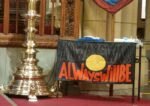
Banner displaying the Aboriginal sovereignty statement ‘Always Was, Always Will Be’ within the cathedral during the Peace Lecture. Photo by Dr Angela Baeza.
About the authors
Dr Pekeri Ruska is a Goenpul woman from North Stradbroke Island and a Research Fellow in the ARC Centre of Excellence for Indigenous Futures at the University of Queensland. Her research extends Indigenous sovereignty theory by providing its ongoing practice among Quandamooka people.
Dr Krystal Lockwood is a Gumbaynggirr and Dunghutti woman, and Research Fellow in the ARC Centre of Excellence for Indigenous Futures at The University of Queensland. Her work explores both the impacts of carceral systems, and the ways First Nations peoples, families and communities create and sustain just futures.
Dr Angela Baeza is a Diaguita woman from the Chilean desert, educator, and a Research Fellow at the ARC Centre of Excellence for Indigenous Futures at The University of Queensland. Her research centre on relationships among Indigenous communities, schools, and support systems, guided by community knowledge and lived experiences.
See previous articles on peace and global health





Add Comment