

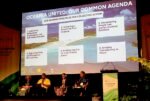


Below are a series of reports from the Pre-COP and related meetings in Fiji this past week, including:
- Pacific leaders set out climate and health solutions: Climate and Health Alliance
- Powerful witnesses: Dr Kimberly Humphrey, Co-Chair of Doctors for the Environment Australia
- Scene setter by Croakey columnist and contributor Isabelle Zhu-Maguire
- Climate health financing brief
- New heat and health resources
- Recommended reading
- What’s next for health along the road to COP31.
Pacific leaders set out climate and health solutions
Statement by Climate and Health Alliance
Pacific community leaders have called for urgent action to protect women from extreme heat and climate disasters, and for climate finance to reach the local health systems supporting them.
The calls are among the priorities emerging from a Pacific-led Talanoa, held in Fiji on Thursday ahead of COP31, which brought together lived experience, community knowledge and expertise to determine shared climate and health priorities for the region.
The Talanoa was attended by 85 people representing many Pacific countries, including Kiribati, Tuvalu, Samoa, New Caledonia, Fiji, Tonga, Aotearoa New Zealand and Australia’s Torres Strait Islands.
Climate change is already affecting the conditions that underpin health and wellbeing across the Pacific, from safe water, food and sanitation to functioning health services, homes and livelihoods, maternal and child health, mental health, and culture and connection to place.
But the Pacific climate story is not one of a region waiting for others to act on its behalf.
Pacific peoples are rights-holders, defenders and leaders who have driven the global movement for climate justice for decades. They bring knowledge, lived experience and solutions to a crisis they have done little to create.
Those solutions were the focus of the Pacific Climate and Health Talanoa, held behind closed doors in Nadi, Fiji on Thursday, led by the Climate and Health Alliance (CAHA) in partnership with the Alliance for Future Generations Fiji (AFGF).
Rather than asking Pacific communities to respond to priorities or solutions developed elsewhere, the Talanoa used a traditional Pacific methodology to put Pacific people at the centre of defining what needs to happen next.
The leaders also called for an end date for fossil fuel extraction and subsidies, and for money to flow to communities who are ready and willing to implement local solutions. “Right now, climate finance doesn’t reach people at the grassroots, it ends up in the pockets of businesses, governments and NGOs.”
The Talanoa identified six key priorities for action by governments and global decision-makers:
- Keep 1.5 alive: Pacific peoples are already seeing serious health impacts from the current level of warming. Moving beyond the 1.5 degree agreement is not an option. In fact, it was already a compromise from Pacific nations when it was agreed in 2015. This means an end to fossil fuels and its subsidies.
- Pacific people know how to adapt to climate change in their region: Put Pacific peoples, including Indigenous peoples, women, young people and people with disabilities, at the centre of climate decision-making.
- Communities need resources at the grassroots: Deliver accessible, predictable, long-term climate finance directly to communities who can invest in locally relevant solutions which suit their community and geography. Right now, climate finance doesn’t reach people at the grassroots; it ends up in the pockets of businesses, governments and NGOs.
- Make Pacific health systems resilient in the face of climate change: Pacific health systems, infrastructure, workforce and essential services are not prepared to withstand climate impacts like floods, storms and sea level rise.
- Invest in nature-based solutions to protect food, water and culture: The degradation of land goes beyond environmental impacts. It affects health, agriculture, water security, livelihoods and cultural continuity.
- Respect Pacific peoples’ legal rights to health, safety and culture: Protect Pacific peoples’ rights to health, safety, culture and self-determination, including control over Indigenous knowledge and data, and dignity in the face of loss and displacement.
The outcomes come at a pivotal moment for Pacific climate leadership, with Fiji hosting the Pre-COP and Australia preparing to serve as Negotiations Lead at COP31.
The Australian Government has committed to “centring Pacific priorities” in that role, creating both an opportunity and an obligation to ensure Pacific demands are heard and reflected in the negotiating process.

Pacific solutions, determined by Pacific people
Talanoa is a traditional Pacific approach to inclusive, open dialogue, bringing people together to share stories, knowledge and lived experience and build collective understanding and consensus.
It has been recognised by the Intergovernmental Panel on Climate Change (IPCC) as a method for gathering information and evidence in the Pacific.
The Pacific Climate and Health Talanoa was a closed-door consultation, with no media present. This was deliberate: creating a trusted, culturally grounded space where participants could speak openly and where the agenda could be shaped by Pacific perspectives rather than an external audience.
Unlike a conventional consultation built around predetermined questions, positions or solutions, the process allowed priorities to emerge from Pacific participants themselves.
Holding the Talanoa face-to-face in Fiji was also fundamental to the process. Trust, relationships and cultural context create space for experiences, knowledge and ideas that can be difficult to capture through conventional research, surveys or consultations conducted at a distance.
The result is a shift in the starting question: away from “what is happening to the Pacific?” and towards “what are Pacific people demanding happens next?”
CAHA CEO Michelle Isles said the distinction was fundamental as global attention turns towards COP31.: “For decades, the Pacific has been described through the impacts of climate change. But that is not the whole story. Pacific peoples are rights-holders, defenders and leaders in climate justice, with deep knowledge of their communities and clear solutions for protecting health, culture and future generations.
“This Talanoa built on over a decade of Pacific advocacy and was shaped through our engagement with women across Polynesia, Melanesia and Micronesia who are on the frontline of climate impacts. The Talanoa was an opportunity to hear these voices together in the culturally grounded space of Narewa village, home to the Traditional Owners of the lands where the pre-COP was held, to collectively determine the priorities they want decision-makers to act on.
“Health is fundamental to those priorities. Climate change reaches into almost every condition that allows people to live healthy lives, from water, food and housing to functioning health services, maternal and child health, mental health and connection to culture and place.
“Health and community leaders across the Pacific agreed that the world must move from ‘listening’ to the Pacific to handing over the keys and giving them the authority, resources and space to lead to safeguard health and the memory of future of cultural identity.”
What is good for the Pacific is good for the world
The solutions being advanced by Pacific peoples have significance far beyond the region.
Climate change is placing growing pressure on health systems, food and water security, communities and livelihoods around the world. Pacific communities bring decades of experience, knowledge and leadership in responding to these interconnected challenges.
Their leadership has global relevance. “Listening to Pacific leadership isn’t simply an act of solidarity. Pacific peoples hold knowledge and solutions that can help shape better climate and health policy for everyone,” Isles said.
“What is good for the Pacific is good for the world. The solutions being put forward here, and the way Pacific communities understand the connections between health, climate, culture, community and place, have lessons far beyond this region.”
Australia has committed to centring Pacific priorities
The Outcomes Statement now creates a pathway for Pacific priorities to travel from Fiji, through Australia’s health and political conversation, and ultimately into the COP31 negotiating process.
Australia will serve as Negotiations Lead at COP31, while Fiji will host the Pre-COP, placing Pacific priorities directly before global decision-makers in the lead-up to the negotiations.
The Australian Government has committed to “centring Pacific priorities” through its role. “Australia has made a clear commitment to centre Pacific priorities at COP31. Pacific peoples are now telling us what those priorities are,” Isles said.
“The test is what happens next. Australia has an opportunity to listen to Pacific demands, back Pacific-led solutions and use its role to ensure those priorities are carried into the negotiating rooms where global decisions will be made.
“This isn’t about Australia speaking for the Pacific. It is about Australia being accountable to the commitment it has made and using the platform it has at COP31 to ensure Pacific peoples can speak for themselves, and that the world listens.”
Pacific leadership at the centre
Liliana Lagibalavu, an Indigenous Fijian woman and gender and health advocate with the Alliance for Future Generations, emphasised the cultural significance of Talanoa.
“In the Pacific, the consultative Talanoa process is a crucial step for self-determination. We have used Talanoa for centuries to build trust and inclusive decision-making. When it comes to adapting to the climate crisis in the Pacific, evidence gathered through Talanoa carries more weight than scientific research.”
She said Pacific peoples carry the weight of their communities when they speak up for ambitious climate action.
“We have communities, people, children, mothers whose whole entire lives we are carrying on our back as we come into these rooms. These islands are looking at us to help amplify their voices at a time where they just don’t feel that they’ve been heard. Not just now, but for decades,” she said.
“The Australian Government has set itself up as our ally and friend… We are really hoping that this is not performative, that this allyship is genuine, that you truly are in this to help us.”

Powerful witnesses
Dr Kimberly Humphrey, Co-Chair, Doctors for The Environment Australia writes:
After COPs hosted in petrostates like the UAE and Azerbaijan, Pre-COP in Fiji and Tuvalu was a welcome change, centring those most affected by the climate crisis.
Across the Pacific, heat, food and water insecurity, and displacement are ever-present threats, and countries there have been adapting to them for many years. Their governments and health workers are powerful witnesses to what climate change is doing to health, and agents of change, often with limited resources.
That leadership deserves support, but finance remains elusive. Pre-COP saw only about US$15 million in new pledges to the Pacific Resilience Facility, well short of its US$500 million target for COP31.
Lower-income countries need an estimated US$310 to 365 billion a year for adaptation, yet international public adaptation finance was just US$26 billion in 2023.
With wealthy, high-emitting nations again not coming to the table to answer for their emissions, or pay what they owe, the stakes for COP31 are immense. As an example, at Pre-COP, UN climate chief Simon Stiell presented a survey in which nearly three in four maternal health professionals reported rising heat-related pregnancy complications.
He called for maternal and newborn care in adaptation plans, backed by resilient clinics and trained health workers. For COP31, a practical first step is prioritising resilient primary care, and the health workforce, in adaptation finance, consistent with the Belém Health Action Plan.
Adaptation alone will not protect health. As President of Negotiations, Australia must lead by ending new coal and gas approvals and committing to a transition away from fossil fuels.
The health of all communities depends on this: without rapid global emissions cuts, we will reach the limits of adaptation.
Setting the scene
Isabelle Zhu-Maguire writes:
Those interested in climate negotiations and geopolitics have all been looking to the Pacific this week for the UNFCCC pre-COP31 conference being held in Fiji and Tuvalu.
Amongst the talk about the conference being too expensive and having a disappointing number of leaders in attendance, I explain below what this conference is, what pre-COPs are meant to achieve, and what some of the discussions have looked like on the ground.
The United Nations Framework Convention on Climate Change (UNFCCC) is the international legal body which determines the responsibilities of all signatory states on climate change.
As a ‘framework convention’ UN mechanism, the UNFCCC is a large and moving beast. There are dozens of negotiating tracks from legalistic language on climate change mitigation, financing, education, gender and everything in between.
Because of the mammoth size of negotiations, the two-week Conferences of the Parties or ‘COPs’, which happen at the end of each year, are simply not enough time for countries to find consensus. Hence, there are multiple mechanisms and high-level events which facilitate discussions, negotiations, and coalition building amongst states all year.
The pre-COP is one such mechanism. On a typical year, the pre-COP is very small, very technical and held in the COP host country. Ministers are rare to be in attendance. It would be extraordinary to have any world leader attend.
Rather, in a usual pre-COP, it is technocrats and negotiating staff who are sent off to work. The negotiations are often contained to climate finance negotiating topics and remain constrained to closed doors and technicalities.
Why is this year’s pre-COP different?
I suppose the easy answer to why this pre-COP is so different is simply politics. But there is some very useful context to understand why.
Fiji has actually hosted a pre-COP conference before. In 2017, Fiji was the host (also known as the ‘presidency country’) of COP23. This role of ‘president’ is typically decided a few years before.
The presidency travels around the world each year via the UN’s geographical blocs. Countries within each bloc have to decided amongst themselves who will host. Türkiye and Australia are in ‘Western Europe and other’ bloc and Fiji was the host for ‘Asia-Pacific’. Since there are five blocs, the COP will return to each region after five years.
This role of president in 2017 gave Fiji control over the action agenda and significant influence over the negotiations. However, given the massive size of COP conferences, Fiji did not have the infrastructure to physically host tens of thousands of attendees.
So, 2017 saw the pre-COP come to Fiji with COP23 physically hosted on the UN campus in Bonn, Germany.
What is different this year compared to 2017 was well relayed to me by one Pacific activist – this year Fiji was being treated like a venue and not a host.
Whilst there are mechanisms in place which have allowed for consultation of Pacific Islanders in the set-up of this pre-COP, this event is still within the Türkiye-Australia COP31 co-presidency mandate and has been largely facilitated by Australia.
I note that a pre-COP in the Pacific was always a part of the Australian bid to host COP31. But given the co-presidency arrangement of COP31 between Türkiye and Australia, this pre-COP politically signifies the compromise made.
However, this cynicism should not take away from fact that a Pre-COP in the Pacific is still significant and facilitates powerful, meaningful and nuanced conversations about Pacific experiences of climate harm.
What does pre-COP look like this year?
The pre-COP was largely being hosted in the tourism capital of Fiji – Nadi, which is on the western side of Fiji’s largest island Viti Levo.
A very small delegation of heads of states and world ministers did spend one night on Tuvalu. This ‘leaders’ trip’ takes a leaf about of the Pacific Islands Forum book, putting leaders together to intimately discuss contentious topics.
In Fiji, the pre-COP conference was physically being hosted over three hotels. The Sheraton on Denarau hosted the ‘Blue Zone’ where ministers, negotiators and a small number of approved civil society members and scientists actually participated in the negotiations. The ‘Green Zone’ is the public space and was hosted in the Sofitel on Denarau and the Crowne Plaza in Waikoloa. Apparently 3,000 people were in attendance across these three five-star hotel resorts.
As a member of civil society, I was relegated to the Green Zone where there were up to six parallel streams of panel-style events at once. These panels were chosen by the Australian Government from a list of 800 applications.
All attendees received free pre-COP branded merchandise upon registration and were provided with free food. These little luxuries add a level of comfort, but the thousands of free tote bags, bottles, and laptop cases do pose questions about unnecessary waste and consumption.
There were smoothly running electric buses carting us around. Local taxi drivers were also very busy but were complaining about the traffic.
Key points
There have been a few high-level announcements made, including Australia promising $7.29 million for Pacific renewables. However, attendees have noted this is a disappointingly small amount of money and comes from a $50 million pool already promised to the region.
There is also a pending ‘Taku Pakasoa Declaration’ mentioned by Prime Minister Anthony Albanese in his speech at the ‘Leader’s Opening Plenary’. You can watch the leaders’ plenary speeches on YouTube.
We also heard rumours that the leaders meeting in Tuvalu was not all smooth with Australians apparently ‘over-stepping’.
Civil society events in the Green Zone highlighted the need to include Pacific knowledges, stories, emotions, and sciences into climate discussions. This need is so prominent, and their exclusion has clearly been so harmful, that discussions have become upsettingly repetitive.
Outside of these events, there have been some protest demonstrations on the beaches. Several billboard campaigns at the airport and in the streets of Nadi from various Pacific and Australian organisations have targeted the negotiators and the Australian Government’s fossil fuel expansion.
Stickers have quickly become a currency in the conference, with laptops becoming populated by stickers with phrases like ‘Pacific Feminist’, ‘Protect Scott Reef’, ‘Make Polluters pay’, and ‘Protect our Island Homes’. With each day I notice attendees displaying more Palestinian keffiyehs and more West Papuan flags.
There are also many tourist families around the hotels, just staying for holidays. One must think they all accidently booked a trip to Fiji that they will never forget.
• Isabelle Zhu-Maguire is a PhD candidate at the Coral Bell School of Asia and Pacific Affairs, Department of International Relations within the Australian National University. Her thesis investigates the ways in which Australia listens and responds to the climate advocacy of Pacific Island Nations. She contributes the regular Croakey column, Pacific Islands focus. Declaration: This report is supported by an Australian Communities Foundation grant provided to the Climate and Health Alliance. The grant is helping to support Croakey Conference News Service coverage of Pre-COP and COP31 meetings.
Climate health financing
 The Western Pacific Region of the World Health Organization released a brief to help countries identify sources for climate finance that can help address health issues.
“When designed and targeted well, investments to address climate change can deliver substantial health benefits, including reduced disease burden, improved air quality, enhanced productivity, lower health system costs and stronger community resilience,” says the brief.
It highlights many ways the climate crisis is exacerbating pressure on health systems – through increased demand, including for emergency care, disease control and disaster responses. At the same time, countries must invest in climate-resilient health infrastructure, supply chains and service delivery models to withstand growing climate risks, and must also decarbonise the health sector
Together, these adaptation, mitigation and loss-and-damage needs are generating substantial financing requirements that extend well beyond the scope of traditional health system budgeting and funding mechanisms, says the brief.
Without additional investment, health systems across the Western Pacific Region risk service disruptions, worsening health outcomes and far greater long term fiscal losses, it says.
The same might be said for many other regions as well, Croakey suspects.
New heat resources
 Meanwhile, a Global Heat Forum was held in Bangkok from 6-9 October, with experts discussing the importance of early warnings linked to health action plans, climate-smart urban planning for cooler streets and homes, and legislative protection for workers in factories, fields and construction sites.
An executive summary of a forthcoming report, ‘Extreme heat and health: Global evidence for action’, was released. The report will provide a policy-relevant assessment of the current state of scientific knowledge on health risks associated with extreme heat and evidence-based measures to reduce those risks.
Policy briefs were also released to address questions often asked by decision-makers, including:
- What are the most effective policies and interventions to protect people from extreme heat?
- How can heat-related inequities be reduced most effectively?
- How can long-term planning, governance and urban development strategies best protect people from extreme heat?
- How does extreme heat affect worker health and safety, and what policy actions are needed to protect the global workforce?
- What are the health risks of indoor heat, and what is known about reducing them?
A Global Call to Action on Heat and Women’s Health was also launched at Pre-COP31 in Fiji, urging governments to protect women and babies from the health impacts of extreme heat.
As temperatures rise, pregnant and postpartum women and their babies face growing risks to their health, it says.
To understand how extreme heat is affecting maternal and newborn health, Wellcome commissioned a survey of 1,000 healthcare professionals working in pregnancy, childbirth, postnatal and newborn care across Australia, Brazil, India, the UK and Zimbabwe.
Fndings include:
- 73 percent reported that heat-linked cases of complications have increased over the past five years.
- 81 percent are concerned that, without action, extreme heat will pose a growing risk to maternal, foetal and newborn health.
- 98 percent had cared for a woman or baby whose health they believed had been affected by extreme heat.
- 92 percent want more training, guidance and resources to help protect pregnant women during pregnancy.
Further reading
The Conversation: Pacific people pay exorbitant prices for energy. Rich countries should back their renewable transition
This article states: “Australia announced it would spend a modest A$13 million to help Pacific nations electrify and transition to renewables, including $7.3 million for energy professionals to lead the region’s transition, and money for solar-powered schools in Fiji and renewable projects in PNG. While these initiatives are welcome, this is not new money; these projects are funded out of the government’s Pacific program, launched at COP29 in 2024.”
It also says that around 80 percent of the Pacific’s energy supply comes from imported oil products, with Pacific nations spending between 10 and 25 percent of their GDP on fossil fuel imports, and the average Pacific island citizen paying some of the world’s highest electricity prices, almost three times the global average.
The authors say Australia should support Pacific nations to replace diesel-powered electricity with renewable technology, including decentralised solar energy systems with battery storage, with three key priorities:
- Ensure local ownership of the technology
- Train and support local technicians to maintain, repair and care for renewable energy systems
- Provide sufficient funding for the purchase of replacement parts over the life of the system.
National Indigenous Times: What the world can learn from the Pacific
Professor Sir Collin Tukuitonga, Co-Drector of the University of Auckland’s Te Poutoko Ora a Kiwa, Centre for Pacific and Global Health, joined pre-COP31 discussions convened by the WHO Asia-Pacific Centre for Environment and Health (ACE), to explore the health co-benefits of climate action.
Co-hosted by Dr Sandro Demaio and Dr Liz Bennet from ACE on 7 October, the meeting also included WHO Regional Director Dr Saia Ma’u Piukala, and Australia’s Special Envoy for Climate Change Adaptation and Resilience Kate Thwaites.

Professor Sir Collin Tukuitonga writes in the NIT article about the long history of Pacific peoples in adapting to challenges. He noted that innovation can emerge from Indigenous knowledge systems, community leadership and collective action.
“For centuries, Pacific societies have adapted to environmental change through collective decision-making, stewardship of natural resources, intergenerational knowledge systems and a deep understanding of the relationship between people and place. These approaches are proving remarkably relevant in a world searching for sustainable pathways forward,” he said.
“For generations, Pacific peoples have developed solutions to complex challenges using approaches grounded in collective responsibility, long-term thinking and enduring relationships with people and place. These achievements may not always dominate headlines, but they are helping shape international law, environmental policy, public health and scientific discovery.
“As the world prepares for COP31, perhaps the most important question is not what the Pacific needs from the world, but what the world can learn from the Pacific.”
• Sir Collin is a Niuean-born New Zealand/Aotearoa doctor, public health academic, public policy expert, and advocate for reducing health inequalities of Māori and Pasifika people.
Next on the road to COP31
13-14 October: A CAHA’s Leaders Summit in Parliament House, Canberra, bringing together representatives from health, youth and climate organisations, First Nations communities and government.
5-7 November: COY21, Antalya, Türkiye. CAHA will co-host the Conference of Children and Youth for Climate Action (COY21), bringing together children and young people from around the world to connect, exchange ideas and build their capacity to engage meaningfully in the UNFCCC process.
9-20 November: COP31, Antalya, Türkiye. CAHA will coordinate a delegation comprising youth, Indigenous and Pacific representatives, to build attention and support for Pacific demands for climate justice and health equity.
According to the WHO, COP31 marks an important step for global climate and health action. Health is one of 10 priority themes of the COP31 Action Agenda, “Dynamic and Resilient Health Systems”, and a dedicated Health Day will take place on 9 November, the first day of COP31.
See Croakey’s archive of articles on COP31 and on climate and health





Add Comment