



A voice on the world stage
Chloe Pigneguy
GLOBAL INFLUENCE Travelling to Geneva as part of World Physiotherapy’s global delegation to the World Health Assembly, APA National President Dr Rik Dawson found himself at the centre of international conversations about rehabilitation, aging and musculoskeletal care. Melissa Mitchell reports.
When APA National President Dr Rik Dawson MACP accepted an invitation to join World Physiotherapy’s delegation to the 79th World Health Assembly in Geneva, Switzerland, it represented an opportunity for Australian physiotherapy to influence the future of rehabilitation, healthy aging and musculoskeletal care.
Held this year on 18–23 May, the Assembly is the World Health Organization’s (WHO) decision-making body, bringing together health ministers, government representatives and global health leaders to determine international health priorities.
Rik was one of just five members of the World Physiotherapy delegation, reflecting his expertise and Australia’s growing reputation as a global leader in physiotherapy research, health economics and innovative models of care.
‘It was a fantastic opportunity to elevate the value of physio internationally and reinforce our domestic agenda,’ Rik says of the event. World Physiotherapy invited Rik because of his dual expertise as APA National President and as a researcher specialising in healthy aging and falls prevention.
His experience proved particularly valuable during discussions on healthy aging, rehabilitation and musculoskeletal health – areas expected to become increasingly important as populations age.
Australia being the first country to release an economic value of physiotherapy report, the APA’s Value of physiotherapy in Australia, contributed to the invitation, Rik says.
‘I think a key reason I was invited was the APA’s sustained investment in evidence-based advocacy, particularly our work embedding health economic analysis into our evidence assets. That investment has strengthened the profession’s credibility and influence.’
During the Assembly, Rik attended discussions on healthy aging, chronic pain, rehabilitation frameworks, assistive technology and healthcare economics.
These forums give governments and professional organisations opportunities to exchange ideas, showcase innovative models of care and influence future policy. Rik says they have significant implications for Australian physiotherapists.
‘Many governments are there, including Australia’s, and they hear about innovative models of care.
Often that’s the opportunity for physiotherapy to be talked about.’ Rik says the conversations reinforce Australia’s domestic advocacy priorities while exposing governments to successful approaches from around the world.
‘World Physiotherapy has made it a strategic goal to raise physiotherapy within WHO – and they have. We are in the top five health professions. It does elevate our standing internationally.’
A key part of Rik’s role was representing World Physiotherapy in conversations about aging, where physiotherapy was recognised as a critical contributor to healthier, more independent aging populations.
He also addressed the WHO’s proposed rehabilitation outcomes framework, advocating for better recognition of allied health professions and improved workforce data.
Current international rehabilitation measures largely overlook allied health, making it difficult to understand workforce capacity or plan future rehabilitation services, particularly in low- and middle-income countries.
‘There need to be some measurements on workforce. We need to understand what the allied health workforce is in developing and low- and middle-income countries so that we understand how to support those countries.’
Improving rehabilitation data, Rik adds, is about much more than numbers.
‘Rehabilitation may commence with a medical intervention but when it comes to improving functional and quality of life outcomes, physiotherapy plays an enormous role.
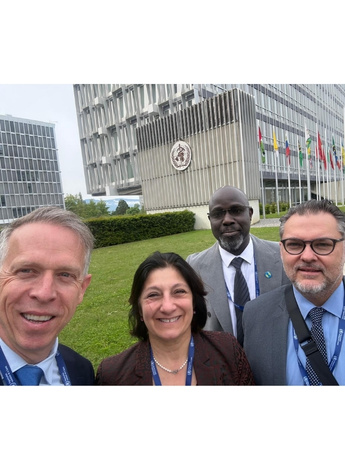
Rik Dawson outside the WHO headquarters in Geneva with French National Council of Physiotherapists President Pascale Mathieu, World Physiotherapy CEO Dr Sidy Dieye and World Physiotherapy President Mike Landry during the 79th World Health Assembly.
Physiotherapists are positioned to be the number one first contact practitioner for musculoskeletal issues. We have that as a domestic advocacy agenda item and we were promoting that internationally.’
Australia’s leadership in first contact physiotherapy and the APA’s work demonstrating the economic value of physiotherapy attracted considerable international interest, Rik says, noting that Australia’s evidence base is helping to shape conversations well beyond its borders.
‘We’ve got the evidence to say that physiotherapists are superior at assessing, diagnosing and directing people onto the right pathway, which may be surgical and operative or may be conservative and physio-led.’
Rik was chosen to deliver World Physiotherapy’s official statement on the WHO’s global strategy for integrated emergency, critical and operative care.
The invitation to make a statement reflected physiotherapy’s growing influence within the global health community. However, international events intervened.
Delays caused by discussions on conflict, Ebola and malaria pushed the Assembly agenda back by two days. Despite extending his stay in Geneva by a day, Rik didn’t get the opportunity to address the Assembly floor.
Instead, another World Physiotherapy representative eventually delivered the statement.
‘It was a big thing for World Physiotherapy to be invited to speak on non-operative care pathways.’ Although he did not personally present the statement, its message reflected one of the delegation’s key priorities – that rehabilitation should be integrated into healthcare from the outset rather than introduced only after medical treatment.
The statement read: ‘Rehabilitation plays a vital role in emergency, critical and operative care – supporting recovery, preventing complications and facilitating the functioning that makes survival meaningful.
Evidence confirms that strengthening rehabilitation across all levels of care contributes to the effectiveness and efficiency of health services and reduces pressure on overstretched emergency, critical and operative care systems.
‘World Physiotherapy, supported by the World Rehabilitation Alliance, is committed to implementation of the draft global strategy for integrated emergency, critical and operative care.
Rehabilitation must not be an afterthought but included from the outset and integrated as a routine standard of care for conditions addressable by emergency, critical and operative care.’
The Assembly also provided opportunities to examine how different countries are responding to aging populations.
Rik says he was particularly impressed by communitybased physiotherapy programs in Taiwan and Singapore, where publicly funded services focus on reablement, falls prevention and maintaining independence through tailored exercise and community physiotherapy.
Looking ahead, Rik expects healthy aging and musculoskeletal health to become increasingly important priorities for both the WHO and national governments.
‘Aging and musculoskeletal conditions are going to cost society so much and they’re interrelated.’
Attending the World Health Assembly was professionally rewarding and deeply inspiring for Rik, who describes it as ‘a highlight of my professional career’.
He says physiotherapy will play an increasing central role as countries seek cost-effective ways to improve quality of life, reduce hospital admissions and support aging populations.
‘We need to invest in physiotherapy.’







Add Comment