

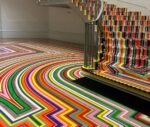


During a recent visit to Canada, Professor Bronwyn Fredericks was captivated by a colourful exhibition at the Vancouver Art Gallery, and below shares her delight in the experience.
Bronwyn Fredericks writes:
I was captivated as soon as I saw the work Zobop (Colour-Chrome) by Scottish artist Jim Lambie at the Vancouver Art Gallery. Installed in the rotunda of the Art Gallery, it fills every inch of floor space.
Zobop (Colour-Chrome) transforms what is a neoclassical architectural space in a building built between 1906 and 1911 into something filled with colour, and movement. This is why I was captivated.
I asked one of the security workers if I could walk on it, and was told I could, and additionally to walk up the stairs if I wanted to get to the second floor or use the elevator around the corner. The rotunda is a thoroughfare from one section of the gallery to another.
At that point I noticed other people had come into the space and were also staring in amazement or maybe disbelief. They chatted to each other and then to me. The artwork engaged us as individuals and then fostered our engagement with each other in the energy the work created within the space.
I walked into the space and absorbed it. I then sat on the steps to gain a closer understanding of the surface.

It was then that I realised the work was not painted, but made of different widths, colours and textures of tape. An array of vinyl tapes that you might use in packing, plumbing, and so forth. The floor, stairs, and landing were all covered in it.
This had me in awe; imagine the patience it took to ensure the patterns and the lines were straight, and didn’t overlap the other lines and the days, and weeks involved in its installation. The security worker said it took five to six weeks to install the work. Care is taken with the choices of colours, to provide movement, and energy. Not one of the colours stands out and or overshadows the others. They all work together, in collaboration.
I thought about the artist Jim Lambie, and the process of creating something that challenges what art is and engages and challenges the viewer. There is no way to be a passive observer of Zobop (Colour-Chrome), as one must walk through the space to get to another gallery or to the next floor via the steps or the elevator.
Lambie transformed the rotunda from being a functional off-white architectural space into an immersive artwork. I felt like even my movement in the space became part of the energy, and when I sat on the stairs within the space, I too became part of the artwork.
On returning to my hotel at the end of the day, I looked up other examples of Jim Lambie’s work and discovered that he is renowned for work which includes mixed-media.
Based in Glasgow, he has a whole series of works which have been installed across the world that also feature vinyl tapes, along with other everyday items. They are all experiential in the same way as Zobop (Colour-Chrome). They are not for passive observation.
I felt happy after being in the space and engaged and uplifted. The work resists confinement other than via the walls and steps, which are structurally fixed in a building originally built for the Provincial Law Courts.
I didn’t feel confined by what is or is not art after experiencing it, and wondered whether the artwork itself was not just an installation but also an intervention asking, what is in fact art?
• Zobop (Colour-Chrome) opened at the Vancouver Art Gallery on 22 October 2025 and will finish on 12 October 2026. Bronwyn visited the gallery on the afternoon of 23 July 2026.

Author details
Professor Bronwyn Fredericks is an Indigenous woman from south-east Queensland, and the Deputy Vice-Chancellor (Indigenous Engagement) at The University of Queensland, a theme lead with the ARC Centre of Excellence for Indigenous Futures, and Chair of Croakey Health Media.
Previously at Croakey
- Reflections on a mural: If We Lose Our Reef, We Lose Ourselves
- After the Rain: an incredible experience and creative achievement
- Artistic interrogations of artificial intelligence highlight environmental health impacts
- When digital archiving fails: the art of technological obsolescence
See Croakey’s archive of articles on the arts and health





Add Comment