



Digital check-ins, wayfinding, patient flow and outpatient prescribing systems will feature as part of the digital technology at the new Dunedin Hospital Outpatient Building when it opens later this year.
The five-storey building will use self-service check-in kiosks and digital wayfinding, supported by a patient flow system that can send reminders and track patients as they move between clinics and other departments.

Health NZ Digital Delivery Services’ Phil Baskerville told Pulse+IT the technology was intended to make it easier for patients to navigate the building while giving staff greater visibility of patient journeys.
“When people come in, they’ll be able to find themselves like they do at an airport and basically get guided to the waiting room – a clinic waiting room,” Mr Baskerville said.
“Sitting behind that is a management system, which reviews people and sends them reminders – and also helps move them around the building so staff can see where people are – especially if they’ve got sort of multi-departmental visits.”
Mr Baskerville said the approach was “digital first, but it’s not digital exclusive,” with patients still able to check in without using their own device.
Health NZ has committed $82.4 million of the $225.5 million allocated in Budget 2022 for the New Dunedin Hospital digital programme to the Outpatient Building.
Patient portal
The building will use patient journey boards that allow staff to see where patients are, while appointment reminders will be sent electronically.
A patient portal will also be available in time for the building’s opening – it will not be initially used widely.
The portal will allow patients to view upcoming appointments, confirm attendance, request a reschedule, check in using a mobile device and receive directions to their clinic.
Mr Baskerville said accessibility had been a particular focus of the portal work, including for patients who may find using a physical kiosk difficult.
“We have done a lot of work with the app to make sure that it is accessible,” Mr Baskerville said.
Health NZ will initially concentrate on ensuring the workflows supporting the portal were working for staff before enabling more functionality for patients.
The portal isn’t a general mechanism for patients to receive clinical results, with Mr Baskerville noting the release of some results, particularly MRI and CT findings, could require greater clinician involvement, while existing arrangements for areas such as blood test results will continue.
Existing clinical systems retained
The outpatient building will not introduce a new electronic medical record or patient administration platform.
Instead, Health NZ has built on the South Island’s existing HealthConnect South clinical environment and patient administration system.
Mr Baskerville said the project had deliberately reused existing systems where possible.
“We’ve enhanced that, and we haven’t implemented anything new,” he said.
“Apart from a clinic room scheduling solution, which integrates into the patient administration system, there’s nothing new we’ve implemented in that regard.
“It’s all been enhancements and reuse from other tools that are already in the HNZ stable.”
Clinic rooms will be centrally scheduled rather than permanently assigned to individual services, with the facility moving towards morning and afternoon clinic sessions.
Health NZ has also centralised internal and external referrals and carried out work within the regional clinical portal, including electronic patient surveys and text messaging.
The project has also been tasked with removing paper medical records, although Mr Baskerville said this did not mean eliminating all paper from the facility.
E-prescribing and imaging
The outpatient building will use electronic outpatient prescribing, with Southern becoming the first South Island district to introduce the Octans Meds outpatient prescribing tool.
The system is already being trialled at Dunedin Hospital ahead of the new building opening and works with existing prescribing technology, with other South Island districts hoping to adopt it in 2027.
Mr Baskerville said prescriptions could be lodged electronically and sent to a patient’s chosen pharmacy.
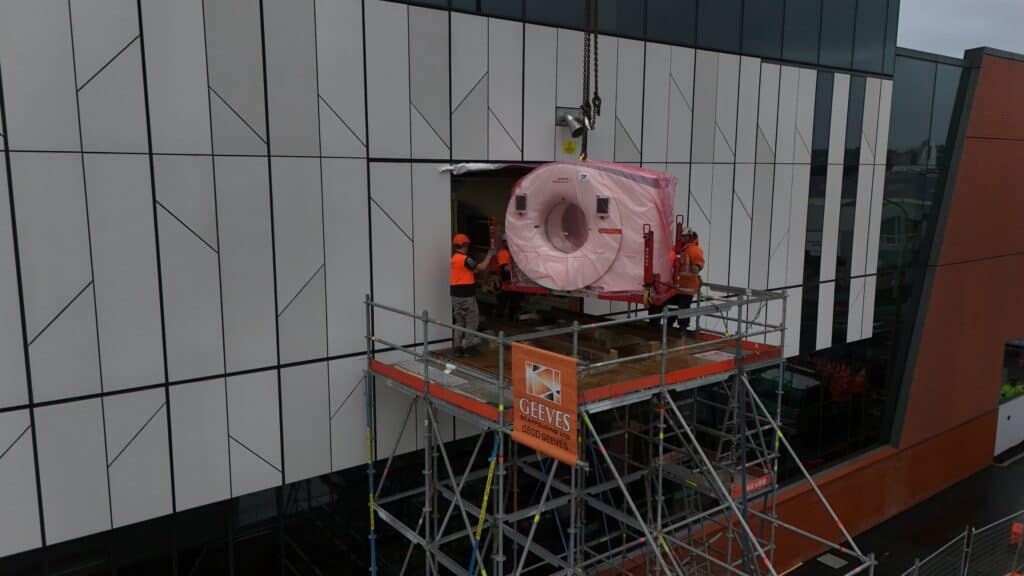
Meanwhile, new MRI and CT scanners installed for the facility will connect into the same radiology information systems already used by Dunedin Hospital.
The imaging equipment is being integrated into existing systems as part of commissioning, meaning clinicians should not have to learn a separate radiology environment when the building opens.
Location-grade Wi-Fi
Significant work had also gone into digital infrastructure that patients and clinicians may not directly see.
The building has more than 300 wireless access points providing what Mr Baskerville described as “location-grade Wi-Fi”.
The network will allow Health NZ to locate tagged equipment within the building using Wi-Fi positioning.
“We’ll be able to tag high-value equipment or frequently used equipment such as wheelchairs or ultrasound machines and be able to go and find it – as opposed to wandering around the building looking in cupboards,” he said.
A distributed antenna system has also been installed in partnership with the Rural Connectivity Group, creating in-building cellular coverage where mobile reception would otherwise drop away.
The facility has resilient network connectivity back to the existing Dunedin Hospital, new firewalls and redundant infrastructure including back-up cooling for communications rooms.
Standard for future
Mr Baskerville said one of the project’s less visible legacies was the development of a new standard for cabling and communications rooms.
The standard covers areas including heating, cooling, power, device capacity and cable runs and has been agreed for use across new hospital builds.
The same approach was being used for the Nelson and Whangārei hospital developments, with Health NZ noting the Dunedin digital programme was a model for upgrades at the two hospitals.
Mr Baskerville said the infrastructure had been designed around a “long-life, loose-fit” approach, allowing the building to accommodate future technology and changes to clinical services.
Commissioning underway
Health NZ’s digital teams have now moved into the building and are carrying out commissioning and readiness work ahead of opening.
The work includes checking installed computers and devices, Wi-Fi, digital signage and facility systems room by room.
Staff will also begin simulations in the building – including testing nurse call systems and integration between clinical and facility technology.
Mr Baskerville said most software releases were now in production, with the focus shifting to training, commissioning and support for opening.
“The software solutions ran hard and fast for quite a while, but they’ve sort of had their last release into production, and now it’s focused on that readiness training, commissioning, hypercare, making sure everyone knows the plans and the systems to support opening.”
The new outpatient building is expected to open later this year.





Add Comment