


Triple titling is icing on the cake
Melissa Mitchell
For most physiotherapists, achieving APA titling in a speciality area represents the culmination of years of study, clinical reflection and professional growth. For Saurabh ‘Sam’ Bhojwani it became a foundation of something more rare – a unique combination of expertise that has positioned him as the only physiotherapist in Australia to hold APA titles in musculoskeletal, sports and exercise, and occupational health physiotherapy.
As it does for many clinicians, Sam Bhojwani MACP’s physiotherapy journey began on the treatment table rather than in the classroom.
As a young boy growing up in a small town in northern India, Sam was obsessed with cricket and dreamed of a future in the sport.
When a knee injury sidelined him as a junior player, a physiotherapist helped him return to the game.
In addition to managing the injury, the physiotherapist explained the reasons behind the treatment, taught him how to better manage his body and empowered him to prevent future problems.
The experience opened his eyes to a profession that combined science, problem-solving and patient education.
‘I realised this is a great profession to be in, pretty noble, and the person who treated me really educated me about how to manage injuries as a cricketer.’
The encounter ultimately led him towards physiotherapy as a career.
Sam’s initial ambitions were relatively straightforward; sport was the obvious attraction, particularly in a country where cricket occupies such a significant cultural place.
Becoming a sports physiotherapist seemed like Sam’s ultimate career destination. Instead, his professional journey would take him on a far broader and more complex path.
After completing his physiotherapy degree in India, Sam moved to Australia in 2007.
Like many internationally qualified physiotherapists, he faced the challenge of navigating the Australian Physiotherapy Council examination process before he could practise.
Passing the exams on his first attempt proved to be a pivotal moment.
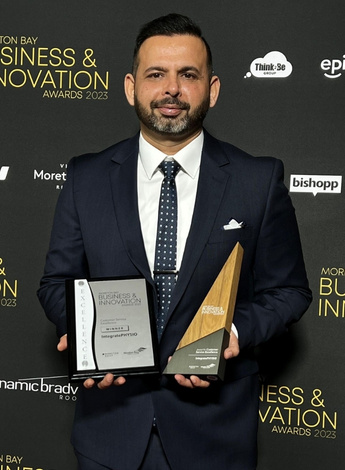
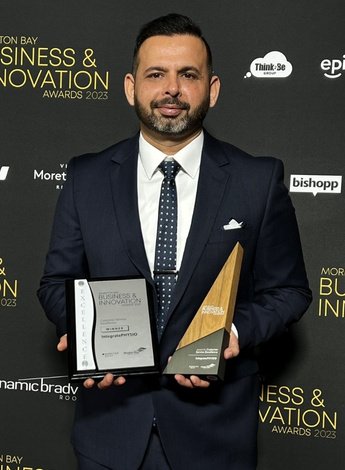
Sam Bhojwani’s practices have won many major awards.
It opened the door to a new professional life and provided an opportunity that would shape everything that followed.
Sam’s first role in Australia was within a hospital setting in Adelaide.
While hospital practice was familiar territory for Sam, who had worked in hospitals in India, his introduction to Australian private practice proved far more confronting.
Suddenly he was treating patients who were paying directly for care and expecting meaningful outcomes.
The experience exposed gaps in his knowledge and challenged him to think differently about clinical practice.
Rather than viewing those gaps as weaknesses, Sam saw them as motivation. The desire to continually improve became a defining part of his career.
It also laid the groundwork for a professional philosophy centred on lifelong learning and evidence-informed practice.
‘As a physiotherapist, and as a health professional in general, my philosophy is that you should always strive to learn more, achieve more, because the day you say “I know everything” is probably the end of your career.’
After more than a decade working in private practice, Sam recognised that experience alone was no longer enough.
While he had developed strong clinical skills, he believed there were still areas where further education would deepen his understanding and strengthen his clinical reasoning.
At the time, Sam was balancing the challenging demands of a family with two young children and working in private practice. Returning to university was not an easy decision.
He applied for a Master of Physiotherapy (Musculoskeletal Physiotherapy) at the University of Queensland and found that competition for a place on the course was fierce, with hundreds of applicants applying for a small number of positions.
Securing a place marked the beginning of a new chapter for Sam. He acknowledges that the postgraduate experience challenged him academically and clinically.
On its completion, he became aware that the qualification made him eligible for APA titling.
For the first time Sam began to appreciate the significance of formal recognition of advanced practice expertise.
Completing his degree and becoming an APA Titled Musculoskeletal Physiotherapist in 2017 brought benefits beyond the credential itself.
It increased Sam’s confidence as a clinician, enhanced his standing with the professional community and helped support his growth.
The experience also demonstrated the value of advanced education in refining clinical decision-making and strengthening diagnostic reasoning.
‘I realised that the master’s titling gave me recognition in the region.
‘And it also gave me the confidence to expand the business, to become better.’
In 2020, Sam and his wife, APA Titled Women’s, Men’s and Pelvic Health Physiotherapist Yamini Kapoor MACP, opened IntegratePHYSIO.
Its first location was in the north Brisbane suburb of Warner. They opened a second clinic at Narangba and now have a team of 18 people across the sites, comprising physiotherapists, exercise physiologists and administration staff.
As his clinical work expanded, so too did Sam’s interests. Increasing involvement in occupational health led him into workplace injury management, injury prevention programs, functional capacity assessments and consultations across industrial settings.
.jpg)
Sam and his wife, APA Titled Women’s, Men’s and Pelvic Health Physiotherapist Yamini Kapoor MACP.
Through site visits and industry partnerships, Sam developed a deeper appreciation for the complex interaction between health, work participation and recovery.
At the same time, he continued to treat athletes and active individuals, maintaining a longstanding interest in sports physiotherapy.
Eventually, both pathways converged. In 2024, Sam embarked on two major professional development pathways simultaneously.
While pursuing occupational health titling through the APA experiential pathway, Sam also commenced postgraduate sports physiotherapy studies, again through the University of Queensland.
Neither pathway was straightforward, though. What initially appeared to be a manageable professional development exercise quickly became a lengthy and demanding process involving academic study, reflective practice, assessment requirements and extensive time commitments.
The pressure extended well beyond study. Sam was also managing a successful private practice, supporting his young family and balancing the competing demands familiar to many physiotherapists in leadership positions.
Long clinical days were often followed by evening study sessions and weekends devoted to assignments, assessments and professional development requirements.
‘There were times when I was covering for sick staff, with pressures at home.
‘And at the same time I had to be at uni two to three days a week. Sometimes I thought, why am I doing this?’
Yet each time he considered stepping away, and he admits there were many of those times, Sam returned to the same motivation. His patients.
The focus on patient outcomes became the driving force behind Sam’s persistence, determination and hard work.
The result was a milestone few could have anticipated. In early 2026, Sam achieved APA titling in both occupational health physiotherapy and sports and exercise physiotherapy.
While dual titling combinations such as musculoskeletal and sports and exercise physiotherapy are completed with some regularity, Sam’s combination of musculoskeletal, occupational health and sports and exercise titling is unique to him – he is currently the only physiotherapist in Australia to hold all three.
However, Sam does not view the achievement as simply accumulating credentials.
Instead, he believes the combined expertise has fundamentally changed the way he approaches patient care and how his patients see him.
‘Having those three titles together, I’ve seen a change in clients’ perception of me. They trust me differently; they respect me differently.
‘When they see the credentials, they’re like, “This guy must know what he’s doing.”
‘It signals to the community that you are the best possible person for them to get help from. That’s why our business has grown the way it has.
‘My wife also has titling – in women’s, men’s and pelvic health. She finished her postgraduate degree recently and she got her titling at the same time as I did.’
The musculoskeletal pathway strengthened Sam’s biopsychosocial approach to assessment and management.
The occupational health pathway broadened his perspective on work capacity, workplace demands and long-term functional outcomes, while the sports and exercise physiotherapy pathway enhanced his understanding of performance, rehabilitation progression and return-to-sport decision-making.
Together, they have changed the way he sees patients.
‘If you came to me 10 years ago with knee pain, I would look at the knee and go, okay, this is the problem; let’s fix this.’
Today, though, Sam considers presentations through a much wider lens.
‘I now start seeing that whole person, not just one problem.’
The integration of these three speciality areas has allowed Sam to connect clinical factors that might otherwise be overlooked.
Whether managing a worker recovering from injury, an athlete returning to competition or an individual balancing health challenges with occupational demands, Sam can draw on multiple perspectives to inform care.
The result, he believes, is more comprehensive management and better outcomes.
The impact of his triple titling goes beyond individual patient encounters. Within his practice, Sam actively encourages other physiotherapists to pursue postgraduate study and advanced professional development.
Several members of his team are currently undertaking further education, supported by a culture that values learning and clinical excellence.
Sam sees advanced training not as an end point but rather as an ongoing responsibility.
Mentorship has also played a central role throughout Sam’s journey. He credits numerous clinicians, educators, specialist physiotherapists and APA staff for helping him navigate the challenges of postgraduate training and titling.
Their guidance reinforced the importance of professional community and the willingness of experienced practitioners to support emerging leaders.
The experience has left him determined to do the same for others.
His message is particularly relevant for physiotherapists from international backgrounds who may question whether advanced professional recognition is within reach.
Having arrived in this country as a young graduate from a small town in India, Sam understands those doubts firsthand.
He also understands the opportunities available to clinicians willing to invest in their development.
‘I want to show others that this is possible, whether you’re from a small town or a metro city, whether you come from overseas or were born here.
‘I think the system here rewards hard work. If you work hard, you will arrive on the path you’re going towards. Trust the process.
‘I don’t think anything will stop you if you’re willing to work hard here. And that is the Australian way of life. I think no other country would give you that opportunity.’





Add Comment