

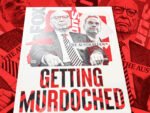


Introduction by Croakey: The dedication in the front of a new book, ‘Getting Murdoched: How Murdoch’s media wields power and punishment’, is as simple as it is powerful: “For the bullied”.
We have no shortage of books or academic inquiries investigating the power and influence of the Murdoch media empire. But journalists and academics Professor Andrew Dodd and Professor Matthew Ricketson had an interesting idea for a different take.
They coined an imaginary verb as the past participle of ‘murdoch’: “To be targeted or editorially attacked when one’s ideas or deeds do not accord with a media proprietor’s programs or publications. Murdoching hinders or harms those targeted and distorts and debases public discussion. It manifests in many forms, some of which resemble journalism. As in, ‘getting murdoched’.”
Their new book shares the stories of diverse people who have been murdoched, including Aboriginal academics and authors Professor Anita Heiss AM and Distinguished Professor Larissa Behrendt AO, Sarah Schwartz, a Jewish lawyer who has campaigned against Israel’s human rights abuses, as well as climate scientists, journalists and many others.
“Murdoch’s News empire has perfected dozens of ways of ruining reputations and damaging public discourse, not by practising fearless reporting to serve the public’s interest but by abusing people, punching down and crap journalism,” write the authors.
The book brings many public health lessons, including the importance of including the media in analyses of the commercial determinants of health, and of engaging with media policy as a critical upstream determinant of health and policy.
Dodd and Ricketson argue that regulatory failure and the concentration of corporate media power have enabled the Murdoch empire to block many progressive policies, from climate action to human rights and the Voice referendum.
Another key takeaway is the visceral harm that bullying causes; many of those featured in the book reported suffering serious mental health distress and trauma as a result, including suicidal ideation.
The book ends with a guide for surviving a murdoching, including tips for maintaining wellbeing. It also suggests supporting others. “If you know someone getting murdoched, consider reaching out to them and offering moral support. Even small gestures are deeply appreciated.”
With the permission of the authors, we publish an extra below about Benjamin Law’s experience of being murdoched after writing a Quarterly Essay about the Safe Schools program (references are available in the book).
Andrew Dodd and Matthew Ricketson write:
A murdoching may be aimed at individual progressives, or it may be directed at an entire progressive cause such as human rights. Even an innocuous‑sounding sex‑education campaign can draw the company’s ire.
In February 2016, The Australian ran a front‑page story headlined ‘Activists push taxpayer‑funded gay manual in schools’ and suggested that sex education and anti‑bullying program Safe Schools was advocating activism rather than promoting tolerance.
The program had been set up by the federal Liberal–National Coalition government and aimed to provide support for lesbian, gay, bisexual, transgender, intersex and queer school students. According to independent studies, LGBTIQA+ Australians were more likely to commit suicide than any demographic in the country.
The Australian went to the conservative Australian Christian Lobby for comment; spokeswoman Wendy Francis was quoted saying eleven‑year‑old children were too young to be taught about sexual orientation and transgender issues. ‘A lot of children are still pretty innocent about this stuff – these are adult concepts.’
Over the next year, familiar elements of the murdoching playbook were rolled out. Editorials and columns trenchantly damned the Safe Schools program. An alarmed parent reported – wrongly – that her son had been told he could wear a dress to school.
Roz Ward, a La Trobe University academic advising on how the program should be implemented, was pilloried for her left‑wing views and shamed for saying the Australian flag was ‘racist’.
The Minister for Education was pressured to roll back the program so he ordered an independent inquiry, which found the program was sound. He ignored their advice and downgraded the program anyway.
The Australian’s description of the program intensified: in February an editorial referred to the ‘so‑called Safe Schools Coalition’. In March it was the ‘not‑so‑safe schools program’. Come May it was ‘the gender fluidity Safe Schools program’, and by year’s end it had become the ‘Marxist inspired Safe Schools’.
In this one‑year period the newspaper published 200 stories about Safe Schools; that is 90,000 words.
Battleground
Clearly, sexuality and gender identity was becoming ‘a handy battleground to score points in a bigger culture war’, as Benjamin Law puts it.
Law is an openly gay Asian‑Australian writer who has written columns for News outlets. Alarmed by The Australian’s coverage, Law wrote a Quarterly Essay entitled Moral Panic 101. Apart from correcting some of the misleading coverage, Law’s essay provided on‑the‑ground reporting in schools about kids’ views on sexuality and gender identity and a primer on the nuances of queer politics, which he admits he knew little about.
Publication of Moral Panic 101 on 9 September 2017 coincided with the rancorous debate about the same‑sex marriage plebiscite. On 31 August, Law tweeted to his 77,000 followers: ‘Sometimes find myself wondering if I’d hate‑fuck all the antigay MPs in parliament if it meant they got the homophobia out of their system.’
Law maintained he had been joking and that hate‑fucking was a Generation Y term for ‘consensual sex with someone disagreeable’ – but he cheerfully admits the tweet was provocative. It triggered at least two reflexive responses from News.
First, he needed a roasting for his posting. But News was also deploying a ‘don’t look here, look over there’ strategy to avoid the substance of Law’s criticisms.
Two days after the essay’s publication, as Law began publicity, The Australian published a headline: ‘Writer’s “joke” tweet draws Coalition MPs’ fire’.
In the article, conservative politicians lined up to incinerate Law. One said he was undermining the campaign for same‑sex marriage, while another, Andrew Hastie, who before parliament had been a military officer, said ‘I’d like to see him try.’
Law had expected the newspaper to trawl through his ‘colourful Twitter history’ and was not surprised by the obligatory pile‑on by News’ columnists, or even by letter writers calling him a ‘would‑be rapist’, but admits he was blindsided when the first question in an interview about the essay with ABC television’s News Breakfast program was about his ‘disgraceful tweet’.
He shouldn’t have been, he reflects now, as the clear intention of The Australian’s article was to draw attention away from the content of his essay – and other news outlets were beginning to reflect that twisted conversation.
Then people from the queer community began getting in touch, asking, ‘Why would you write something about raping Andrew Hastie? The last thing we need during the same‑sex marriage debate is someone like you throwing out shit like that.’
Encouragement and advice
That the coverage was needling friends and allies he found as difficult to deal with as the threats online or the anonymous call at home one night with heavy breathing.
It was around this time Law received a letter from Larissa Behrendt, empathising with him, offering encouragement and echoing the advice she’d been given.
These attacks are designed to humiliate and are a form of psychological warfare … No one with a heart or soul could be unaffected by these vicious campaigns … The best advice someone gave me was that no matter what happens no one can take away your talent. That is truer of you than most. You are now part of a very exclusive and esteemed club. Our ideological enemies come for us because we are a threat. If we weren’t, they wouldn’t bother.
Law recalls her gesture ‘meant so much to me’, and he too resolved to do the same for others he saw being monstered in the media, like Osman Faruqi, a journalist who has worked at the ABC and The Age. From Manne to Behrendt to Law to Faruqi, an invisible daisy‑chain of support was created.
Meanwhile, Law realised he needed to wrest back control of his public image, and he did, seizing on negative tweets or Facebook posts about the hate‑fuck tweet ‘to put out my narrative and publicise the Quarterly Essay’.
He began engaging with people, both in the queer community and elsewhere, about what was actually going on, and found most accepted his explanation.
One in particular, he remembers, was a father who initially thought his tweet disgraceful. Benjamin gave him the context and how the essay was mainly about children’s safety and suggested he might read it.
The man did and came back to him saying, ‘I am so moved and so grateful that you wrote that. Weirdly, I wouldn’t have picked it up except for the original articles. I’ve never thought about what it might be like to have a son who is gay or came out as trans but you’ve forced me to confront some issues and helped me to feel more equipped, and I’m really grateful for that.’
Law appreciated the father’s honesty, and reflects wryly, ‘Wow, that would not have happened if The Australian had not attacked me!’
• Disclaimer from Melissa Sweet: I have known the book’s authors for many years, and have worked with them in various capacities.
See Croakey’s archive of articles under #CroakeyREAD





Add Comment