




Introduction by Croakey: Many health issues were on the agenda of the 50th Australian Labor Party National Conference, which took place against the backdrop of the rise of far-right populist politics and a devastating escalation of the climate emergency in Spain, France and elsewhere.
While the conference provided an opportunity to air some important health concerns, whether this translates into reform and investment in areas of need is another matter, reports Jason Staines.
Jason Staines writes:
Wide-ranging health issues – including gambling reform, climate change, oral health and voluntary assisted dying (VAD) – were on the agenda of the Australian Labor Party’s recent national conference in Adelaide, on Kaurna Country.
While many of the health-related discussions resulted in stronger platform language or renewed commitments, only one produced what advocates describe as a clear and relatively straightforward pathway to reform: removing Commonwealth legal barriers that prevent aspects of voluntary assisted dying (VAD) care from being delivered via telehealth.
The contrast with oral health, where delegates endorsed a roadmap towards improved access to dental services without a commitment to funding or a timetable, illustrates the different ways health reform moves through Australian politics.
In one case, advocates say only a small legislative amendment is needed. In another, years of policy development have yet to translate into significant change.
In both cases, a large question mark hangs over the extent of political commitment for action, especially given the Prime Minister’s well known opposition to expanding access to VAD through telehealth.
Some history
The conference’s clearest health policy development came in support for removing Commonwealth legal barriers affecting VAD consultations delivered by telehealth.
The issue stems from provisions inserted into the Commonwealth Criminal Code in 2005, when lawmakers sought to curb internet suicide chat rooms and websites promoting suicide. At the time, VAD was not lawful anywhere in Australia and telehealth was nowhere near as commonplace as it is today.
Following the Federal Court’s 2023 decision in Carr v Attorney-General (Cth), however, those provisions were found to apply to voluntary assisted dying because the Criminal Code’s prohibition on using a “carriage service” to counsel or incite suicide encompasses lawful VAD for the purposes of the federal legislation.
The practical consequences extend well beyond video consultations. Because “carriage service” includes telephone, email and internet communications, health practitioners in some jurisdictions have adopted highly conservative practices to minimise legal risk.
Depending on state guidance, this can mean doctors travelling hundreds of kilometres to conduct consultations in person, prescriptions being delivered by hand or post rather than electronically, and clinicians avoiding discussions that would ordinarily occur using secure telehealth systems.
Although there has never been a prosecution under these provisions in relation to voluntary assisted dying, advocates say the uncertainty has created significant barriers for patients and health professionals alike.
Equity concerns
Penny Hackett, president of Dying With Dignity, said the law was having a “significant effect” on the delivery of voluntary assisted dying despite there being no prosecutions in the 21 years since the offence was introduced.
She said terminally ill people living in regional and remote Australia, or those too frail to travel, were particularly disadvantaged, while doctors, pharmacists and care navigators often travelled hundreds or even thousands of kilometres to provide services that could otherwise be delivered remotely.
Hackett also argued the implications may extend beyond voluntary assisted dying itself.
She said there was a significant risk the provisions could also affect discussions between clinicians and patients about other lawful end-of-life decisions, such as refusing life-sustaining treatment or voluntarily stopping eating and drinking, because these conversations could potentially fall within the broad operation of the offence.
Health organisations, including the Australian Medical Association, Go Gentle Australia and Dying With Dignity, have called for the Commonwealth law to be amended.
Go Gentle Australia chief executive Dr Linda Swan said in a statement the conference vote was “a positive first step” towards improving equitable access to end-of-life care while preserving safeguards contained in state and territory VAD legislation.
Separately, she told Croakey that allowing telehealth “will not require any practitioner to use it”.
“The gold standard will always be in-person consultations and conversations,” she said. “But the reality is that sometimes this is simply not possible, or it is harmful to patients who, because of the distances involved or their deteriorating health, cannot travel to appointments. It is in these situations where telehealth should be an option, based on medical need.”
Swan said the restrictions affected “far wider implications on clinical care” than eligibility assessments alone.
“The ban on the use of a ‘carriage service’ has far wider implications on clinical care including preventing doctors from sending an eScript to the centralised VAD pharmacy and from providing follow-up phone or video conversations with patients to clarify steps in the process,” she told Croakey.
“The impact of restrictions on the dispensing of scripts can add a week or more delay – and not every patient has that time.”
Responding to concerns raised during the conference that end-of-life discussions were too complex or sensitive to be conducted by telephone or video, Swan told Croakey those concerns were “unfounded”.
“As befits the gravity of the request, the VAD application and assessment process as set out in every state and territory law, is deliberately careful. It involves multiple steps and is highly scrutinised. Australia’s laws are among the most regulated in the world.”
She said telehealth was already an established part of healthcare.
“If VAD is too complex or sensitive an issue for telephone or video in Australia then the same must be true for other serious life-and-death medical interventions that are routinely carried out via telehealth. These include palliative care.”
The legislative solution itself appears relatively straightforward.
Hackett said the issue could be resolved by adding a small number of words to the Criminal Code, making clear that the offence does not apply to acts lawfully carried out under state or territory voluntary assisted dying legislation.
Swan said Parliament was “not being asked to re-prosecute whether VAD should be allowed”.
“That debate has been had,” she said. “It is a much simpler question: now that voluntary assisted dying is legal, why are some dying Australians unable to access it?”
Progress needed
Asked what would constitute meaningful progress following the conference vote, Swan told Croakey: “Meaningful progress would be acceptance from the Government that this is an issue its own rank and file has prioritised as important for the equitable delivery of end-of-life care in rural and regional areas.”
“There is still work to do to ensure MPs from all political persuasions understand the issue and why this is a safe, practical and equitable reform.”
Whether that change occurs, however, is now a political rather than legal question. As Michelle Grattan reports in The Conversation, Crossbencher Kate Chaney already has a private member’s bill on the notice paper that would remove the ban on the use of telehealth.
Chaney has written this week to Rowland, with copies to Albanese and Tony Burke, leader of the House of Representatives, saying she will seek a suspension of standing orders to bring on her bill when parliament resumes on Tuesday week.
“People are enduring exhausting and painful travel to access VAD. Every week this anomaly remains unaddressed is a week in which that needless suffering continues,” Chaney wrote.
“I would ask that the Government provide Labor Members the opportunity of a free vote that the National Conference has endorsed, for the Suspension of Standing orders and on the Bill itself.”
Chaney’s next chance to bring forward her bill would be in September (there is a roster for private members’ bills), according to Grattan. Then, she could give a speech but, unless the government chose otherwise, the bill would then just languish like almost all private members’ bills.
Grattan reports that how the Cabinet divides on the issue will be significant: “Apart from Albanese and Rowland, Burke would presumably be against change – his political opposition to euthanasia goes back to when he worked closely with then Liberal MP the late Kevin Andrews to overturn the Northern Territory assisted dying law. Burke, not in federal parliament then, was executive director of Euthanasia No!.
“But on the other side of the argument is a weighty voice – that of Health Minister Mark Butler. Butler reportedly was influential in getting the issue debated at the Labor conference, part of a trade-off for the left going soft on other contentious matters.”
In The Zap this week, health policy expert Charles Maskell-Knight PSM reported that Attorney-General Michelle Rowland told the ALP conference: “I am personally not convinced that a person confronting an end-of-life decision shouldn’t be afforded the dignity of a personal face-to-face consultation with a medical practitioner.”
Maskell-Knight wrote: “With all due respect to the Attorney, this isn’t the Commonwealth’s business. State legislatures have undertaken exhaustive debates to develop and enact a system of VAD for their jurisdiction, and if they are prepared to countenance telehealth as part of the process, that should be a matter for them, and is nothing to do with a Commonwealth MP.
“Rowland should also consider that “a personal face-to-face consultation with a medical practitioner” might be a lot harder in most of NSW than in her electorate based on Blacktown, 30 kms west of the Sydney CBD”, he said.
Meantime, a spokesperson for the Attorney-General told Croakey that voluntary assisted dying “remains a very sensitive and personal issue”.
“The Albanese Government understands there are a range of complex issues arising out of the interaction between Commonwealth legislation and state and territory VAD schemes,” the spokesperson said. “We will continue to consider these issues in consultation with the states and territories.”
Oral health matters
If voluntary assisted dying demonstrated how a relatively small legal amendment can remove barriers to care, oral health highlighted a different challenge: that of translating longstanding commitments into practical reform in the face of many barriers, including bureaucratic and political inertia
Delegates agreed to strengthen Labor’s platform by committing to “develop a roadmap towards improved access to dental services, prioritising those with the greatest need”.
The wording replaces an earlier commitment that described oral health as “the missing element of Medicare” and promised consultation on universal access to affordable dental services.
Tan Nguyen, spokesperson for the National Oral Health Alliance, told Croakey the revised wording aligned with the alliance’s longstanding advocacy for a structured roadmap, rather than an immediate commitment to incorporating dental care into Medicare.
He said the process should be guided by expert advice, including through the appointment of a Commonwealth Chief Dental Officer.
Nguyen also suggested work on the next National Oral Health Plan was already well advanced; he understood it was awaiting final approval before consideration by Health Ministers. He expected the Government may seek to release the updated plan alongside new funding or program initiatives.
For health policy analyst Adjunct Associate Professor Lesley Russell, however, the key question is not the wording of the platform but whether it produces measurable change.
“The Albanese Government has paid lip service to the need for improved access to oral healthcare/dental services but it is clearly not on the agenda any time soon,” she told Croakey.
Russell pointed to the failure to replace the National Oral Health Plan 2015–2024 as an indication of the Government’s priorities.
Rather than waiting until universal dental care becomes financially feasible, she argues there are practical reforms that could begin immediately.
One priority would be treating dental caries as a preventable disease by focusing more strongly on children and preventive care. Another would be extending Medicare-funded dental services for people with conditions such as oral and head-and-neck cancers, where dental treatment is often an essential part of successful medical care rather than a separate issue altogether.
In previous analysis, Russell has argued Australia’s longstanding separation between medicine and dentistry no longer reflects contemporary evidence linking oral health with broader health outcomes. She says better integration of dental and medical services would improve care for patients with complex conditions while reducing avoidable costs to the health system.
Oral health expert Adjunct Associate Professor Leonie Short said older Australians should be a priority focus, and that progress at the conference was not enough “for the nearly 300,000 people who live in residential aged care homes in Australia”.
“Twice-daily oral care is often missed or seen as too difficult and time consuming to deliver. So older persons are living their lives with dirty teeth, gums and dentures, smelly mouths, pain and infection To me, this is widespread neglect and should be treated as elder abuse,” Short said in a statement to Croakey.
She said an absence of champions for dental reform, the lack of a dedicated consumer dental advocacy group and dentistry’s history of being separate from mainstream healthcare did not augur well for dental being put into Medicare anytinme soon.
“We need a strong union to champion our calls for a Senior Dental Benefits Scheme,” she said.
“I’m calling for a broad coalition of aged care organisations (COTA and OPAN), health and community service advocates (PHAA and ACOSS), dental groups (ADA and OHAA), and unions to lobby Federal Labor MP Fiona Phillips to help older Australians smile, talk and eat with confidence.”
Beyond the conference floor
The conference also considered a range of other issues with important health implications.
Delegates strengthened Labor’s language on gambling harm, including support for stronger regulation and annual reporting, although advocates continue to press for broader reforms recommended by the parliamentary Murphy inquiry.

Climate change featured prominently throughout the conference, but largely as an energy, environment and economic issue rather than a health priority.
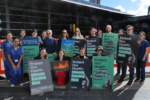
Dozens of health professionals participated in a Climate and Health Alliance (CAHA) Speak Out in front of the conference venue as part of a longer term campaign to put the National Health and Climate Strategy and a Climate Safety Plan on the Government’s agenda for investment.
Watch this video with Rowena Seutatia MacDonald, Youth Coordinator for the Pacific Islands Council of South Australia (PICSA), talking about climate impacts for Pacific Islands nations.
Michelle Isles, chief executive officer of CAHA, said climate change and sustainability “were not evident in any of the policy formulations on health at the conference”.
“This is a significant missed opportunity,” she told Croakey. “Climate change will drive the need for more dynamic health services and it was apparent that new policies have not been stress tested under future climate scenarios.”
Isles said the conference structure itself reflected that separation, with sessions divided between “A Strong and Healthy Society” and “Safeguarding Our Climate and Environment and Powering Australia’s Future”.
“It was unclear whether delegates are joining the dots that a healthy environment enables healthy society,” she said.
Isles said there were positives, noting that Climate Change Minister Chris Bowen, Assistant Minister Josh Wilson and Special Envoy for Climate Change Kate Thwaites understood the links between climate and health, and were embedding those issues into Australia’s preparations for COP31 and national adaptation planning.
Looking ahead to the coming spring and summer, CAHA president Dr Catherine Pendrey said governments needed to ensure GP clinics, hospitals, aged care facilities and other health services were prepared for increasingly frequent and severe climate-related disasters.
“The biggest concern for community health during the upcoming Australian spring and summer is the prospect of deadly bushfires, floods, storms and heatwaves,” she told Croakey.
Pendrey said Australia still lacked a dedicated National Health Adaptation Plan and called for greater investment in implementing the National Health and Climate Strategy as part of broader efforts to strengthen the health system’s resilience to climate change.
Meanwhile, extreme weather events in Europe, including heatwaves and devastating bushfires, are highlighting the issues at stake for healthcare systems and communities’ health, in the short and long-term.
First Nations
The conference also highlighted the many unresolved policy concerns for First Nations people following the defeat of the Voice referendum.
While Labor reaffirmed its commitment to implementing the Uluru Statement from the Heart, advocates said key elements — including truth-telling and agreement-making — remain unfinished.
Ahead of the conference, there were concerns that changes to the party’s platform could weaken support for establishing a Makarrata Commission. In the event, the conference produced no significant new commitments on First Nations reform.
Uluru Statement signatory Thomas Mayo said a national truth-telling process remained essential. “There needs to be a Makarrata commission, there needs to be national coordination on truth-telling and agreement-making,” he said.
The Kaurareg Aboriginal and Kalkalgal and Erubamle Torres Strait Islander man also expressed concern that racism had intensified since the 2023 referendum, saying Australia had “somewhat gone backwards” on Indigenous issues.
Former cabinet minister Ed Husic also used the conference to argue Labor should renew its commitment to Indigenous truth-telling. As he criticised what he described as the party becoming “allergic to dissent”, Husic warned that politicians needed to be prepared to publicly debate difficult issues rather than avoid disagreement.
Meanwhile, the Productivity Commission’s release this week of the 2026 Annual Data Compilation Report, which tracks Australia’s performance towards the targets and indicators in the National Agreement on Closing the Gap, shows that of the 19 targets, one has been met, three are on track to be met, five are improving but are not on track to be met and four are worsening.
The Australian Capital Territory, Tasmania and the Northern Territory have the highest number of targets showing no change or worsening.
“The deadline for meeting most of the targets is 2031 so we are already past the halfway point. Governments will need to redouble their efforts for the promise of the National Agreement on Closing the Gap to become a reality,” Commissioner Selwyn Button said in an accompanying statement.
From resolutions to reform
While the conference brings an important opportunity for highlighting key areas of need in health-related reform, its outcomes will depend not on conference delegates but on decisions taken by ministers and Parliament in the months ahead.
As Minister Butler told The Conversation on Thursday, when asked about the conference VAD decision and future action: “The national platform and resolutions of the party, represent short and long-term aspirations of the ALP. The government of the day sets government policies.”
And so the advocacy challenge remains for those working for better policy in many key areas affecting health, including for First Nations people, climate health, oral health, and more equitable access to VAD.
See Croakey’s archive of articles on health reform





Add Comment