





Introduction by Croakey: Health and community advocates in Victoria face engaging with new Ministers in key portfolios for public health in the run-up to the state election, with Health Minister Harriet Shing and Energy and Climate Minister Lily D’Ambrosio today announcing their resignations from Cabinet and plans to retire from politics.
Environment Victoria paid tribute to D’Ambrosio as Australia’s longest serving, and “arguably most effective climate and energy minister”, who oversaw the share of renewable energy in Victoria’s electricity mix increase from 11 percent to 45 percent.
“D’Ambrosio frequently led national debates that transformed Australia’s response to climate change and the energy transition,” said Jono La Nauze, CEO of Environment Victoria. “Under her leadership, Victoria put electrification on the map, grasped the nettle of an orderly closure for coal power stations and led just transition for energy workers.”
Meanwhile, the new Victorian Premier, Ben Carroll, has been delivered a powerful message about what would be lost with the closure of VicHealth. Marie McInerney reports from a rally of VicHealth supporters outside the state’s Parliament yesterday.
Marie McInerney writes:
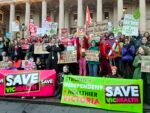
Supporters of VicHealth rallied on the steps of the Victorian Parliament this week, urging new Premier Ben Carroll to save the independence of the internationally acclaimed health promotion agency and its efforts to rein in big corporations that profit from harmful products.
Around 200 supporters braved cold and wet conditions in Naarm Melbourne on Wednesday to support a procedural debate on VicHealth in the state’s upper house. They urged Carroll, who was installed as Premier this week, to overturn last year’s decision to ‘dissolve’ the independent agency into the Department of Health, for the sake of a relatively small budget saving and at great cost to the community.
VicHealth is “a global leader in health promotion,” said leading public health expert Professor Rob Moodie, who was CEO of the organisation from 1998 to 2007.
Speaking to the rally, he listed the agency’s achievements, including tobacco and alcohol control, skin cancer protection, curbs on gambling promotion, and some of the earliest public health interventions on mental health, family violence and women’s and girls’ health.
VicHealth has “a convening power like no other agency that I’ve seen in Victoria”, he said. “It’s about listening. It’s about supporting communities, whether they’re rural or remote communities, whether they’re defined by country of origin or by sexuality or by ability or by Indigeneity.”
But arguably its most important role, and why it needs to be independent, he said, is to take on the enormous challenges to community health from the “huge, unhealthy industries” – tobacco, vaping, alcohol, gambling and fast food – who increasingly “stalk the corridors of power”.
Moodie, Professor of Public Health at University of Melbourne and Honorary Professor of Public Health at the Kamuzu University of Health Sciences in Malawi, said communities need independent, trusted bodies in health to provide advice, lead advocacy, support community-based work, and lead policy development.
“Fairness is at the heart of a VicHealth impact, whether it’s family violence or alcohol harm or racism or homophobia or climate resilience or food insecurity,” he said.

Political determinants
Public health experts and allies across Australia and the globe were shocked late last year when the Labor Government, led by then Premier Jacinta Allan, announced its plan to axe VicHealth on the recommendation of a review of the Victorian Public Service.
It was announced as a Budget saving measure, despite VicHealth’s annual $47 million funding representing just 0.04 per cent of the annual State Budget and 0.14 per cent of total Victorian health expenditure, despite investment in preventative health delivering a return of $14 on every $1 invested, the rally was told.
The Opposition Liberal Party and Upper House cross bench, which has the balance of power, opposed the decision, and have vowed to block or scrap pending legislation.
However, retiring Greens MP Dr Tim Read cited concerns whether the support from conservative parties will prove “durable”, particularly given the powerful role that One Nation may play after the state election on 28 November.
The short debate in Parliament on Wednesday marked the lodgment of a petition signed by thousands of VicHealth supporters. This year’s State Budget continued funding for VicHealth as a separate entity for another year, and there is no word on when legislation to close it might be introduced.
Shadow Minister for Health Georgie Crozier, a former nurse, midwife, diabetes educator and hospital supervisor, could have been more reassuring during the debate that a Liberal Government would stick with its vow to save VicHealth.
While generally supportive about VicHealth’s work, she said “you can argue that there are too many agencies”, and that “the only reason we are having this debate is because of the dire situation of the Victorian Budget”.
Crossbencher and Libertarian MP David Limbrick may have hinted at the position a strong One Nation cohort might take after the election, blaming VicHealth for firebombing attacks and the role of organised crime in the illegal tobacco and vaping markets in Victoria.
Many VicHealth supporters hope the change of leadership in the Victorian Government may be a circuit breaker for the agency ahead of the election.
At the rally outside, Read, a former GP, talked about how he had been diagnosed earlier this year with metastatic cancer, which he blamed on not covering up enough in the sun as a young person.
This had informed his decision to make saving VicHealth his mission in his remaining time in Parliament (read his valedictory statement).
“I couldn’t stay silent,” he said, urging all supporters to actively reach out to candidates in the upcoming state election, acknowledging the ongoing struggle to put prevention and health promotion high on the election agenda.
“A conversation is way more powerful than an email,” he said. “A few people meeting a candidate is even more powerful.”
Tackling predatory industries
CPSU Victoria branch secretary Jiselle Hanna told the rally that VicHealth’s independence was critical, given the power of unhealthy corporate interests and the susceptibility of governments to their pressure.
“We can’t rely on them not to succumb,” she said, reminding rally-goers of the tobacco industry’s huge efforts to stymie plain packaging under the Gillard Federal Government.
Another speaker, Dr Nick Rose, co-founder and executive director of Sustain: the Australian Food Network, said the move to weaken VicHealth is “really about people power versus the power of corporations”, in a fight that has been brewing for four decades.
Rose said VicHealth’s support has been vital to the growth and success of his organisation, which supports community groups to strengthen food security and tackle dietary-related ill health by expanding access to healthy and affordable food.
Its funding, strategic focus, and leadership “is crucial to achieving better population health outcomes for Victorians …[and] to tackling the growing burden of chronic diet-related ill health and disease”, he said.
Rose said the State Government’s argument has been that much of VicHealth’s work is being done now by Public Health Units within the Department.
While he welcomed the PHU’s “exemplary work”, he said it does not duplicate or replace the systems-focused work led by VicHealth and its hundreds of community partners.
“Rather it is complementary and mutually reinforcing,” he said, pointing to the Food First in the West partnership, led by the Western Public Health Unit (WPHU) and funded by VicHealth, as an excellent example that brings together over 55 institutions and organisations in a groundbreaking collective impact initiative.
This is exactly the whole of government, whole of system, collaborative and long-term approach that is needed to tackle entrenched public health challenges such as the “predatory and harmful” fast food industry in Victoria.
This is “a $30 billion behemoth that is marching across our suburbs”, with up to eight fast food outlets for every single healthy food outlet in many suburbs, he said.
“Tackling this entrenched corporate power requires both political will and political independence, and as we know, that is what VicHealth represents,” Rose said
Axing it, he said, “makes no economic sense and no public policy sense”.
“The only winners from its abolition will be the corporate actors who profit from the rising burden of chronic disease in this state and this country.”


Mariam Hachem, president of the Victorian branch of the Public Health Association of Australia (PHAA), also spoke at the rally, saying her branch’s mission is very simple: to ensure that fewer Victorians get sick.
“And for four decades, there is no other organisation that has exemplified this more than VicHealth,” she said.
In 2022 the PHAA branch had included VicHealth in its ‘top ten’ of initiatives that have contributed to Victoria’s public health success.
“VicHealth has booted tobacco advertising out of footy and out of the arts. It’s helped save over half a million lives in terms of smoking. It led the landmark report naming violence against women as a leading cause of ill health a whole decade before Royal Commission [into Family Violence] was established,” she said.
“Strong, cohesive public health is the vehicle that is carrying every Victorian toward a longer, healthier life, and VicHealth is the machinery that’s running that engine,” she said. “Without it, we won’t go far.”
Juanita Pope, CEO of the Victorian Council of Social Service (VCOSS), also pledged the community services sector to the fight to save VicHealth, saying it is “really a fundamental part of the glue that makes us more effective and stronger together”.
Pope said political observers know that new Premier Carroll “has a history of really caring about health and our sector and being partners with us in many respects”.
She hoped he knows “that the smartest thing you can do for a health system is to stop people needing it in the first place, and that’s why we’re all here”.
“So here’s the ask today and beyond: keep VicHealth independent, keep it funded, keep it standing on its own two feet. Because if governments want economic value, healthy people, and a fairer Victoria, let’s not pull apart the body that does all three.”
Note: additional quotes were added after the original publication of this article
Watch the rally
See Croakey’s archive of articles on VicHealth





Add Comment